ICv2 has released its quarterly update about the hobby gaming market. But this one also comes with articles about their yearly market survey. They estimate that the total hobby games market climbed to $880 million in sales a year in 2014. They updated their methodology and reestimated the 2013 market at $735 million. For those of you that haven't already done the mind-blowing math in your head, that means that the market as a whole has grown 20% in one year.
The figures are also broken down into 5 sub-categories: collectible games, miniatures, board games, card and dice games, and roleplaying games. My interest is, naturally, on roleplaying games. But, we'll take a look at the miniatures numbers as well. Although its the smallest of the 5 categories, roleplaying games had the best growth with a 67% increase in sales. That's wonderful news for roleplayers out there--for every dollar that was being spent on gaming in 2013, $1.67 is being spent today.
I went ahead and ordered a copy of the full report, which is fascinating. It's got an article called "D&D Juggernaut Rolls On As Pathfinder Slides." One retailer recounts that Pathfinder had a 75% market share in the RPG market in the dark 4th Edition days and that in the last year Pathfinder has lost 75% of its sales to 5E. I'm not going to list the total sales amount in the RPG category (ICv2 has not posted that figure online, so I'll leave it as a secret). But, that reduces Pathfinder's sales from 75% of the market to only 19%. The bulk of the sales (which are also the majority of sales in the roleplaying games category overall) have gone not just from Pathfinder but from Pathfinder to 5E.
Fortunately, continuing to hold on to nearly 20% of a market that's grown by 67% is still pretty good. But, how has the market shifted amongst the roleplaying games? We know that D&D and Pathfinder remain the two best sellers in the category. But, this is where some of the other information from the report comes in. The report also notes that growth in the miniatures category was 0%. So, people are spending the same amount of money on minis for their RPGs that they were spending in 2013. But, D&D and Pathfinder are RPGs that focus on players using miniatures. So, it seems odd that those two games would be doing well but that miniatures sales are flat.
A few possibilities present themselves. Maybe people are changing editions from 3.5/Pathfinder/4th and therefore they already have a lot of miniatures. If you're going to make the investment to purchase a new edition's Player's Handbook, Dungeon Master's Guide, and Monster Manual, maybe you don't have cash to throw out on minis. Or maybe 5E and Pathfinder are cannibalizing against each other and the growth in the RPG title overall is in other systems. Numenera had a good run and Green Ronin's AGE system are popular--and neither of them require minis. I'm thinking that maybe the growth we are seeing is not growth in just the big guys, but roleplaying games in general getting more popular?
Showing posts with label Pathfinder. Show all posts
Showing posts with label Pathfinder. Show all posts
Monday, July 20, 2015

Thursday, July 16, 2015
Behold! The fearsome lava guppy!
 |
| The real fish still looks pretty damned fearsome! |
io9.com is running an article about tiny, fanged fish that can actually live in underwater volcanic rifts. Per usual, this made me want to design a monster. I know that lava-spitting fish aren't terribly original (hello Metroid), but sometimes you just feel the urge.
There were a lot of things that I found really cool about this fish from the article, like:
- We don't know if this is an adult fish or just a larva;
- Everyone thought the coastal cousins of these undersea volcanic-based fish were just getting swept into the open ocean and dying;
- They thrive in acidic waters (I was tempted to give my version some acid resistance, but decided that with being immune to fire--how else do you swim in magma?--this would be overkill. That said, change the damage types and it still works.)
- There are also volcanic lobsters! You could also flip the Cold-based template from the first Reign of Winter AP to make some of these as well.
- THERE ARE ALSO SHARKS LIVING IN UNDERSEA VOLCANOES!
Honestly, I like these guys more as traps than I do as combatants. Imagine that the PCs need to cross a small bridge across a lake/river/other liquid body of lava/magma. Suddenly, the lava guppies surface and begin pummeling dripping blocks of magma at the PCs. Those PCs will either have to run like hell to get across the bridge or do some real creative thinking about how to freeze the lava and take out their enemies. I guess a really nuts barbarian might just charge in. Hopefully even through his rage he'd run out after burning himself on the molten lava. Stats for both 13th Age and Pathfinder are below.
13th Age
Lava Guppy
A waxy red fish pokes its head out of the magma. Opening its mouth, a dark red glow illuminates a row of razor-sharp teeth from within.
2nd Level Archer [(magical) beast]
Initiative: +4
R: Firespit +7 vs. PD, 7 damage
Miss: 2 points fire damage
Natural even hit: Magma sticks. Target must use their standard action to clear off the magma or take another 7 fire damage on its next turn.
C: Spiky Teeth! +9 v. AC, 10 damage
Resist Fire (18+): Fire attacks against the lava guppy must roll an 18 or higher or do only half damage.
Nastier Specials
Acid loving fish: Underwater volcanoes have acid as well as magma and this fish love both. These fish switch between fire and acid resistance as a quick action.
Once bitten: With a successful spiky teeth attack,
AC 18
PD 16 HP 36
MD 12
 |
| (c) Unknown |
Icons
Archmage: Are lava guppies a natural creation or a magical experiment gone horribly wrong? If the Archmage knows, he's not telling. Either way, their magma-producing glands can be used to empower spells for throwing fire or for heating the Archmage's floating islands and the upper reaches of Horizon. But what happens if the Blue or the Lich King finds a way to turn those glands into flying fire-spitting fish?
Crusader: Word has it that when the Crusader reclaimed one hellhole into one of his fortresses, the lava guppies transformed into golden fish that sing. The Prince of Shadows could find a buyer for one of those. In fact, he could play several buyers off against each other.
Diabolist: Rivers of magma guarded by lava-spewing fish. Check!
The Three: Rumor has it that the Red uses a specially-trained school of lava guppies to clean him when bathing.
Pathfinder
A waxy red fish pokes its head
out of the magma. Opening its mouth, a
dark red glow illuminates a row of razor-sharp teeth from within.
Lava Guppy CR 1
XP 400
Neutral Small Magical Beast
Init +4; Senses low-light vision, darkvision 60 ft.; Perception +4
XP 400
Neutral Small Magical Beast
Init +4; Senses low-light vision, darkvision 60 ft.; Perception +4
Defense
AC 16, touch 15, flat-footed 11 (+4 dex, +1 size, +1 dodge)
hp 13 (2d10+2)
Fort +4, Ref +7, Will +0
Vulnerable cold
Immune fire
hp 13 (2d10+2)
Fort +4, Ref +7, Will +0
Vulnerable cold
Immune fire
Offense
Speed swim 40 ft.
Melee bite +1 (1d4-1 plus sharp tooth)
Ranged firespit +6 (2d6 plus magma)
Special Attacks sharp tooth
Melee bite +1 (1d4-1 plus sharp tooth)
Ranged firespit +6 (2d6 plus magma)
Special Attacks sharp tooth
Statistics
Str 9, Dex 18, Con 12, Int 2, Wis 11, Cha 8
Base Atk +2; CMB +1; CMD 15
Feats Dodge
Skills Perception +4; Stealth +8;Swim +7 Racial Bonuses +8 Swim
Languages none
Base Atk +2; CMB +1; CMD 15
Feats Dodge
Skills Perception +4; Stealth +8;Swim +7 Racial Bonuses +8 Swim
Languages none
Ecology
Environment magma
Organization solitary, dual, school (3-12)
Treasure None
Organization solitary, dual, school (3-12)
Treasure None
Special Abilities
Fire
spit (Su): As
a ranged attack, a lava guppy can spit a blob of magma with a range increment
of 30 ft. Creatures hit by the blob must
make a DC 14 Reflex save to avoid the liquid sticking to them. Those who fail take damage as exposed to lava
(Core Rulebook 444). Pouring water on the affected person or fully
immersing them ends the effect immediately.
Sharp
tooth (Ex): On
a successful bite attack, the victim must make a DC 9 Fortitude save or be
subject to bleed 1. A successful DC 15
Heal check (costs a standard action) or receiving magical healing ends the
bleed damage.
Descended from
fish that acclimated to living in oceans near volcanic rifts, lava guppies have
evolved to swim in rivers of magma. Lava
guppies are frequently placed as guards by those immune to their fiery spit and
who have access to rivers of lava, trusting in intruders inability to attack
their magma-based guards from land. Born
as tiny tadpoles, lava guppies grow to measure 2 feet long and weigh 35-50 lbs.
as adults.
Tuesday, July 14, 2015
RPG Interest Remains High

But, lately I'd noticed the Kickstarter projects are losing steam. Kobold Press' Advanced Race Compendium didn't raise nearly as much as I'd expected and Legendary Games' current Legendary Planets Kickstarter, though quickly funded, hadn't picked up as many people as I'd thought that they might.
|
Title
|
Date
Closed
|
Total
Raised
|
#
of Backers
|
Funding
per Backer
|
|
Mythic Mania
|
May 6, 2014
|
$69,362
|
461
|
$150.46
|
|
Southlands
|
October 18, 2014
|
$97,728
|
1,044
|
$93.61
|
|
Advanced Races Compendium
|
May 17, 2015
|
$51,040
|
797
|
$64.04
|
|
Legendary Planets
(as of 7/14/2015)
|
Ongoing
|
$35,938
|
275
|
$130.68
|
Similarly, I've felt a little more gaming fatigue myself lately. I mainly focus on Pathfinder and 13th Age. In the Pathfinder world, the RPG line is moving into more and more niche products with this month's Occult Adventures and next spring's Ultimate Intrigue. I'm enthused about both of those releases, but they don't have the wide appeal of something like an Advanced Race Guide, Ultimate Combat, or Advanced Player's Guide.

I'm considering picking up Eyes of the Stone Thief at GenCon this year (gotta use that discount for GMing 13th Age at GenCon on something fun!)--especially if the group of test gamers I've lined up for this weekend decides that they really like playing 13th Age! But, it just doesn't seem like there's a lot coming out right now.

So, it seems like people are interested, but might also just be spending less money. What does everyone else think?
Monday, July 6, 2015
First time as a regular PFS GM
So, I ran my first Pathfinder Society scenario. Technically, I'd run a Pathfinder Society scenario back during the winter during GadCon, but I was a last-minute fill-in GM, so I don't really feel like it counts. Plus, the GadCon scenario was a convention special and this one was a regularly-released scenario, so the types of players and the expectations were totally different.
I ran Out of Anarchy on the Monday after it came out. I was not expecting a scenario so long or so convoluted. While I hadn't had a lot of time to digest this scenario, I had reread the Pezzack entry from Towns of the Inner Sea, which really helped with the background. Without that base to work with, I would have had a MUCH harder time GMing this thing. There are some PFS scenarios that require almost no background. For instance, I introduced a gaming group to Pathfinder using [druidy scenario] and it didn't require much background knowledge at all. In the Pezzack scenario, I'd have had no idea what was going on.
So, what are my takeaways from GMing a regular old PFS scenario? First of all, GMing is all in the art of presentation. I'm a lobbyist by trade during the day, so faking it is something I'm trained to do anyway. But, while you can fake a lot of things, players have certain expectations. And, unsurprisingly, how your players see you changes how they play at your table. What caught me out? Well, I was running short on time. I'd printed color copies of the mad grids, but I hadn't had time to cut them so that they connected without white paper overlap. One of my players caught me, called it a rookie mistake, and everything changed--at least as far as that player was concerned. It wasn't bad or anything and fortunately we both knew what the rules were in all the situations that game up. But, if there had been a disagreement, it would not have been pretty. That said, I hope that he still had a good time even after I hadn't cut the edges off of things.
PFS in DC is also a lot more roll-playing focused than it is role-playing focused. I don't mind that--both mixed together are what make for a fun game. That said, there's a lot of role-playing going on in this scenario. It was over an hour before the PCs got into their first fight (some parties might consider getting into a fight at all a liability, but not I) and everyone was excited when the time to actually roll something more than skill checks came about.
All in all, I really, really enjoyed this session. The scenario as written gives GMs and players the opportunity to do a lot of roleplaying. PCs should also expect to have to do some critical thinking, which was fun for a scenario. They also tried to design a scenario that was as sandboxy as possible. That's where knowledge of the previous, underlying gazetteer product was so helpful--I was able to lean on the knowledge (that's mentioned as being cannon in the scenario, for all you PFS rules lawyers out there) that was used to build the scenario and therefore fill in some of the plugs.
I think I enjoy convention GMing more. For one thing, convention players are just so damned grateful to have someone running their game. For another, there's much more time to prepare! Also, at conventions, I don't feel as rushed (which is ironic, because you actually have a time slot at a convention). I also feel like people really appreciate GMs that get into having terrain and real miniatures rather than just having to fly through hand-drawns maps, flip maps, and map print outs.
I've got 8 more games till I get my first GM star. I have decided I can really opine with thoughts about PFS after that. Until then, these are impressions based upon just two instances. One thing I am sure about though: I'd always rather play outside of organized play at all with a set of players dedicated to telling a long-term dedicated story.
Thursday, June 25, 2015
Vigilante Class Walkthrough
 |
| Stephen Amell as Oliver Queen Copyright the CW, licensed for promotional use of the show Arrow. |
Vigilante Class Overview
Alignment restrictions: None
Hit Dice: d8
BAB: 3/4
Good saves: Reflex & Will
Poor saves: Fortitude
Skill ranks: 6 + Int bonus
Class Skills: Bluff, Craft, Diplomacy, Disguise, Escape Artist, Knowledge (local), Perception, Perform, Profession, Sense Motive, Sleight of Hand, and Stealth + skills from his/her specialization
Proficiencies: Light and martial weapons; light armor, medium, armor, and shields
In general, we've got a good basis for a class here. The playtest PDF is 14 pages long, though 2.5 of those are title page, short forward by Jason Buhlman, and the OGL text. The class skill list is pretty good, especially considering that each vigilante's specialization will add a few extras along the way. The one exception is the choice not to give Intimidate as a class skill. Only the Avenger and the Zealot specializations add it as a class skill. But, one of the vigilante's most useful abilities, renown, is keyed to it. If you're going to key a general class ability to a skill, it ought to be a class skill. On top of this, all but one of the vigilante's class powers are extraordinary abilities, meaning that magic will have few effects on the vigilante's ability to fully exercise his class skills at any time.
Also, for those into this sort of thing, the different vigilante specialization descriptions switch between male and female pronouns, which indicate that we could expect to see multiple iconics for the vigilante. Or, maybe that's just an error since this is a playtest document. It seems like much of the vigilante base class is really just a chassis which the specialization will fill in. Even more than other chassis-style classes like the sorcerer, the vigilante really seems like a blank slate. Or perhaps I should say blank slates--since a lot of the vigilante's powers are tied into whether he's in full-on vigilante mode or mild-mannered daytime social mode, it's almost like a study in multiple personality disorder from a fantasy RPG perspective.
Vigilante Class Powers
Dual Identity (Ex) (1st): What good is a class with two identities if you can't keep them separate. And the two identities are very different from each other. Changing back and forth from one to another takes 5 minutes and must be done in secret. And each identity really is separate. If you attempt to scry on the vigilante's secret identity while he's doing his daytime thing, you get nothing. Vice-versa for attempts to connect the day to the night.
Interestingly, each identity can have its own alignment, provided that both are within one step of each other. This can be a challenge, because although you can take feats and class abilities based on one of the alignments, you can only use them when in the identity that qualifies for those abilities. So, if you're a Zealot (divine caster inspired) vigilante with a nighttime lawful neutral identity that casts divine spells granted by LG Iomedae and a daytime true neutral identity, no divine spells for you during the day. Some might see this as a challenge, others might see it as an interesting role-playing opportunity.
Social Grace (Ex) (1st, 2nd, 6th, 10th, 14th, 18th): You've got your dual identities, but don't want them getting connected. A vigilante gets a +20 bonus to Disguise checks while in his social/daytime identity to appear merely as a member of polite society. A word of caution: this does not work both ways. There is NO corresponding ability not to have the nighttime identity linked back to the daytime identity, so be secretive and don't get caught taking the law into your own hands.
Also, at 2nd level and at every 4 levels thereafter, the vigilante picks a skill tied to a mental ability score. The vigilante gets a +4 bonus on checks related to this skill when in his social/daytime identity only.
Vigilante Specialization (Ex) (1st): Each vigilante picks a specialization between avenger (warrior focused), stalker (roguish), warlock (arcane caster), and zealot (divine caster). I'll cover those in more depth later. But, one thing that I do like about this choice is that it opens up lots of space for more design. There's space for new vigilante talents AND there's space for more specializations. The specializations are more keyed to the nighttime/vigilante identity, but I'm digressing there.
Vigilante Talents (2nd): At 2nd level and every even level thereafter, a vigilante picks up talents related to his specialization. To me this was something of a 50/50. On the one hand, it's cool that the talents are tied into the specialization. On the other, the vigilante has the opportunity to do a lot of interesting things with skills. I'd have preferred that there be some universal vigilante talents that any vigilante can take. I like this for two reasons. First, it recognizes that there are some abilities that would be useful to any vigilante, regardless of specialization. Second, universal talents go a long way to opening up future design space. If Paizo or a 3rd party publisher wants to design a new vigilante specialization in the future, they are stuck designing everything in that specialization from the ground up. With some universal talents, it'll be easier to fit a new vigilante specialization on a 1-2 page spread in a Player's Companion.
Renown (Ex) (3rd, 9th, 15th): The vigilante gains the power to go around town in his mild-mannered identity and talk up how scary his secret identity is. At first this can only be done for a small area (village or neighborhood of up to 200 or so) but it grows over time. The vigilante spends his time talking up his nighttime identity and word gets around: he gets a +4 bonus on Intimidate checks while in his nighttime identity. At 9th level, the vigilante can influence a community up to 5,000 people large or two communities of up to 2,000 people. The intimidate bonus increases to +6. At 15th level, the population area increases to 25,000 (or two cities of up to 10K) and the Intimidate bonus increases to +8.
This is a cool ability, but it could be improved in a couple of ways. First, Intimidate isn't a class skill for the vigilante. The Avenger and Zealot specializations get it, but the Warlock and the Stalker don't. This ability is too central to the vigilante's schtick not to be a class ability to everybody. Secondly, the jumps are too big. There are more gradiated settlement sizes and there's no reason not to expand this ability out to take advantage of all of them.
Startling Appearance (Ex) (5th): Okay, this is just awesome to conceptualize. The vigilante is setting up an ambush and--wham!--the hammer of justice is falling on some malefectors. If the vigilante makes an attack against a foe that's unaware of his presence, the foe is treated as flat-footed for the rest of the vigilante's turn. But also, the foe takes a -4 penalty on attacks made against the vigilante until the start of the vigilante's next turn. Basically, this gives the vigilante the opportunity to attack twice or to go up against some foes that might normally be able to hit him hard and take him out early.
Loyal Aid (Ex) (7th): What kind of a vigilante doesn't have a good support crew. Now there are game mechanics to make this happen for you as vigilante. Within the vigilante's area of renown, the vigilante gains a bonus on diplomacy checks to gather information equal to 1/2 his level. So, that's starting off as a +3 and rising pretty quickly. Once per week, the vigilante can also increase the DC of skill checks for others gathering information about him or trying to track him by his level. So, if the vigilante controls when he'll be striking, he's going to be incredibly hard to follow back to his lair. Similarly, if the vigilante knows someone will be looking for him, time to up that Diplomacy DC to figure out what the vigilante is up to!
Many Guises (Ex) (9th): Allows a third identity, John Q. 6-pack. The vigilante appears as a generic person of his race; his alignment detects as neutral; and he ports over that +20 Disguise bonus to appear this way. Assuming a decent Charisma score and a few ranks in Disguise, it's going to take about a 30+whatever the vigilante rolls on the d20 to figure out that he's not who he appears to be. To whit, you ain't catching him.
Frightening Appearance (Ex) (11th): This stacks on top of Startling Appearance and improves it. As a free action, the vigilante makes an Intimidate checks against his target and enemies within 10 feet to demoralize them. Note that because of his Renown ability, the vigilante is getting a +6 bonus to that Intimidate check in addition to any skill ranks, class skill bonuses, ability score bonuses, and a d20 roll. Chances are excellent that the demoralization will work and good that it'll extend its effects by beating the necessary DC by 5.
Quick Change (Ex) (13th): The vigilante can change identities as a full round action, but must make Disguise checks to stop those that know his other identity from making him. On the other hand, using a whole minute means the change is made and nobody figures him out.
Stunning Appearance (Ex) (17th): It starts with appearance, so it must improve on the Startling and Frightening Appearance abilities, right? You betcha! And it stacks. If the vigilante's appearance attack hits, the victim must make a Will save or be stunned until the end of the vigilante's next turn.
Everyman (Su) (19th): The vigilante can now appear to be specific random Joe Q. Six-Packs. The vigilante gets the +20 Disguise bonus to be this rando person and a +10 bonus on Bluff checks to act like that person (remember bonuses if the vigilante knows the target of his impersonation). The vigilante is even so good at this that spells and spell-like abilities designed to find that other individual find the vigilante in disguise instead 50% of the time.
Vengeance Strike (Ex) (20th): A vigilante can use up to 5 consecutive standard actions to study his target before striking from unawares. For each round the vigilante spent in study, the vigilante gains the option to use following: +4 bonus on the attack roll, +3d6 precision damage, or treat the die roll as 2 higher for the purpose of threatening a critical hit. (i.e., for each round in study the vigilante picks one and if the vigilante picks the same one twice, the effects stack. Does that mean that 5 rounds of study can yield +15d6 damage? Yes. That's why this will likely be nerfed to +2d6 damage per round in study, but that's still pretty awesome).
Vigilante Specializations
Avenger
Class Skills: Climb, Intimidate, Knowledge (dungeoneering), Ride, Survival, Swim
Base Ability: Full Base Attack Bonus
Selected Talent Options:
- Armor Silence (Ex) & Armor Skin (Ex): Avengers that take these talents don't apply armor check penalties on Stealth (silence) or Acrobatics and Escape Artist (skin) skill checks when wearing light or medium armor. Umm...is it me or is this an ability that rogues would love to have? Why don't they get it?
- Close the Gap (Ex): Designate one foe within 20' not adjacent to the vigilante. That foe doesn't get attacks of opportunity against the vigilante so long as the vigilante ends his turn adjacent to the foe.
- Environment Weapon (Ex): Choose a ranger favored terrain. So long as there are moveable items around, can find an improvised weapon as a swift action and use it without penalties to attack rolls.
- Favored Maneuver (Ex): Gain Improved [insert combat maneuver here] AND gain another +2 bonus on foes that are unaware of the vigilante when the vigilante uses the maneuver on them.
- Fist of the Avenger (Ex): Gains Improved Unarmed Strike and does bonus damage of vigilante level divided by four.
- Living Shield (Ex): When grappling an opponent and being attacked by another opponent, make a combat maneuver check against your grappled opponent. If you succeed, opponent takes damage from the other opponent's attack.
- Signature Weapon (Ex): Choose a type of weapon. Gain Weapon Focus feat as a bonus feat. At 8th level gain Weapon Specialization in that weapon.
- Vital Punishment (Ex): Gain Vital Strike as a bonus feat. Once per round when making attack of opportunity, apply Vital Strike to the attack.
Class Skills: Acrobatics, Appraise, Climb, Disable Device, Knowledge (engineering), Use Magic Device
Base Ability: Deal +1d6 extra damage against foes that are unaware of the vigilante's presence. Increases by +1d6 every 2 levels. Can also use it against foes that are aware of vigilante's presence when sneak attack would normally be in play, but the d6s are lowered to d4s.
Selected Talent Options:
Base Ability: Deal +1d6 extra damage against foes that are unaware of the vigilante's presence. Increases by +1d6 every 2 levels. Can also use it against foes that are aware of vigilante's presence when sneak attack would normally be in play, but the d6s are lowered to d4s.
Selected Talent Options:
- Another Day (Ex, Su): When dropped unconscious because of hit point damage, automatically stabilize but appear to be dead.
- Case the Joint (Ex): Spend one hour at a location while in social identity. Make a DC Knowledge (engineering) check. If you succeed, may reroll any one failed skill check related to that location (stealth, disable device, and sleight of hand are specifically called out).
- Foe Collision* (Ex): When dealing hidden strike damage (base ability above), deal an equal amount of nonlethal damage to a foe adjacent to the enemy (even if not adjacent to you).
- Leave an Opening* (Ex): At beginning of foe's next turn, if stalker vigilante threatens the foe stalker vigilante gets an attack of opportunity.
- Mighty Ambush* (Ex): Successful hidden strike allows vigilante to drop damaged enemy unconscious for 1d4 rounds. (Fort negates)
- Perfect Fall (Ex): As long as there's at least a wall nearby, never suffer falling damage. Even if no wall, suffer only half damage. Always land on your feet.
- Perfect Vulnerability (Ex): Make one attack per day against a foe's touch AC (denying Dexterity bonus).
- Rooftop Infiltrator (Ex): Gain climb speed equal to half of normal speed.
- Strike the Unseen (Ex): Gain Blind-Fight as bonus feat and make hidden strike damage against foes who are totally concealed.
- Throat Jab* (Ex): Successful hidden strike on an opponent renders opponent unable to speak until vigilante's next turn.
- Twisting Fear (Ex): Whenever vigilante imposes the shaken, frightened, or panicked conditions on an opponent, opponent also suffers extra non-lethal damage equal to half the vigilante's normal hidden strike damage. This applies with the normal ability to apply shaken condition to enemies by demoralize them?
Warlock
Class Skills: Fly, Knowledge (arcana), Knowledge (history), Knowledge (planes), Spellcraft, Use Magic Device
Base Ability: Ability to cast limited number of 1st level arcane spells.
Selected Talent Options:
Class Skills: Fly, Knowledge (arcana), Knowledge (history), Knowledge (planes), Spellcraft, Use Magic Device
Base Ability: Ability to cast limited number of 1st level arcane spells.
Selected Talent Options:
- Arcane Training II-VI: Available at the levels at which a warlock vigilante would become eligible to use a new level of spells, the warlock vigilante must use talents to gain spells of the higher level.
- Arcane Striker (Su): Gain Arcane Strike as a bonus feat. At 12th and 16th levels gain further effects normally tied to magic weapons that can be applied to the arcane strike.
- Bombs (Su): Gain bombs like an alchemist. Don't add intelligence to bomb damage because "don't possess the alchemist's thrown anything class feature." So, if you take the Throw Anything feat, do you start adding Int damage to bombs?
- Caster's Defense (Su): Gain Combat Casting as a bonus feat. If successfully casts defensively, gain DR/magic equal to 1/2 vigilante level for one round. At 10th level, the DR also gains an alignment component.
- Educated Defense (Su): If successfully identify a spell using Spellcraft, use immediate action to negate the spell. Can negate up to as many spell levels per day as the character has vigilante levels.
- Elemental Battle Armor (Su): Gains resistance 5 to cold, electricity, or fire. At 4th level, those attacking vigilante with natural weapon or non-reach handheld weapons take 1d6 points of that same energy every time they strike the vigilante.
- Mystic Bolt (Sp): Gets a ray-like melee touch attack of elemental energy. Using it doesn't provoke attacks of opportunity. Can also be used as a ranged attack with a range increment of 30 feet. Does 1d6+[vigilante's level] damage of energy damage. Can take Weapon Focus for it, but must take Weapon Focus (mystic bolt) rather than Weapon Focus (ray).
- Social Simulacrum (Sp): Create simulacrum (as per lesser simulacrum) that lasts up to 4 hours.
- Tattoo Chamber (Su): Magically absorb some items via a tattoo. Can retrieve the items with a swift action and can also trigger spell-like abilities of the items while stored as if the vigilante were wielding them.
Zealot
Class Skills: Intimidate, Knowledge (nature), Knowledge (religion), Knowledge (planes), Spellcraft, Survival
Base Ability: Limited spellcasting ability of 0th and 1st level spells off of the inquisitor spell list.
Selected Talent Options:
Base Ability: Limited spellcasting ability of 0th and 1st level spells off of the inquisitor spell list.
Selected Talent Options:
- Channel Energy (Su): Channel energy as a cleric of vigilante's level minus 4.
- Divine Bastion (Su): Swift action to gain CMD bonus equal to 1/2 vigilante level. At 5th level can grant bonus to allies adjacent to vigilante as well. Can use as many times per day as the character has vigilante levels. Comment: I'd feel like this ability was more balanced if the character had to expend extra uses for each other character that receives the CMD bonus.
- Divine Training I-VI (Ex): First of all, this HAS to be a type. This can't be an extraordinary ability, can it? Anyway, gain ability to cast inquisitor level spells of higher levels as the vigilante achieves levels when those spells would normally be castable.
- Domain: Gain one cleric domain's powers, though not it's bonus spells or spell slots.
- Empower Symbol (Su): As standard action, empower holy symbol to act like center of consecration/desecration spell. At 10th level, this just happens passively.
- Life Bond (Ex): When ally within 30 feet takes damage, vigilante can instead take half of that damage. Useable once plus vigilante's Charisma bonus times per day.
- Revivifying Touch (Su): Once per day can use to heal an ally that died within one round. Touch heals 5d8+[one point per vigilante level] and brings that person back from the dead if healing sufficient to bring back to life.
- Stalwart (Ex): If vigilante succeeds at a Fortitude or Will saving throw, the vigilante avoids all effects of whatever caused the saving throw. Basically this is improved uncanny dodge for the other two types of saves...at the same time.
In general, I don't think I like this class very much. First of all, it just doesn't feel particularly coherent. Rather than discrete classes, these just seem like abilities that could be layered onto the fighter, cleric, wizard/sorcerer, and rogue class to let them be dual-identity heroes. One on hand, it has a lot of abilities that I find to be a little bit overpowered. On the other, they don't all fit together very well. In general I find the class disorganized and lacking coherence--for players at least. I find that this class is fantastic for villains! Villains need some of these abilities to get past things like alignment detection and Sense Motive checks. Not all villains of course, but certainly the main villain mastermind that orchestrating everything. What fun is it if the villain can't overcome that. So, I think that I might grant some bonus levels in vigilante to villains.
But for players, this just doesn't seem like a well-organized class. I have high hopes for Ultimate Intrigue. My plans for running an entire Kaer Maga campaign hinge on giving players the ability to do a lot more with skill checks. (Okay, actually, they really just hinge on convincing the PCs that there will be ramifications if they kill humanoids or other civilized creatures, but I still have high hopes for Ultimate Intrigue). What I'm seeing about this class doesn't fulfill those hopes. I'm used to better class designs out of Paizo.
But for players, this just doesn't seem like a well-organized class. I have high hopes for Ultimate Intrigue. My plans for running an entire Kaer Maga campaign hinge on giving players the ability to do a lot more with skill checks. (Okay, actually, they really just hinge on convincing the PCs that there will be ramifications if they kill humanoids or other civilized creatures, but I still have high hopes for Ultimate Intrigue). What I'm seeing about this class doesn't fulfill those hopes. I'm used to better class designs out of Paizo.
Friday, June 19, 2015
Breaking: Playtest for new Pathfinder Class the Vigilante

BREAKING: No--I'm not Paizo and I'm not Pathfinder, but I do love them both! Paizo's opened up the playtest for the class that will be coming out in its new Ultimate Intrigue in 2016. Visit the site to check out the class. I'll be doing the same and letting you know thoughts once I've had a chance to check it out.
Thursday, June 18, 2015
Gay in Gaming Cons
For now, I want to talk about the gaymer movement in conventions. The most visible of these is the group that operates the Tabletop Gaymers website. They're the ones responsible for all of the rainbow Gaymer and Ally ribbons you see at GenCon every year. This year they're doing it again, but with a twist. At first they planned to fund the ribbons through a GoFundMe (disclaimer: I donated), but later the makers of Cards Against Humanity agreed to spring for paying for all of them (or here, for those without group access), leaving more funds to go to other conventions and to be pledged to help end LGBT youth homelessness. For those of you that don't know, LGBTs make up a hugely disproportionate share of America's homeless youth.

 The Tabletop Gaymers have put together a bevy of awesome events this year and I want to make sure that you know about them! There are social events for meeting up on Thursday evening and Friday lunchtime and evening. There are several seminars including Diversity in Gaming Culture, Gaymers, Diversity in Gaming panels by GenCon and by Paizo, the ever-popular Queer as a 3-sided die (sold out), and How to Make Gaming More Inclusive. Of course, don't forget the Saturday night party event at Talbot Street. This thing starts at 9PM and is definitely NOT sold out. So pick up some tickets for only $22 (includes entrance and shuttle to/from downtown).

I also want to talk about another seminar that's already happened. At PaizoCon back in May, Paizo's staff presented a seminar about diversity in Pathfinder. There are some really good points here and I like the candor with which Paizo's staff deals with this issue. To whit:
1) They admit that diversity is something that everyone needs to constantly strive for;
2) They admit that there are some areas where they feel like they have made strides (GLBT, gender) but there are others where they face real challenges (primarily racial diversity);
3) They admit that they need to improve on all fronts, even the ones where they have made progress; and
4) An audience member asks about diversity and incorporating characters with physical disabilities such as blindness. This was among the best discussions about how the company could bring discussion of this topic into the game--both as an accessibility issue for reading sourcebooks but also as presenting characters like that in their materials. Great job!
I was going to round this post out with a reference to FlameCon, which just concluded in Brooklyn. But, I've used up a lot of space already so check out pictures on io9.com.
Tuesday, June 16, 2015
Legendary Planet Adventure Path
It's no secret that I'm a fan of Legendary Games or that I'm a fan of Kickstarters. What I'm really excited about is Legendary Games' new Adventure Path, Legendary Planets! They are planning 7 linked adventures that take characters across space (and time, even if it's only forward) in a space and swords craziness in either 5th edition or Pathfinder rules. Best of all, they are going to make lots of use of all the ridiculous Pathfinder Mythic stuff they've been working on for the last couple of years! Since the last of these was a well-funded and well-executed Kickstarter to fund Mythic expansions for every feat, spell, and monster in the game...I'm looking forward to them getting to use their proven track record to make some awesome stuff!
Don't just take my word for it. Visit the page or watch the video:
As of today, just the second day of the Kickstarter, they're already funded for 3 (really 4) of the books. Here's a quick rundown of titles and authors to whet your whistle:
 The Assimilation Strain by Tom Phillips and Neil Spicer
40 pages long for a party of 1st level adventurers
Already written and run a few times at PaizoCon by the Legendary Games team.
Presumably it's introducing the PCs to space.
Neil Spicer wrote the first installment in Paizo's Iron Gods Adventure Path. It was an excellent introduction to technology for fantasy RPG characters and this promises to be a good next step.
 To Worlds Unknown by Jim Groves
Jim Groves is all over the Paizo boards as a poster and all over Pathfinder products as an author. I've enjoyed everything he did, including the opening adventure in the Mummy's Mask Adventure Path. Since The Assimilation Strain is supposed to be a sort of pre-quel to the space adventure, Legendary Games has done something smart by placing another good AP-opening author on their official first adventure.
It's already 96 pages long (64 adventure, 10 Bestiary, 10 page planetary gazetteer, and 12 pages TBD) because of stretch goals.
This one is designed to cover levels 2 through 5.
The Scavenged Codex by Mike Shel
Another experienced adventure writer is jumping on board here. This one has also funded to be a 96-pager (same format for all modules). It will cover levels 5-8.
The Dead Vault Descent by Matt Goodall
Another experienced hand. This third adventure has also funded at the 96-page level. So, if nothing else, we can expect to get three amazing adventures post haste. The Legendary team has promised to finish the AP even if their Kickstarter stretch goals for doing so aren't all met...it will just take them much longer to do so. This adventure covers levels 8-11.
The Dead Vault Descent is the most recently funded item thus far. From here on out, the formula works as follows:
+ $2,000 beyond last book: New book written at 64 pages
+ $2,000 more: 10 page Bestiary is added
+ $2,000 more: 10 page planetary gazetteer is added
+ $2,000 more: 12 more pages bonus content for 96 pages total
+2,000 more: another book is opened and the process starts again.
The rest of the series is:
Confederates of the Shattered Zone by Richard Pett for 11th to 14th level player characters.
The Depths of Desperation by Steven T. Helt for 14th to 17th level player characters.
Mind Tyrants of the Merciless Moons by Tim Hitchcock for 17th to 19th level player characters.
To Kill A Star by Jason Nelson for 19th to 20th level player characters.
What more could you ask for? Maybe all of them bound together in a single hardback book? Well, that's happening. Plus, as more people sign on, more content gets created. Jason's being coy on the Paizo.com boards, but it's pretty clear that one of these sharing or people joining on goals will be a free player's guide. So get out there and get signed up!
Don't just take my word for it. Visit the page or watch the video:
As of today, just the second day of the Kickstarter, they're already funded for 3 (really 4) of the books. Here's a quick rundown of titles and authors to whet your whistle:
40 pages long for a party of 1st level adventurers
Already written and run a few times at PaizoCon by the Legendary Games team.
Presumably it's introducing the PCs to space.
Neil Spicer wrote the first installment in Paizo's Iron Gods Adventure Path. It was an excellent introduction to technology for fantasy RPG characters and this promises to be a good next step.
Jim Groves is all over the Paizo boards as a poster and all over Pathfinder products as an author. I've enjoyed everything he did, including the opening adventure in the Mummy's Mask Adventure Path. Since The Assimilation Strain is supposed to be a sort of pre-quel to the space adventure, Legendary Games has done something smart by placing another good AP-opening author on their official first adventure.
It's already 96 pages long (64 adventure, 10 Bestiary, 10 page planetary gazetteer, and 12 pages TBD) because of stretch goals.
This one is designed to cover levels 2 through 5.
The Scavenged Codex by Mike Shel
Another experienced adventure writer is jumping on board here. This one has also funded to be a 96-pager (same format for all modules). It will cover levels 5-8.
The Dead Vault Descent by Matt Goodall
Another experienced hand. This third adventure has also funded at the 96-page level. So, if nothing else, we can expect to get three amazing adventures post haste. The Legendary team has promised to finish the AP even if their Kickstarter stretch goals for doing so aren't all met...it will just take them much longer to do so. This adventure covers levels 8-11.
The Dead Vault Descent is the most recently funded item thus far. From here on out, the formula works as follows:
+ $2,000 beyond last book: New book written at 64 pages
+ $2,000 more: 10 page Bestiary is added
+ $2,000 more: 10 page planetary gazetteer is added
+ $2,000 more: 12 more pages bonus content for 96 pages total
+2,000 more: another book is opened and the process starts again.
The rest of the series is:
Confederates of the Shattered Zone by Richard Pett for 11th to 14th level player characters.
The Depths of Desperation by Steven T. Helt for 14th to 17th level player characters.
Mind Tyrants of the Merciless Moons by Tim Hitchcock for 17th to 19th level player characters.
To Kill A Star by Jason Nelson for 19th to 20th level player characters.
What more could you ask for? Maybe all of them bound together in a single hardback book? Well, that's happening. Plus, as more people sign on, more content gets created. Jason's being coy on the Paizo.com boards, but it's pretty clear that one of these sharing or people joining on goals will be a free player's guide. So get out there and get signed up!
What's an Eidolon?
This post started off as a review of Ash Law's
article Eidolons for 13th Age
Monthly. Since then it's expanded into much more, though I still
intend to give my thoughts about Ash's article. The article expanded because as
I was printing Eidolons, I wondered,
"What exactly is an eidolon, anyway?" And so my research began.
Fortunately, I was researching for a blog post instead of a scholarly article,
so it was more important that my quest yielded ideas than that it be
comprehensive. In fact, it need not even be correct, though I believe that it
is.
For a completely unsurprising first
step, I visited the Wikipedia page on
eidolons. The term comes from a Greek word meaning
image, idol, double, apparition, phantom, or ghost. Specifically, in Greek
history it was the visible but incorporeal spirit of a person, either living or
dead.
Eidola (the other plural) exist both for
the living and the dead. In fact, they seem to be very akin to souls. Wikipedia
gives a great bit contrasting the eidolon as housing a person's psyche after
death (Homer) against the eidolon as a vessel for kleos, an individual's
honor or glory. Kleos did not decay, so it was the best type of fame. It also
passed down to children, both actual ones and your ideas and inventions. Since the ancient Greeks believed that
a man's spirit lived on through his reputation and his mark on history, the two
ideas aren't mutually exclusive.
 |
| Symbol of the Theosophical Society |
The Theosophists
believed the eidolon was a person's astral body. This fits in nicely with the
Greek concepts but by extension means that the body couldn't be active while
the eidolon was away. That seems to clash with the idea of Helen of Troy's
eidolon being in Troy while she was physically living in Egypt the whole time.
(I'm going to ask y'all to rely on Wikipedia here. I do not have time to read The Odyssey and The
Iliad to double check this.) From a game perspective, I like both the idea
of the separate spirit and the person's consciousness being active while the
consciousness is also active in the physical body. It makes for better stories.
So the eidolon is kind of like the you that you are when you are having a
daydream.
But there is so much more! I'll spare
you a list of all the eidolon references from the Wikipedia post, but there are
several in literature as well as games. In Pathfinder, Wikipedia refers
to the eidolon as "a golem-like animated statue brought to life by a shard
of divine energy." I'm no fan
of Pathfinder's summoner
class, but this doesn't sound like the original or the unchained
version to me.
 |
| H.D.'s Papers hosted by Beinecke Library. Hosted on flickr. |
I said that I wasn't going to list all
the literary and historical mentions of eidola, but I would like to discuss a
couple of them. First, H.D.'s (Hilda Doolittle,
who apparently went by her initials but also needs to be identified in full so
effectively is just double mentioned all the time) epic poem has a section
called Eidolon. The poem is Helen in Egypt.
My tablet's listing it as 91 pages long, so I only read Book
III, Section 4, which is called Eidolon.
It's about the figurehead on Achilles'
ship, which was carved in the form of a mermaid to represent his mother,
Thetis. H.D. asks:
had she been cut from an awkward block
of ship-wood at the ship-builders,
and afterwards riveted there
or had the prow itself been shaped
to her mermaid body,

This can be interpreted as the eidolon
spirit being somehow separate from the ship. One interpretation is that the
eidolon was "riveted" to the vessel as a final piece of
ornamentation. But, another, cooler interpretation is that the spirit was
somehow placed/trapped in the piece of wood that would become the boat's figurehead
and that the ship was built up and around it. Imagine if all ships came with a
bound spirit? What would that spirit be like? Would it be a bound person or
mermaid or a portion of a greater idea--like a portion of the spirit of the
ocean or of a forest or of a country from whence the wood was cut. Maybe
building a ship is an evil act and the figureheads take on the form of dryads
that are bound to the wood. If the god of sailors/sea travel/the ocean is evil,
this is a great way to incentivize land travel. Sea travel might be fast, but
it's unsafe. Or, if it's safe, it's only through the use of the bound dryad
spirits, so merely traveling by ship is an evil act.
 |
| Thetis. (c) 2008-2015 by Quicksilverfury Hosted at Deviantart.com |
After speaking to the mermaid’s
form, H.D. asks, "Did anyone touch her ever?" Touch is being used
here in a metaphorical sense, but it's still open to ambiguity. If touch is
being used to indicate sexual intercourse, it implies that the spirit
imprisoned must come from a virgin. That's all fine and good for vampires and
traditional hero stories but I don't think that's how H.D. is using touch here.
Instead, it makes sense if touch refers to establishing a sympathetic emotional
response, as in "Her story touched my heart." Thetis, who the mermaid
is carved to resemble, was an ocean goddess. The ocean is often portrayed as
being uncaring.
But maybe the ocean can learn to care.
From a benevolent perspective, the bound spirits could be a portion of the
ocean that ties the ship to the ocean itself. Perhaps ship-builders are priests
of the ocean goddess and preside over the binding process. Want a quest for an
artifact? The priests of Country A can bind ocean spirits into their ships as a
sign that their people are favored of the ocean goddess. The PCs are from
Country B, which will soon go to war with Country A. The PCs are tasked with
stealing the artifact from the temple in Country A's capital to even the score.
Maybe the artifact can be redeemed to bless Country A's ships after a quest is
fulfilled. Maybe the artifact isn't in Country A's capital city but instead
rests at a nigh-inaccessible shrine on an island near the edge of the World's
Ocean and blesses the country of the last person to successfully pass its test.
Country A's ocean dominance comes from being the last to visit the shrine.
Plus, this also allows for a sea full of the spirits of those who died
searching for the island floating within it and emitting phosphorescent green
light and I like that image. Maybe all three: the artifact has rests in the
temple in Country A's capital city, but it can only be reconfigured by taking
it to the distant island shrine. Of course, no one knows where the map to that
island shrine is located anymore, so the PCs will need to find that as well.
And, I've drafted an Adventure Path outline...the poem mentions a 'girdle of
sea-weed,' and that sounds like a cool magical binding agent to me.
Maybe the ocean does have feelings: feelings
of rage. Part of its spirit is trapped within the figurehead and cannot escape.
Can these ocean spirits come to have Stockholm Syndrome? Maybe by properly caring for the ship,
sailors transform a part of the heartless ocean into an ally. Really, the
possibilities for a nautical eidolon are endless.
 |
| Jason Thompson has created a web comic version of The White Ship. You can read the whole thing online at http://mockman.com/2011/01/24/the-white-ship-page-1/. |
The other source for eidolon inspiration
is H.P. Lovecraft's
The White Ship. It's only seven pages long and, being
out of copyright, there are free versions everywhere. It was originally
published in The United
Amateur (Vol. 19) No. 2 in 1919. In the story, our narrator
cares for an aging lighthouse and used to receive glimpses of the ways beyond,
the ways beneath, the ways that were, and the ways that might be. A bearded
captain sailing a white ship takes the narrator on a long ocean voyage to visit
several lands (it's all part of a larger metaphor about self-knowledge, but
that's for another time).
 |
| Thalarion is a *rough* place! (c) Jason Thompson Hosted at mockman.com |
The second of those lands is "Thalarion,
the City of a Thousand Wonders, wherein reside all those mysteries that man has
striven in vain to fathom." We don't learn much about Thalarion (because
it's a metaphor for what we don't know and therefore it tautologically
unknowable). Lovecraft tells us that it's huge carven (I originally read this
as 'craven,' which puts a whole other spin on the story) gate is called
Akariel, its populated by daemons and mad things, it's ruled over by the
Eidolon Lathi, and the streets are white with the unburied bones of those who
looked upon Lathi. Is Lathi forbidden knowledge? Lovecraft was definitely a fan
of the trope that there were some things humans were just not meant to know.
This is a good way of covering that ground. There are lots of things that man does
not know (maybe they escape as we learn about them? Maybe Lathi's legions trade
them for [insert weird thing Lathi wants here] and we learn them?) but the
things the humans don't know are ruled over by those things that can never
leave Thalarion, the things that humans were not even meant to know.
Eidolons could be ephemera of
unobtainable knowledge. They could be the reflections of reflections of
reflections of the sounds of humans uttering the profane words. They could be
the spirits of the profane words themselves, wandering the universe in hopes
that someone will speak them again. There's fascinating information out there
about eidola. Just plumbing two literary sources brought out a wealth of ideas.
Walt Whitman also has a poem called Eidolon. Does anyone else get ideas
from there or elsewhere?
Monday, June 15, 2015
Pathfinder Melee Tactics Toolbox Review
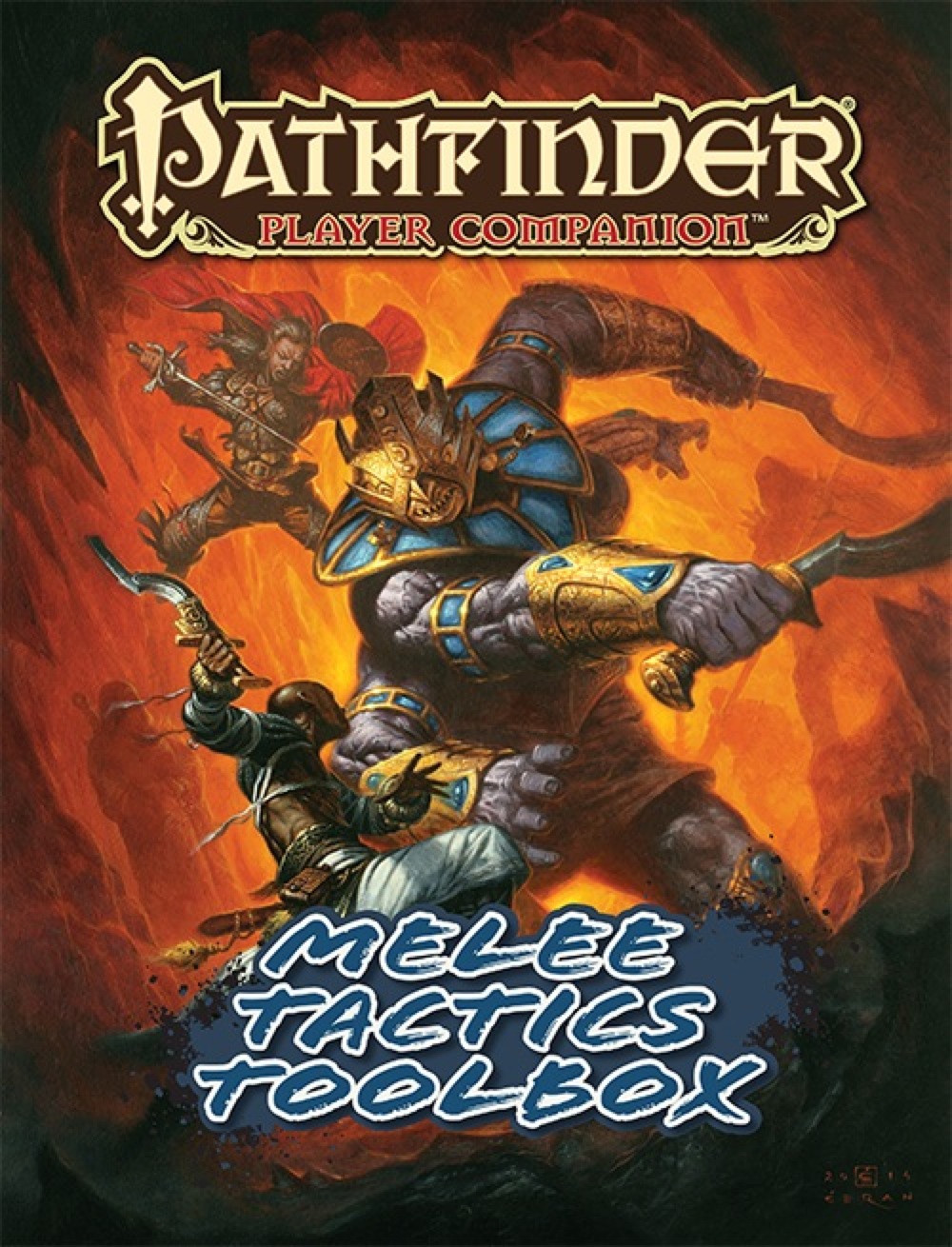
Let's start with the obvious: there's a
calikang on the cover of this module. I've loved this monster since I first saw
it in the Inner Sea World Guide, so I'm always happy to see it getting
some press. Sajan and Jirelle look like they will get the best of it. It's
interesting that Sajan is holding a weapon. One of the book's later sections
goes to great pains to remind us that unarmed combat is melee combat as well,
so I would have liked to have seen him fighting unarmed. Calikangs don't have
any damage resistance, so a good flurry of blows (unchained or core) would be a
great attack on one of these beasts.
But that's imputing game design on art.
Art's job is too look cool. And while I think it might have been fun to have
Sajan flurrying away on the calikang, he and Jirelle (who I hope has some sneak
attack damage coming, swashbuckler or no) look like the bad asses they are
taking on this hulk. In fact, much of the book's art is really good. It's not
an action scene, but page sixteen illustrates all the various swords that exist in the game. It's very cool and helpful--the best quality in a gaming aide.
Page 27 also has a good picture of Lini holding what appears to be a spell
siphoning sickle and ready to make trouble for anybody messing with her.
Cover to Cover
Art is done! On to content! Let's start
with the inside covers, which come out as a wash. On the front inside cover are
short single paragraph descriptions of fighting schools in Brevoy, Lastwall,
Katapesh, and Absalom. The art attached is map-related and non-specific. With
the exception of the Tempering Hall, a warrior training academy on the Isle of Kortos specializing in
training Iomedean Paladins but accepting all righteous warriors, all of these
are better detailed on pages 18-27 of Inner Sea Combat. I don't object to
rehashing old content, but doing so ought to involve fleshing it out rather
than abbreviating it.
Fortunately, the back inside cover more
than makes up for its partner's failing. The back cover has a "Combat
Options Overview." And it's
awesome. It's not the coolest thing in this book, but it is the page that will
be most useful to the largest number of people. Okay, Boyd, so you like it.
What's in it? First, they list
just about every melee combat action a character can take, including ones from
the hardback line like the Advanced Player's Guide. Each action is followed by a column for
"type" and for "action." Type explains if the action is basic (anyone can do it), a
combat maneuver, or if it requires a feat. Next, the opposite column gives the
types of actions: attack, free, melee, standard, full-round, and swift. This is
awesome! Seriously, if Paizo wanted to make this page a single page PDF and
sell it for something like $0.99, they could!
To the Meat!
The book is designed to cover melee
combat writ large, but it specifically calls out Bloodragers, Cavaliers,
Fighters, and Rogues as the classes that will get the most out of the book.
That said, there's something for everyone. There's an archetype for each called out class, but
here are also 16 combat feats, 4 general fights, 2 new fighting styles with
three feats each, and 4 teamwork feats.
There's also an explanation of feats on page 5 that details every type
of feat and what that feat category means. Super useful for the novice to
intermediate player. There are also new weapon and armor special abilities;
bardic masterpieces; magic armors, weapons, and items; mundane equipment; and
(gasp!) even a couple pages of spells.
Different Types of Melee Combat
Early on, the book reminds us that
"there’s much more to melee combat than weapon choice. Armor-wearing
combatants must balance protection and mobility. A high Strength score is
crucial to many melee attack builds, but it’s also possible to build an
effective melee combatant by focusing on Dexterity." This introductory advice is followed by
two page spreads on up close armed combat, defensive melee fighting, mass
combat, unarmed combat, and stuff useful for unexpected combat situations.
Let's take a brief look at each:
Close quarters fighting: this section, like the others,
begins with basic advice for this type of fighting. It would be interesting to
go and compare this advice with the advice for new players in the Strategy
Guide. I'm guessing some overlap, but there's much more here! There are three
interesting feats here, one of which I'd consider for my PFS fighter.
·
Artful Dodge (Combat) gives an extra +1 dodge
bonus to AC when the feat-holder is the only person threatening an enemy.
Unlike Dodge, which requires Dex 13, Artful Dodge is keyed to Int 13 as a
prerequisite. Additionally, it doubles as Dodge for fulfilling the prerequisite
of any other feat.
·
Press to the Wall (Combat) allows you to count
objects like trees and walls as allies for the purposes of flanking. It only
works when the feat-holder is the only person threatening the enemy and
requires both Step Up and BAB +3, but it's still a solid feat for a PC to take.
·
Steadfast Slayer (Combat) provides that when the
feat-holder using a two-handed weapon and is the only person threatening and
opponent larger than them, the feat-holder gains a +2 bonus on melee damage.
·
Other feats in this section: Circling Mongoose(Combat), Heroic Leader (Combat), Mirror Move (Combat), and Redirect Attack(Combat).
Defensive Combat: more feats and an archetype!
·
Armored Athlete (combat) is for those fighters
who are tired of failing armor checks or those rogues that want just a teensy
bit better armor. Choose a single Str- or Dex-based skill in which you've got
at least three ranks. You reduce your armor penalty for using that skill by 3.
If you've got 10 or more ranks, the penalty is reduced by 6. Finally, classes
with armor training 2 (aka fighter 7 or higher) can use this with heavy armor
too. Great feat!
·
Just Out of Reach (combat) gives characters a +4
dodge bonus to AC when attacked by someone more than 5 feat away using reach.
Unclear if this applies only to reach weapons or if it also applies to
creatures with a natural reach, like large and larger creatures. Downside is
that the feat requires both Dodge and Mobility as prerequisites.
·
Other feat: Leaping Evasion
·
Castellan (Cavalier archetype): Castellans
manage castles, though this is more of a generic urban defender class. You get
some sweet bonuses when defending or fighting in urban areas. All in all, it's
a useful archetype. But, it breaks the archetype theme and goes back to the
generic cavalier theme with its "Guard Companion" animal companion
granted at level 4 (companion functions as Druid level -4)
Mass Melee: This section provides support for when all
Hell breaks loose. There's going to be at least one if these fights in every
campaign (and likely in every PFS scenario), so read up on the very useful
general tactics before considering the feats, the bardic masterpiece, and the
drill sergeant fighter archetype.
·
Feats included: Got Your Back (Combat,Teamwork), Harrying Partners (Combat, Teamwork), Open Up (Combat, Teamwork),
Phalanx Formation (Combat), and Stick Together (Combat, Teamwork)
·
Bardic Masterpiece "Battle Song of thePeople's Revolt" is flavored to be like the drum and woodwind military
songs of the American Revolution, though it's Andoran here. With 4 ranks in
Perform (percussion) or (wind) he bard trades in a feat or spell known to pick
up this masterpiece which uses a single bardic performance round per round,
costs only a standard action to initiate, and is subject to Lingering
Performance. When the masterpiece is chosen, the bard selects a single Teamwork
feat. Whenever the bard uses the masterpiece after that, all allies within 30
feet who are affected can that Teamwork feat. Finally, Paizo, you have found a
way to make Teamwork feats useful for one more class!
·
Drill Sergeant (Fighter archetype) is an Advanced
Class Guide-type class that mixes the fighter with the cavalier. I like it
too. The drill sergeant loses bravery in exchange for getting the cavalier
tactician class feature. Weapon training does happen, but only for one group
(still advances though), he picks up the greater tactician feature at 9th level
and at 13th level, all allies within 30 feet using weapons from the same weapon
group get half the drill sergeant's weapon training bonus. Finally, at 17th
level, the drill sergeant picks up the master tactician class feature.
Unarmed Combat: gives tactical advice for both those that
choose to fight unarmed and those who lose a weapon. If you've thought your way
through these issues, questionable how much you'll learn in this section. If
you haven't, this is worth a read. This section also gives us two fighting
styles with three feats each and a bloodrager archetype:
·
Cudgeler [sp] Style: focuses on dealing
non-lethal damage. I like this feat, especially for those rare games where
there are real consequences for killing guards and the like.
·
Kraken style: grappling style with emphasis on
crushing an opponent.
Seriously causes harm to people once you've grappled them. A Kraken
Style brawler would be a terror to fight against...so let's make one to fight
some PCs. By seventh level, a monk with this entire feat tree can deal 1d6+Str
bonus + Wis bonus + 4 per turn just for maintaining a grapple. That's likely at
least 10 damage and on average closer to 13.
·
Bloody-Knuckled Rowdy (Bloodrager archetype):
loses DR, gets one fewer spell known at each level, and loses fast movement in
exchange for Improved Unarmed Strike. Trades out uncanny dodge and improved
uncanny dodge for bonus style feat at 2nd level and Combat Style Master(UC) at
5th level. Finally, deals unarmed strike damage as a monk equal to bloodrager
level -2.
Unexpected Fighting: again has some good tactics I'm not
going to spoil. Also 9 more feats and a rogue archetype:
·
Aquatic Spell (Metamagic): Spell functions
normally underwater but casts as one level higher
·
Deadly Grappler (Combat): When you're grappled,
most non-heavy weapons deal damage against one you're grappling with as if one
size larger.
·
Grappled Caster: Gain +4 on concentration checks
when grappled. Stacks with Combat Casting.
·
One Eye Open: DCs for your Perception checks
don't increase just because you are asleep. Never be surprised even if you fall
asleep on watch ever again!
·
Reactive Arcane Shield: immediate action to
activate Arcane Shield now occurs before attack roll against you is resolved.
All adjacent allies also gain shield's deflection bonus to AC for one round.
·
Other feats: Aquatic Combatant (Combat),
Explosive Escape (Combat), Juke (Combat), Shrug On (Combat)
·
Makeshift Scrapper (Rogue archetype):
interesting archetype built off idea of getting Catch Off-Guard and Throw
Anything as bonus feats. Could be fun to mix with monk in multiclass.
Gear here!
I am gonna give one example of the good,
break down the math and the tactics advice in this book. From page 18,
introducing new melee weapons, "A wide threat range results in more
frequent critical hits, which is especially useful when facing multiple weaker
opponents or if you have critical feats or abilities that trigger on critical
hits. A high multiplier is better when facing fewer, more powerful opponents,
as the additional damage is more effective against damage reduction and useful
for abilities that trigger when you drop a foe, such as Cleaving Finish
(UC)."
New weapons including the machete and the manople. I wish I'd had
the machete, which grants a +1 on Survival checks to get along in the wild in
addition to damage, when I ran Souls for Smuggler's Shiv. My players would have found one early
on. The manople basically let's you be Wolverine and it's only a matter of time
before someone makes a retractable set as a magic item. The book also places
them in fighter weapon training groups.
Next come some interesting, thoughnon-magical, items. First is the acrobat's pillar (50gp, 40 lbs.). The pillar
is basically a tall pole with waving wooden arms that you try and dodge for
practice. It's standard kit in the doorway to a room full of training ninjas
trope and no heroes headquarters is complete without it. Mechanically, if you
practice against its waving arms for an hour and succeed on a DC 20 Acrobatics
check, you get a 24-hour +2 bonus to Acrobatics checks for avoiding attacks of
opportunity for moving into & out of opponents' threatened squares. That's
quite a bonus! Don't forget the waster (1 gp, weight varies), an extra-heavy
training weapon that gives characters that successfully train with it a bonus
to CMD.
Next up we have the exemplar weapon salve (350 gp, 1 lb.). Turns
a normal weapon into a masterwork weapon. This is some cool treasure to give
out at low instead of the ever-expected masterwork weapons used by hostile
NPCs.
The melee contingency kit (150 gp, 14
lbs.) has a little of everything you might. We'd to take on a monster with type
of DR. There's cold iron, silver, acid, alchemists fire, and holy water in
there. Other items include: armor truss, bounty hunter's kit (common &
superior), handle harness, quickcatch manacles, a rockshard canister, shield
bosses (reinforcing, breakaway, hooked, illuminating, and masterwork), sunder
block, and surefoot training blocks.
Man the Battlements!
Of course, a lot of melee combat is
defense and that's why we get new magic armor qualities and new magic
armors! Let's start with the armor
qualities:
·
Channeling: keyed to positive or negative
energy. Wearer reduces damage from other type of energy channeled by 10. If the
wearer can channel the type or energy paired to the armor, three times per day
can increase dice rolled on a channel by 1. (Cost: +18,000 gp)
·
Evolving: Before I even write this,
there's a big ole X on this entry on my notes copy. And now I see why, it's
related to summoner eidolons. Basically, once per day on command, armor fuses
into wearer and for 30 minutes grants some eidolon evolutions. Summonses are
the devil so no. (Cost: +1)
·
Frosted: I like the flavor here. Too
often we focus on mechanics to flavor's detriment. These armors are coated in
thin layer of frost and shimmer faintly with bluish-white hue. Gives +4 bonus
to CMD and inflicts 1d8 cold damage to hose who constrict, pin, or swallow the
wearer. (Cost: +2)
·
Singing: shield only allows to sing for
up to 10 rounds once a day to function like bard's countersong ability.
I'm pretty meh on this one. (Cost: +1)
·
Volcanic: Always save the best for last.
Heavy armor only and gives off soft red glow. Once per day wearer can make it
erupt, with liquid Fire (1d6 damage) and smoke (concealment) affecting all
adjacent squares. One round later, all 9 squares turn to difficult terrain. My
dwarven foe hammer needs this in PFS. (Cost: +2--that's a steal!)
This review is getting long, so here
are a few notes on magic armors. Armor of the Sands has cool flavor and
good abilities--especially for a rogue that might end up in melee combat. The elephantshield is a shield fighter's dream. The gelugon armor adds an
attack. (What's a gelugon? I need to look that one up!). All barbarians lust
after the Mammoth hide and the wizard's mail is the magic armor
that finally broke the game. Our only salvation is that people who love to optimize caster's are unlikely to look in a book about melee fighters. Hidden in plain sight!
You wanna fight me with that?
Weapon special abilities:
·
Culling: only on melee slashing weapons.
Deals +2d6 damage on initial Cleave attack as well as any extras that you get.
(Cost: +2)
·
Growing: once per day, item functions as
if one size larger but without penalties for using larger sized item. (Cost:
+1)
·
Shrinking: with command word shrinks to
size of small dagger so can be more easily snuck around. (Cost: +1,000 gp)
·
Smashing: does extra 2d6 damage to
inanimate objects, includes sundering. (Cost: +1 bonus)
·
Spell Siphon: steals one or more buffs
from its targets if forego a critical hit. (Cost: +5 bonus)
·
Sticky: forego critical to make bonus
steal combat maneuver to take opponent's weapon. (Cost: +1 bonus)
What about specific magic weapons? The Akitonian blade gives some cool low-gravity-style movement and Acrobatics bonuses.
The riddling khopesh? Why that thing is just asking to be made into an
intelligent weapon...
Wondrous Items and Spells
The amulet of quaking strikes
allows the wearer to make a strike against the ground and do damage to everyone
within a 20' radius. I like this, but a little similar to the foehammer's 13th
level ability to me. The Arms of the Marilith look so much fun for a player,
but like a GM looking for game balance's nightmare. The crown of challenge
undermines the inquisitor's main class feature. The eyes of the liar, coming
in at only 16K gold, grant a +5 to Bluff checks and immunity to detect thoughts. Standard evil villain gear from here on out. The vestments of war are cool for buffing channeling and fervor abilities.
As usual for Player's Companions,
they've released some spells with awesome flavor. What’s unusual for a Player’s Companion is that lots of the spells
have general application. Player’s
Companions often have some really cool spells that would be totally awesome in
one single corner case. But,
absent that, it’s not really that great. That problem is not present here. Upon reflection, these spells are all really great to be
placed on scrolls—that way the PCs can decide to use them or learn them. There are also a surprising number of druid
spells on this list. If you’re
running a melee druid, fiery runes
and vine strike should be given
serious consideration.
I thought I’d try explaining it in table form:
Spell
|
General
Applicability?
|
Flavor
|
Crunch
|
Notes
|
Maybe
|
Meh…generic
“ward”
keeps items in character’s possession.
|
DC of
Sleight of Hand checks to remove items warded is increased by 20 and affected
creatures gain +20 bonus to CMDs against disarm and steal combat maneuvers.
|
This is an
example of a spell with weak flavor.
The items are just warded.
Granted it could be useful if you knew the party would be facing an
enemy with tactics that involve stealing weapons, but you’ve
got to know that to make it work.
|
|
Yes
|
An
insubstantial spirit of force that resembles a cloudy vapor hovering around
your fists or any melee weapons you hold appears.
|
When you
use an attack/feat that normally applies penalties to your attack roll (fight
defensively, Power Attack, etc.), this spell reduces the penalty by 1 for
every five caster levels.
|
This is an
awesome spell, especially for a buffing caster (note that it didn’t
make it onto the bard or cleric lists).
If you’re supporting the party tank, what better role than to let
her use her explosive options without incurring any of the normal penalties?
|
|
Yes
|
An illusory
duplicate of you steps clumsily into an adjacent space, presenting a tempting
target before winking out of existence.
|
Any
creature threatening the moving illusory double must make a Will save or use
an attack of opportunity on it.
|
This is
also a good spell of general applicability. It’s more of a corner case than blade tutor’s
spirit or fiery runes, but it’s
still a pretty useful option especially if you have another character that
needs to move around the battlefield to do some raising from the dead or
positioning themselves for a sneak attack/flank.
|
|
Yes
|
You turn
one of your weapons into a two-dimensional object of length and height only.
|
You can
still wield the weapon just fine at it now ignores all armor except for force
effects. Bludgeoning items do
only half damage and are treated as slashing (weird mental image of a bad
paper cut there).
|
In general,
I like this spell. It’s
low enough level that it might actually be useful too. I’m currently building an Aberrant
bloodline sorcerer for PFS. He
fights with a longspear so that no one can hit him and this would be a fun
little spell for him to try out.
|
|
Yes
|
The weapon
is imbued with a magical rune of fire.
|
When the
weapon hits something, the rune activates, doing 1d4+1 fire damage to the
target for every two caster levels beyond third.
|
You’ve
got to touch the melee weapon to place the rune on it, but the rune is good
for 1 minute/level. This should
give buffing casters the option to cast early in combat or safely from behind
a front-line caster. Curiously,
this spell isn’t on the magus list—that’s exactly the class I’d
expect to benefit most from using this spell.
|
|
Maybe
|
Creates a
melee weapon of your choice made of opaque force.
|
Acts like a
masterwork weapon for 1 minute/level.
|
This is
another corner case. Again, if
the PCs know that they might get disarmed, this is great. If not, why use a spell slot to
memorize it.
|
|
Maybe
|
Target
weapon becomes a reservoir of evil spiritual energy drawn from those it
defeats.
|
When the
targeted weapon is used to reduce a living creature to 0 or fewer hit points,
it gains a +1 profane bonus on damage rolls which increases by +1 for every
subsequent creature downed.
|
The spell
only lasts 1 round/level. That’s
not a lot of time to down a lot of creatures. This spell would be better as a step up from magic weapon, where it would
automatically grant the first +1 bonus and then add as it goes. This would be a cool persistent
effect to place on a magic weapon utilized by a final villain.
|
|
Yes
|
Your skin
becomes more elastic, distributing crushing damage more efficiently.
|
All
bludgeoning and falling damage taken is converted into nonlethal damage.
|
It’s
a pretty good chance that the characters will be facing opponents dealing
bludgeoning damage. This is a
good defensive spell. At levels
4 and 5, it’s a little inaccessible. I’d probably bring it down to level 3.
|
|
Yes
|
A shadowy
afterimage trails behind a targeted weapon, potentially damaging foes even
when the weapon itself misses.
|
Once per
round, when the weapon misses a creature with the target weapon, the wielder
can reroll the attack. If the
reroll hits, the afterimage hits for 1d8 cold damage + 1 per two caster
levels.
|
This spell
is dripping with flavor and its actually useful. If your PCs decide that they need to invade Nidal for some
reason—maybe
they are going to visit the tomb of that Horselord from Tombs of Golarion—Kuthite fighters should be bolstered
by this spell.
|
|
Yes
|
Bristles
burst from your body, lodging in your opponent and blossoming into entangling
vines.
|
Your
natural attacks and unarmed attacks deal an
additional 1d6 points of damage and any creature hit by them must succeed
at a Reflex save or be entangled for the duration of the spell.
|
A
druid/monk multiclass character would be cool thematically and could do some
serious damage with this spell.
The save DC is going to be 12 plus Wisdom and other feat
modifications. The spell is
subject to spell resistance though (how to apply? Does it not do either the damage or just not the
entangling?)
|
So that’s it. I’ve
walked all through the Melee Tactics
Toolbox. And, I have to say, I
like the product a lot more after doing the review than I did after I read it
but before writing the review.
Beforehand, I felt let down that Paizo hadn’t followed up with
something to match the Ranged Tactics
Toolbox. Now, I don’t
feel like they’ve surpassed the book’s ranged sister, but they’ve
at least put up some decent material on the board. There are some interesting feats in here and—I
cannot say this enough—the combat action chart on the back inside cover is
everything.
4/5 stars. Buy this book.
Subscribe to:
Posts (Atom)