Showing posts with label 3rd party. Show all posts

Wednesday, June 24, 2015

Blue Rose Kickstarter Launches

Green Ronin's Blue Rose Kickstarter has launched.  First launched in 2005, Blue Rose has always focused more on romantic fantasy and has always been GLBT-friendly--which has had some mixed reception.  The Kickstarted launched earlier this week.  Green Ronin will be using its Adventure Game Engine (AGE) system for mechanics.

I haven't made a decision about whether to back or not yet.  On the one hand, I want to back something inclusive.  On the other, I've got a lot of setting books and already have dropped significant funds on Kickstarters this year.  I will likely star this one and make a game-time decision with 48 hours left.  It's already funded, so I don't feel like I'm holding them back.  Anybody have thoughts on this thing?


In addition to the setting and mechanics themselves, there are some cool stretch goals.  Here are a few of my favorites:

  • $22,500: Designer Crystal Frasier will detail the laeyvel, embodied souls beyond the more common expressions of male and female in Aldea.
  • $27,500: Designer Jeb Boyt will write a series framework called A Game of Thorns and detail the Pirate Isles.  
  • $33,000: Designer F. Wesley Schneider will write the Orchard of Tears micro setting.
  • $50,000: The setting book goes hardcover.
Crystal Frasier and F. Wesley Schneider are two of my favorite Paizo staffers and have good perspective on making products GLBT-friendly, being GLBT themselves.  I don't know much about Jeb Boyt, but I love all things involving pirates.  And a hardcover is obvious why it's good!


Green Ronin is also promoting the return of Blue Rose with a T-shirt design contest.  Those want to help design artwork that demonstrates "Blue Rose RPG’s world & theme of diversity and inclusion" and invited to do so before July 18.  (Actually, the official rules say the contest runs from June 18-July 18 but that entries must be submitted before June 18, but this seems like a typo).  Winner gets a copy of their shirt and a free copy of the RPG book.  Second and third places get their choice of a free shirt (winner's design, not theirs) or the RPG book.

EDIT: I'm told that winner of the t-shirt design contest also gets a cash prize of $300!

Wednesday, April 1, 2015

Product Review: Kobold Press' Demon Cults #5: Servants of the White Ape

Kobold Press is out with their latest Demon Cult book, Servants of the White Ape.  I backed Kobold's Southlands Kickstarter, so I've been receiving these as they come out.  I did a review of Demon Cults #1, The Emerald Order, which was a fantastic little sourcebook. I'm even more excited about this book than I was after reading The Emerald Order.

First of all, the background here takes place in the "southern jungles."  That's a part of the Southlands that we haven't heard much about or explored as of yet.  Since this gets dropped in there basically tabula rasa, the most fantastic options that I can dream of get to populate the rest of the jungle.  Also, because there's not a lot of detail here, it's easily ported away from it's intended Midgard setting to wherever else I might like to take the Servants of the White Ape.

Overall, I really enjoyed this book.  It's short (less than 15 pages) but it does have some very strong art.  In fact, when you find out what the giant white ape on the cover actually is, you'll want to use this even more!

Also, our climactic bad guy is a summoner.  In general, I hate the summoner class.  But, I love this character.  The fact that Kobold Press has designed a summoner that I not only like but actively want to use in my game is mind blowing.  They have completely revisioned the way the class can work and I'm pumped--I actually want to use a summoner at the table.  Admittedly, our villain here has some pretty vanilla motivations and back story, but there's a lot that can be done with where he is aiming.

The Servants of the White Ape is not a highly detailed organization.  Unlike some of the other Demon Cults, there's really only NPC who is detailed and who plays a roll.  This can be helpful for setting up a climactic battle, but it means that there aren't as many pre-generated middle of the story.  There are other monsters of course--we have the stats for a CR 5 White Ape Warrior, which is a modified dire ape.  The cult also has some allied tribes.  There are seeds for making up a larger organization to oppose here, they're just planed deeper than normal.  But, when they germinate...wow, this group has some potential!

I like the White Ape Warrior.  Since they are the addition of class levels and a few other things to a dire ape, you have to do a little bit of deconstruction to get down to some base level stats, well beyond the dire ape part.  But, once you do that, there are options for an endless number of white apes to fill any NPC role that you'd like them to.  I like this--it means that you can also customize the CRs on white apes very easily.

There are a couple of magic items in the book.  The Father's Staff is a necessary addition of mechanics to some flavor.  But, honestly, there's nothing that makes the Father's Staff anything more than a run of the mill spell in a can staff.  That's a shame because there was another quarter of a page on the magic items page that could have been used with something to make the Father's Staff unique.  So, it's not that the mechanics that make this thing unique got cut, they just never existed in the first place.  Fortunately, the White Ape Hide Armor completely makes up for this.  This magical armor has both cool mechanics and is tied into the overall story with some great fluff about how, exactly, the armor gets made and who it's given to.  I'd take it one step further--I'd add a requirement that the first time a PC tries to don it without the blessing of the [creature whose blessing would be necessary redacted for awesomeness], the PC would have to save or contact spellscourge fever.  That lets the item be amazing, but ups its risk and its flavor.

Finally, let's talk about spellscourge fever itself.  If you ever want to play in this, stop reading RIGHT NOW.  This is awesome--we have a disease that only targets spellcasters and which is particularly deadly against them.  The DCs to save against it are high--especially if it's contracted directly from a white ape.

And if you die from spellscourge fever?  You might come back as a spellscourged creature, which is, frankly, a terrifying template.  Avoiding spoilers, they've chosen a fantastic weakness for these creatures.  I would probably nerf their touch attack a bit--a former seventh level caster picking up a 7d6 touch attack is pretty powerful.  The template is new and weird enough that tying it to a monster will make for a great encounter the first time the PCs cross swords with a spellscourged creature.  One of these would make a fantastic boss to a major arc as the PCs make their way to find out what's really going on with the leaders of the Cult...

Overall, fantastic product with some great innovative ideas and seeds for other developments.  Unfortunately, the seeds are buried pretty deep and will require spending a lot of time creating your own material to support the ideas that are here.  Since I'm pressed for time (hello full time job and night school), I prefer that my books have a little more crunch to them.  The ideas here are really interesting though and all of the improvements that I've suggested are really just how I'd want to customize this product for my own table.  For $3, I recommend checking this out.

Three out of five stars.

Tuesday, March 31, 2015

Invoking IP: TSR v. Mayfair Games

Last week I was reading ENWorld’s TSR, WotC, & Paizo: A Comparative History.  If you haven’t taken a look at it before, I suggest that you slip over there.  They’ve got four columns of information that really encompass the growth of the RPG industry, specifically the fantasy RPG industry covered by (A)D&D and Pathfinder.  But, as I was reading through it, there was an entry for a 1993 judicial opinion in TSR v. Mayfair Games.[1] 

I got very excited!  Maybe there was some case law related to copyright and games.  Alas, there’s not.  But, there is some interesting stuff related to trademark and to contract law (which I will skip over so as to not bore you).  There’s also some interesting language related to how trademark protection might be lost.  We need a little bit of background here.  TSR was always worried that Dungeons & Dragons would lose its protected trademark status.  This can happen when a brand name becomes synonymous with the product itself.  Xerox and Kleenex are good examples of this.  In reality, the product is a photocopier or a tissue, but people often use the brand name more often than the actual product name.  And, when that happens, your trademark can really weaken.  Popular media often refers to RPGs in general as Dungeons & Dragons despite the specific game being played.  So, TSR was always extra vigilant to ensure that this didn’t happen with its trademarks.

So, how was Mayfair Games abusing TSR’s trademark?  They were producing some products, City State of the Invincible Overlord and Role Aids, that were designed to be compatible with AD&D.  To indicate this, Mayfair Games went ahead and threw the AD&D logo on its packaging.  This was probably fair use of a trademark (more on that later), but TSR started to get litigious and so the two signed a contract governing how Mayfair Games could use TSR’s trademark.  In addition to making it clear that Role Aids were not produced by TSR or endorsed by them, Mayfair Games could also only state that Role Aids were compatible with AD&D rather than with RPGs in general.

Mayfair had some minor trademark infringement violations and the judge called them out on it.  In a lot of cases TSR took awhile to respond to these issues.  The law hates delay (in anything except a court case itself, where it’s par for the course) and the common law has invented this nifty concept called laches to deal with it.  Laches apply when someone knew they had a legal claim but just sat on it instead of telling the person harming them to stop perpetuating the harm.  Mayfair Games did a lot of advertising in TSR’s own magazines and tried to apply laches stating that TSR knew about any violations and had waived them by approving the ads.  The judge wasn’t having this on a summary judgment motion, but it could have gone wildly differently if it were argued in open court.  But, the court did not apply laches.

As so often happens, the two parties decided that they’d really split hairs.  Mayfair advertised its products as having “numerous locations that can be worked into any fantasy campaign.”  (TSR v. Mayfair Games at *9).  TSR claimed that was tantamount to breaking its agreement that Mayfair would only advertise its games as being compatible with AD&D.  It actually broke down to the two of them fighting over the differences between the definitions of an RPG and a campaign.  TSR eventually did have to admit that there were multiple campaigns in AD&D.

Legal cases also require the plaintiff to show that whatever he’s complaining about has directly harmed him/her.  In a trademark case, that’s customer confusion.  “Mayfair says that its use of TSR’s trademarks caused no customer confusion.” (TSR v. Mayfair Games at *7)  The court agreed with Mayfair for the most part, saying “this may indeed by a case of minimal damage to TSR…TSR will not be heard to say that it has been hurt when the disclaimer has been adhered to” and “there has been no showing of lost sales or damage to the value of TSR’s trademarks because of Mayfair’s violations.”  (Id.)

But where things really get interesting is how TSR was wielding its trademark might actually have destroyed it or lay the groundwork for destroying it in the future.  “[T]he restriction that TSR incorrectly contends was violated…seems to be purely anticompetitive and hence likely unenforceable as an unlawful extension of trademarks.”  (TSR v. Mayfair Games at *9).  And, “those anti-competitive measures appear to find no rational support in TSR’s legitimate goals for protecting the integrity of its own trademarks.”  (Id. at *12).  The court buries the most important part of this statement in a footnote:
If anything, it would seem that measures that would thus tend to promote AD&D’s market domination would make it more likely, rather than less likely, that AD&D might become a generic term among consumers.  It is only necessary to recall such examples as Eastman’s fight to prevent “Kodak” from entering the public domain, or Bayer’s like fight as to “Aspirin” or GE’s comparable fight as to “Frigidaire.”  (TSR v. Mayfair Games at *12 n.24).

Finally, “[b]ecause of AD&D’s prominence in the marketplace, any revocation of Mayfair’s permission to refer to AD&D with appropriate disclaimers could be fair to destroy Role Aids as a competitor for the marketplace with TSR’s own products.”  (Id.)

Here, a lot of what happened was because TSR and Mayfair had signed a contract governing how Mayfair was and was not allowed to use TSR’s logo.  But, absent that, trademark principles like fair use would have applied, meaning that most of this suit would never have happened.  Mayfair’s “argument might have had force in the absence of the Agreement—but once the parties had entered into the Agreement, such a contention comes too late.” (TSR v. Mayfair Games at *6).  What’s the bottom line here?  Contracts modify your substantive rights so be careful when you do so.  Contracts always require you to give something up and if you’re going to do so, make sure you know exactly what you’re giving up and that you’re willing to accept losing it for as long as the contract remains in force.


[1] Not Reported in F.Supp. 1993WL 79272 (N.D. Ill.)  The opinion is the text readout of an educational only opinion from Westlaw.  I’m going to assume the EN World has their intellectual property shit together, but if not, this could be a huge licensing violation on the part of whomever gave the copy of the opinion to EN World.

Friday, March 27, 2015

Unbelievably Simple Roleplaying - Interesting Simple System

This week I was introduced to the Unbelievably Simple Roleplaying (USR) system.  USR is Scott Malthouse's creation.  Scott writes the Trollish Delver blog.  USR's first positive quality: it's free.  But, beyond that (you get what you pay for, after all), I'm interested in this system and I'd like to try it out.

USR is contained in a 21-page PDF.  That's it.  There's a cover and a copyright page at the beginning.  At the end, there's an ad.  Take that out and there's 18 pages of content.  How does it shake out?


  • Page 1 - Intro
  • Page 2 - What's an RPG
  • Pages 3-6 Creating a character
  • Page 7 Example of a PC
  • Pages 8-11 Rules for playing the game
  • Pages 12-13 Example of play
  • Pages 14-16 Basic setting suggestions
  • Page 17-18 Optional rules
How simple are these mechanics?  Someone has made a cheat sheet that has all of the rules on a single page.  This is the second edition of the rules.

I'd like to print some excerpts from the rulebook, but the copyright page makes it clear that there's no showing anything from the (free) PDF without the express permission of the author.  Part of me thinks that this is part of the common misapprehension in the RPG industry that you can copyright a set of rules, which of course you can't.  That said, the expression of the ideas, the way the rules are presented, and the artwork are protected so I'll stay away from using any clips from the book.  

There is also an excellent page that explains what a roleplaying game is in a single page.  Even if not using USR, this page is incredible for introducing new players to the genre in general.  That was one of the goals of the new edition.  I did not peruse the previous edition, but I'm blown away.  This page also covers the most important rule in all of roleplaying games: no rule is more important than that people have fun.  There are other good tips in the book, such as the recommendation that you should build a party of characters with abilities that match each other.  The rulebook also suggests that players answer several questions about background pretty early in their character generation process.  I personally would bring these to the beginning of the process with a suggestion that players revisit their answers after assigning statistics to make sure the decisions still fit and have informed the character.

The book comes with three pre-designed settings: a spaghetti Western, a space opera, and an urban fantasy setting.  Malthouse says that he plans on releasing future settings for the USR system.  He's released a few of these on his blog: It Came from VHS, a 1980s pastiche of everything awesome in the vein of Spirit of 77 and Slackers, designed for roleplaying in the world created by Kevin Smith's movies.  Hopefully there will be more of these.  The fan community (we'll discuss this in some depth later) has also created some settings.  There's a traditional fantasy setting and a Cyberpunk setting.
The creator's website has mini-setting info that can be used for
making characters in a some rando-awesome settings!

What about the rules?  There are three ability scores: action, wits, and ego.  Action combines the functions of the strength, dexterity, and constitution scores from traditional d20 games.  Wits covers intelligence and wisdom.  Finally, ego encompasses charisma.  Rather than assigning a score to each of them, the player assigns a die to each of them: a d10, d8, and a d6.  Instead of a static score, players roll the die assigned to the score when they need to use it in play.  Hit points are just called Hits.  You roll your action and wits dice to determine your character's hits.  There's a suggestion that PCs could actually just take the average die rolls, similarly to the way they do in many other d20 games.

USR has a skills system similar to 13th Age.  Characters have three "specialisms."  A specialism is basically a skill.  The book suggests 42 possibilities from acrobatics to plant lore to leader.  When it applies, the character adds 2 to any die rolls made that relate to the specialism.  Each skill is tied to an ability score.  I'm 50/50 on this.  One of the best features I've found in the Archmage system used in 13th Age is that skills don't have to be tied to a particular ability score.  That seems like an easy house rule to make--which is one of the things that USR encourages GMs to do.  It would be even more interesting in the USR system--instead of changing a small bonus (usually between 0 and +4), you're changing what die is rolled and changing the probabilities.

There are also four combat specialties: hand-to-hand, light weapons, medium weapons, and heavy weapons.  These grant a +2 bonus to using them in combat.  They're individual specialisms, so taking heavy weapons doesn't necessarily give you skills in using medium or light weapons.  In a modern setting, that makes sense to me.  In a more classic sword and sorcery setting, it might make sense to give players skills with medium/heavy weapons, ranged weapons, and hand-to-hand weapons.

So how does anything happen in the game?  "Attribute tests" are rolled.  You decide which attribute applies to anything and roll the corresponding die.  Advantages or disadvantages can give a player a +1 or -1, but that's about it for modifying rolls.  Contested checks are just rolls against each other and the highest one wins.  Uncontested rolls have a difficulty table.  Combat functions as a contested action ability roll (with the type of weapon granting a bonus) and with bonuses if you have a specialism in the relevant skill for your weapon.  Defenders also make an action roll.  If defenders are higher, it's a miss.  If attackers roll higher, the difference between the two rolls is the damage.  Armor doesn't reduce the chance to hit.  Instead it just reduces the amount of damage dealt.  (Mechanically, this is the same thing, but it feels different, which is nice).

The book closes out with optional rules for narrative points (similar to hero points) and experience points for character advancement if you're planning on playing a full-on campaign with recurring sessions.  

Overall, I really like this system.  I have a few friends who have been asking about what Pathfinder is and saying they'd like to try it.  I think it's a little too complicated for newer players.  USR might be a much better system to try--I'd been leaning 13th Age up until now.  At the end of the day, the system is free and the entire rule book is only 21 pages long.  Definitely worth checking out.
USR has an active fan community.

One of the few things that the rulebook doesn't have are monsters or rules for creating them.  This wouldn't be too difficult for creating villains that are based around the character creation rules.  But, if you want to add monsters that don't follow the PC generation rules there's no guidance.  Fortunately, there's an active fan community on Google+.  One user there has uploaded a short bestiary for fantasy settings.  You could probably reskin the stats here pretty easily for cyberpunk--though you'd need to change out some of the special abilities.  Additionally, haven't found any published adventures--you'll just have to make some of this stuff up yourself!

EDIT: Did I say they were short on monsters?  Trollish Delver has a new update for "Halcyon Fantasy" that gives the basics for running a fantasy game.  4 "classes": warrior, mage, thief, and priest.  Also 4 races: human, elf, dwarf, and halfling.  Some basic abilities and a short bestiary.  You could easily plan a starting adventure out of this.  (3/31/15)

Friday, March 20, 2015

Dragon Kings Arrives

My package from the Dragon Kings Kickstarter finally arrived!  Lookie!  Lookie!
Here is the loot that arrived yesterday!  There's also a large poster, but I didn't
want to unroll it.  Also featured: my kitchen table!

I finally got print versions of the Gazetter (which has been out for awhile) and of the intro adventure (ditto).  Dragon Kings is a system-neutral setting similar to AD&D's old Dark Sun setting.  It's a combo setting/musical album composed by Timothy Brown, he of Head East fame.  I'll do a longer post after I've had time to investigate it in greater depth.  For now, here are some of my quick thoughts:

  • World book - generally good.  As a setting neutral piece, I like that I'll need to come up with a lot of the mechanics myself.  Also, if the project really gets off the ground, I can see there being a fair amount of mechanical content being created and shared around.
  • GM's Screen - I'm half and half on this.  On the one hand, it's a very nice GM screen.  On the other, all of the information is system-neutral and from the World Book.  That means I'm going to have to know all of my system mechanics really, really well.
  • Opening Adventure - Again 50/50, but leaning against.  I did not love the adventure when it was first sent out to all of us Kickstarter backers.  Also, I don't love that Brown chose to print just one system-neutral adventure and only post the system-flavored adventures online.  If I'm getting a print product, I want my mechanics in it.  On the bright side, there are mechanics for D&D, Pathfinder, and 13th Age (more on this in a hot second!)
  • Gazetteer - When I first saw this, I was actually not a fan.  Every two-page spread is keyed to a location/theme of the setting and a track from the concept album.  At first, the printing of the lyrics from the album seemed like wasting a lot of space.  But, upon reflection, the Gazetteer makes a fantastic way to introduce the setting to new players without having to either write a lot of my own material or copy tons of stuff out of the setting book.  Something else I really like:
Hoping that this isn't a copyright violation!  Haven't checked (and will remove
if it turns out that it is).  But, I'm loving that we get one table with the major
players in the campaign setting laid out so baldly.  Also, take a count: there
are 13th main factions.  This is just begging for some translation into 13th
Age--if they haven't already done that in their adventure keyed to that system.


Wednesday, March 18, 2015

TRAILseeker

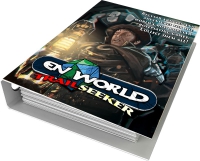
The folks over at ENWorld have an idea for a new Pathfinder monthly.  They are calling it TRAILseeker and propose to fund it through a crowd-funding model on Patreon.  They plan to release an article a week based on the amounts that their donors agree to give to them.  Only willing to spend $1--this will work if you can find 249 other people that feel the same way.  On the upside here, I feel like they have come up with a good deal, especially since they've created a method to limit your maximum monthly spending.  On the downside, they are asking for donations per article but being coy about just how many articles they will produce a month.  But, with the monthly donation cap, you can control that yourself.  They'll start producing once they've got a guaranteed $250/article and will produce the monthly adventure once they are receiving $500/article.

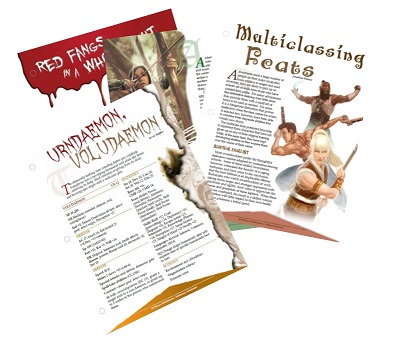
They've also got 4 sample articles:

  • Red Fangs in a White Night: An adventure for 4 7th-level characters in a city housed within a giant translucent dome;
  • Archery Contests: Proposed rules mechanics for creating...you guessed it...archery contests!;
  • Multiclassing Feats: Feats that have prerequisites from two or more class features, requiring characters to multiclass in order to take them; and
  • A new monster: the Voludaemon

I'm intrigued.  These are the people that produced the Zeitgeist Adventure Path--one that I read solely because the first adventure in it is free.  It goes for a long time (like 12 issues I think, he says as he eschews the effort to Google and find out).  I'll do individual articles on each of the samples.  I'm going to make a monthly donation I think.  I'm going to review each of the samples and agree to donate $2/article for each one I like, with a monthly maximum of $20.  Check back daily to see how the various offerings are received and what the final total will be!  What's the worst that can happen--it's Patreon.  If the offering doesn't work out, I can always cancel.  ;)

They also have a slew of future articles planned:


  • After Death, an adventure by Jonathan Garret. Congratulations! Your party is dead. This is an adventure designed for 9th-level characters. It is also a little different, as the PCs will start it dead. Fortunately for them, death is not the end.
  • Weapon Style Feats by Jonathan Palmer. Ultimate Combat introduced a number of style feats focused around unarmed combat and the emulation of animals, as practiced by various races with a clear Eastern influence. Yet the martial arts encompass a greater world than the clashing of bone and muscle.
  • Making Mischief: A Dirty Trick Guide by Thomas Kyle. The ‘dirty trick’ combat maneuver could be considered one of the most fun actions a character can perform in Pathfinder
  • Cherufe, a new monster by Jeff Lee. Cherufe are often believed to be the incarnate spirits of volcanoes. Their anger is said to trigger quakes and eruptions. 
  • Fantastic Tomes & Librams by Russ Morrissey. Every once in a while adventurers stumble across the study of an archmage, a long-lost library, a university, or even just a wizard's bedchamber. What book does a wizard have in his bedside table? What's on the shelves of the archmage's secret study? Which book is being talked about in the streets and taverns of the wealthy district?
  • The Power of Theme by Anthony Torretti.  Tell your story without restricting players.
Check back in coming days to see how the various samples work out.

Wednesday, December 31, 2014

Product Review: Kobold Press' Demon Cults #1: The Emerald Order

Full disclosure: Even though I love it, I find the large Midgard Campaign Setting difficult to navigate.  I know the point of creating a large 3PP campaign setting is to have all the fun with all of your fun subsystems, but it can be a little difficult for me to keep track.  That said, it didn't stop me from contributing to the Southland's Kickstarter.

And that’s one of the reasons that I really like the way Kobold Press has developed Jeff Lee’s Demon Cults #1: The Emerald Order.  It’s got 14 pages (9.5 of actual content when you take out the front and back cover, TOC, a full-page art piece (good art though!), and ¾ page of OGL).  Of that 9.5 pages, .5 is dedicated to anchoring the Emerald Order in Midgard.  The other 9 pages are chock full of great ways to take this evil order and incorporate it into any campaign setting.

The Emerald Order begins with a three-page spread that covers the organization’s goals.  We know that they derive a lot of power from an Emerald Tablet and that they like to work behind the scenes.  Jeff Lee has done a good job of being vague enough to make the organization slottable into any campaign while providing concrete examples of how the Order works to achieve its goals.  We also get stats on the organization’s leader and a full-color, full-page piece of art illustrating him.  Finally, we learn how members of the organization interact with each other and with outsiders. 

I love the next two pages.  The kids at Kobold have created sections for APLs 1-3, 4-6, 7-9, and 10-12 and provided us with three plot hooks for each category that show how an adventuring party might cross paths with the Emerald Order.  These reinforce that the Emerald Order is a secret society and some of them sent some shivers up my spine just reading them.

We’ve then got two pages describing the Disciple of the Emerald Esoterica prestige class.  It’s a bit overpowered compared to normal prestige classes, but I’m willing to ignore it for a couple of reasons.  First of all, it’s a 3PP prestige class, and I feel like they are normally stronger, more in line with 3.5 prestige classes rather than with Paizo-produced Pathfinder prestige classes.  Secondly, it’s highly unlikely a PC is ever going to use this prestige class—it’s really just for villains.  Next we have the Emerald Tablet itself, along with examples of what happens when people experiment with shards of it and the emerald deposit from whence it came.  These include new emerald shard ioun stones and smaragdine golem.


Overall, I really liked this product.  I especially liked the organization.  I have a pet peeve for organization.  It can be maddening to have a plot detail hidden away in a specialized monster’s bestiary entry, for instance.  The Emerald Order admirably avoids this.  Overall, I’m very pleased with this and look forward to the rest of the Kobold material in development to support their Southlands expansion.

Saturday, October 4, 2014

Kobold Press' Southlands Kickstarter


"If you're riding a camel, you are headed somewhere perilous.  And, you know, going somewhere perilous reminds me how I got into the business...Assassin Mountain, early days of the Arabian Nights..." - Wolfgang Baur

According to dndclassics.com, "After a few years of working as a magazine editor for TSR, [Wolfgang] Baur was eager to write a standalone book for the company. He was eventually handed the job of creating "Assassin Mountain" for the Al-Qadim line. With just the title and topic, he was told to write a sourcebook and connected adventures.  Baur read up on assassins, including Rashid ad-Din Sinan, the Old Man of the Mountain, then gave it all a fantasy spin. When writing Assassin Mountain, Baur also did his best to put in "poetry and sentiment" — because the rich Arabian lore of Al-Qadim could be more magical and musical than the typical D&D setting...Baur has more than once said that Assassin Mountain is one of his favorite designs. However, he's also admitted that it has flaws (probably because it was his first major design)."  Baur also went on to pen another al-Qadim title, Secrets of the Lamp, focusing on the ecology of the elemental genies derived from traditional Arab and Persian folklore.

Flash forward 20 years.  Baur now runs one of the most successful third-party publishers in the fantasy RPG business: Kobold Press.  His Midgard Campaign setting was funded through a wildly successful Kickstarter campaign.  Kobold Press describes it as, "a dark world of deep magic, with seven regions flavored by the folklore of Central and Eastern Europe plus a heady dose of weird fantasy."  He's billing the scorching Southlands as the last mysterious place left in the Midgard setting.  Isn't this the perfect time to revisit his roots and to perfect the product that started everything for him?

I certainly hope so.


Why Deserts and Nomads and Genies?

I've had an obsession with Middle Eastern history since college.  After an into class that covered the region's history through 1500, I was hooked and took the class finishing its history to the present, a religion class on Islam, and two semesters of Arabic language.  I was all excited to go into Middle Eastern Studies, but then 9/11 happened and what seemed like a joyful scholarly inquiry got increasingly politicized...but I digress.  Middle Eastern history and folklore, both pre- and post-Islamic, brings so many fascinating tales to us.  There are treasures from the Abbasid caliphate like the 1,001 (or just 8) Arabian Nights with stories like Ali Baba and the 40 Thieves and Sinbad's Seven Journeys.  Persian folklore gives us less well known stories through the Shahnameh epic poem.  

When playing fantasy RPGs, we all get boring of medieval fantasy pretty quickly.  Everyone has their favorite genre and mine is inspired by the Middle East.  After I first got turned on to Pathfinder, my first full adventure purchase was Legacy of Fire, where "the heroes stop a wish-maddened warlord from raising one of the infamous Spawn of Rovagug, a living holocaust cast down millennia before? In order to do so, they'll need to brave sand, flame, and the terrors of the Outer Planes—yet the forces at work against them are limited only by the reach of their imagination. And the enemy has had thousands of years to prepare..."  I don't care that it was written for 3.5 and that I'd have to convert everything to Pathfinder to play it today.  It's a beautiful adventure path if you love the Middle East like I do.

And Golarion's Katapesh is the same way.  Unlike Osirion, which is a little more pulp Egypt or Qadira, which always seems to be forgotten as the stub of their version of the Persian Empire, Katapesh is pure, mercantile, Silk Road ancient Arabia.  And it's awesome.  In fact, Dark Markets--A Guide to Katapesh is without a doubt my favorite campaign setting sourcebook to date.  So, the Southlands Kickstarter has a lot of competition to live up to already.


Midgard Campaign Setting: Southlands Kickstarter

Let's take a look at what the folks at Kobold Press are offering us with their Southlands Kickstarter.  It's running through October 18th.  Full disclosure: I'm already all in and getting copies of the core book, the adventures, and the bestiary (when it makes.  I know it will!).  Therefore, I have a very strong vested interest in you getting in on the action too!

Fortunately, even before you look at what's included in the Kickstarter, take a look at the vast amount of material that Kobold Press is leaking as teaser articles.  Most importantly, they've released a major preview document on paizo.com.  They also have a piece about the sentient jungle of Kush and the cities of the Southlands, They've also thrown up a few Southlands-focused of their collections of curiosities articles for things found at the oasis and things under a pile of bones.  Finally, they've given us some idea-piquing trinkets on a couple different pages.


The Loot


First, they are promising a full-color sourcebook that features both campaign setting gazetteer materials like information on the titan-ruled land of Omphaya and the sorceress who rules Ligna.  There are also player options like new classes & archetypes such as the blind archer, the lotus magician, and the weret hekau.  There's also info about deities/masks of deities.  There will also be traits related to various locations and various races native to the Southlands.  They aren't mentioned, but I'm sure the usual cadre of feats, spells, and magic items will appear as well.

The core book will also include a Bestiary, which will contain all the newest desert and Middle Eastern monsters to be had!  It will be made into a standalone book if they attract 600 or more backers.  (Bonus: They are at 568 at the time I'm writing this with 14 days to go, so I think it's a safe bet they'll make it).  They are also taking submissions from backers at a certain level (though paying to submit your design work for publication feels a little bit backwards).


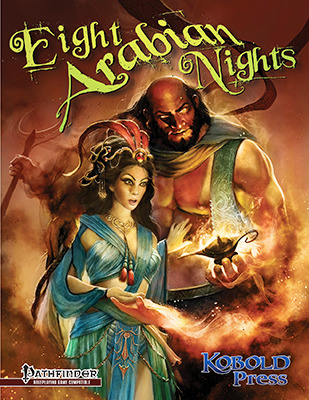
They are also updating a collection of old adventures, Eight Arabian Nights.  They are also adding new adventure content as certain stretch goals, including an adventure by one of my favorite authors, Amber Scott as their next stretch goal  (Amber is one of my favorites first because I think her adventures read like her also fun to read fiction and also because she uses Excel tables when designing adventures to ensure that there is just the right amount of XP in her adventure to level up the party at proper points.  She talks about this in an episode of Know Direction).  

There will also be leatherbound editions of the books for those who are interested and they are going to strike some commemorative coins.  

More interesting (though prohibitively costly at $2,000) is Through the Red Portal, "a lorebook that addresses the history and lost magic of the first wizards and god-kings, describe some of their peculiar talents, and offers a glimpse behind the masks of the gods of Midgard. It makes great reading for anyone looking for an undead necromancer-king, a mummy struck by divine madness, or the curse of the eldest theurge."  Alas, they will not be making a PDF either.  GMs will have to dream up our own miraculous acts performed by the powerful first wizards and god-kings that ruled the Southlands millenia ago.


Strech Goals?  Boy do they have 'em!

The project funded at $16,000 within five hours or so.  So now it's on to extra content!  Not source material, but there are forums unlocked where fans will be able to comment on content as its being developed.  Right now they are only for high-level donors, but the more that sign on, the more widely the forums will be opened.  What else do we have so far?  


  • Campaign setting material
    • Bastet, the Goddess-Huntress and her cult
    • The Emerald Order, some apparently naughty people that have made off with some fantastically powerful emerald tablets
    • A Floating Village, delivered by Paizo's Adam Daigle
    • Full descriptions of gods and goddesses in the Southlands' pantheon
    • The Hand of Nakresh, dedicated to fulfilling the commands of "the simian god of wizards and thieves."
    • The Lost City of the Serpent Crown
    • Lotus Magic: A new magic system native to the Southlands
    • Mardas Vhula-Gai, a lost city infested with gnolls and goblins
    • Per-Bestet, the City of Cats
    • Ramag, a kingdom full of dangerous portals
  • Adventures
    • Tomb of the Elephant God, by Mike Shel, added to the Eight Arabian Nights
  • Setting-neutral material
    • Advanced Races: Aasimar
    • Advanced Races: Gnolls (we all knew this was coming eventually, Kickstarter or no, because they are, as Wolfgang says, "Badass.")
    • Advanced Races: Jinnborn (though it appears with much Midgard-specific info as well)
    • Hero Lab files (Yay!)
I'm sure there will be more added over the next two weeks and I'll try to update this page if work and law school demands make that possible.  But, either way, I'll be keeping track of the Southlands Kickstarter page and hoping to see it hit as many stretch goals as it can.

Did I miss any of the articles anywhere about the Kickstarter?  Have some been added since this post went up?  Did you like or hate this teaser?  Leave a comment and let me know!

Thursday, October 2, 2014

DC Gameday XV

If you're local to the metro DC area, I highly encourage you to check out DC Gameday XV.  DC Gameday happens twice a year in March and October and represents one of my favorite things to do in gaming: play random games that you can't really play without a huge gamer crew.  Oh sure, there will be Pathfinder and D&D games, but you can find one of those anywhere.  I want to use my Gameday to play random ass games.

Games are posted as GMs offer to run them and are listed on the site.  Best of all, because almost all of the games are obscure, GMs tend to offer them as 'come as you are without any system knowledge' games.  So, if you want to try something new, this is totally the place to do it!


It takes place over the weekend of October 25-26.  There are morning and afternoon gaming slots.  Each lasts for four hours.  They also have a big social event on Saturday evening, if you're not being consumed by law school shenanigans like I normally am.  Anyway, registration opens on Friday, October 10 at 8:00 p.m.  And do register at 8:00 p.m.--slots in good games fill up fast.  I was considering offering to GM a 13th Age game, but it looks like someone's already going to do that.  So, I can PLAY 13th Age!!

When I went last spring, I only got to go on Saturday, but got a chance to check out Monsterhearts for the first time and to play a Numenera game in the afternoon.  I'd never played Monsterhearts before--it has easy mechanics and can easily be exported to just about any system.  The system is based on Apocalypse World, but was designed to better explore issues related to sex and different sexuality.  In the classic Monsterhearts setting, you have a turn on mechanic that means that another character may be able to sexually excite your character--even if you don't want them to!  The game we played was loosely based upon the movie Casablanca.  I even got to play a fantastic piano player--who has supernatural powers derived from a deal he made with the devil.


Apocalypse World is a tremendously flexible system.  In fact, there's a Kickstarter closing TODAY called the Spirit of '77 that's also based on it.  What's the Spirit of '77 you ask?  "Spirit of 77 is a role-playing game based on 70’s pop culture – glam music, grindhouse action films, kung-fu, weird science and revved up race-cars on lone highways, outracing Smokey and the Man!"  So, basically it's awesome.  And, the website has a preview adventure posted: The Cruise Ship of the Damned.  They've also taken the time to create a soundtrack of rockin' 70s tunes on Spotify that are supposed to go well with the game.  Perhaps I will offer to GM that one!


Tuesday, September 9, 2014

Illusions of Intellectual Property: Conjuring Copyright

What is Conjuring Copyright?

So, in addition to being a casual gaymer, one of my other hats is not-so-casual law student.  And, I'm lucky enough to attend an institution that's pretty big into intellectual property law.  Though I'm not planning on practicing it (admin law, baby!), I think that tabletop RPGs occupy a fascinating place in the intellectual property mix.  And, given the large number of freelancers and third-party publishers out there, I think that a lot of other people might be interested in the confluence of tabletop RPGs and copyright law as well.  And, on top of that, I need to write a fairly major law review-style paper sometime in the next 18 months.  There's not a lot out there on copyright law in RPGs, so I think it's a topic worth exploring.  So, I'm going to use this blog to write out some thoughts as I do some research.  In keeping with giving fantasy RPG-ish terms for my columns, I'm going to call this segment Conjuring Copyright.

Disclaimer: I am a law STUDENT.  I am not a LAWYER.  I am licensed to practice law in exactly zero states.  Therefore, I cannot offer anyone legal advice.  Repeat: these postings will NOT constitute LEGAL ADVICE.  While I certainly think that my insights into the law are valid, if you have an actual copyright law question, seek out a competent and barred attorney.  Feel free to show them these posts, but don't rely on this blog as a source of binding authority.  Every case is different and I'm not working on yours.  Partially that's because you aren't paying me to do so.  More importantly, it's because it would be a felony if I did take your money to do so without the supervision of a practicing attorney.  So, let's get this straight.  This is an explorational information source.  I am not your lawyer.  You might be a beautiful and unique snowflake.  But you are not my client.

Because this is going to be used for a future paper, I'm going to drop some citations in to make things easier when I come back to it.  Ignore them if you're not interested.  In case you are, I will cite to free databases like Google Scholar rather than the traditional legal databases.

Copyright as it applies to games

Let's get one thing straight.  Games cannot be copyrighted.  This is a concept so old that even old U.S. Courts of Appeals' cases just cite to it as a truism.  But, they do cite to it and rely on it, so we know one thing: games cannot be copyrighted.  This is why no one owns basketball or baseball or bridge or tag.  Facts cannot be copyrighted.  You cannot copyright the capital of Arkansas.  It's just Little Rock.  Ideas cannot be copyrighted.  The Pythagorean Theorem is off limits, too.  So, what CAN be copyrighted?

The "I'm Big on Little Rock" trademarked logo.  In addition to copyrights, trademarks and patents are the other two types of intellectual property.  A copyright protects an expressive work.  A patent protects as useful design, machine, or process.  Trademarks protect product identity.  This particular bugger was trademarked in 1994 by Beth Blevins Carpenter.  I'm using it without her permission, but want her to know that a) I will take it down immediately if asked, and b) I think she's a genius for designing it.


Copyright protects artistic expression.  Most traditionally, artistic express covers things like novels, plays, and art.  Novels involve the creation of characters, places (sometimes), and fictitious events that are woven together into a coherent whole.  Plays are similar, except they require a public performance (which is also a copyrightable expression).  Music is copyrightable too.  (Let's not dwell on this, because music is one of those areas where things get complicated).  Art's pretty obvious.  If you drew, painted, sculpted, etc. something, you have the copyright to it--at least unless you assign it to someone else.

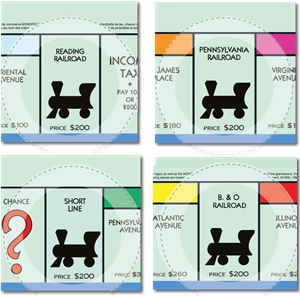
Games are tough though, because they occupy this strange place between expressions and something uncopyrightable (we'll discuss what that is in depth later, but for now let's just go with games are sitting on the edge of the cliff).  Things like the rules of a game are not subject to copyright.  But, many games have artistic expression along side their rules.  So, you can't copyright the rules to Monopoly.  40 squares with pieces moving around them based on rolls of two six-sided dice; some of the squares can become a player's property and others provide other game effects.  Those are rules and ANYONE can create and sell a game that has those characteristics.  But, if you want a board that has Ventnor Ave., Park Place, Boardwalk, and those four specific railroads, you've got another thing coming to you.  That board is a piece of art, my friend.  And art most definitely is subject to copyright.  Now you see why tabletop RPGs are so complicated on this front.

These babies are copyrighted.  That train design is distinctive.  It might also be trademarked, but it's definitely subject to copyright as a part of the Monopoly game board, which is technically a piece of art.


Video games go a long way to illustrate this point.  Because video games comprise a whole lot of art.  And that art is all subject to copyright.  The sound is also subject to copyright.  Even their code is an arrangement that's covered.  Video games sound pretty damn subject to copyright, huh?  Nope.  Underneath all those graphics, sound, and code, there's an underlying system of game mechanics.  Covered by copyright?  I don't think so.

Where does that leave tabletop RPGs?  Well, I won't have a definitive answer to that question for awhile.  We are going to do a lot of investigating.  But, I have a theory about where I'm going to end up.  Right now, at the very outset, I predict that the rules elements of a tabletop RPG aren't subject to copyright.  But, most of the expression elements within an RPG ARE subject to copyright.  This raises all sorts of fun and interesting questions about things like the Open Game License and the Pathfinder license and we are going to look into them!  But, at the end of the day, I'm betting that if you were to print your own book with your own art that covered the rules to ANY tabletop RPG that you'd be able to get off scott free (provided you could pay the court costs Wizards of the Coast, Paizo, or any other game publisher threw at you).

Paizo makes any third-party publisher using their rules system follow rules and stick this little number on their product.  That may be as much boon (it's compatible!) as bane (we have to follow a stinking license!).  But, is it required?
The license that started a new roleplaying game...


Why do we have Copyright?

A lot of people mistakenly believe that the purpose of copyright law is to allow people to control access to their own creations.  This is halfway correct.  But, remember that a copyright exists for a limited time only (though we will explore a dissent by Justice Stevens that questions whether today's copyrights are functionally unlimited).  Here's a dirty little secret: the real purpose for copyright law is to get these ideas into the public domain.  The U.S. Constitution grants the Congress the power, "To promote the progress of science and useful arts, by securing for limited times to authors and inventors the exclusive right to their respective writings and discoveries." (U.S. Constitution, Art. I, § 8).  Public domain works are those whose copyright has expired.  Guess who owns them?  No one does.

Find a work with an expired copyright and you can print and sell all the copies you want for whatever the market will bear.  Of course, so can anyone else, so there's not a huge value in doing so.  That's the whole point.  We want these ideas to get out into general, unprotected circulation.  But, if we don't give authors some control and protection over their creations, they wouldn't make much art for us, would they?  If anyone could take the idea as soon as it was committed to paper, we wouldn't have many people putting ideas to paper.

In economics, this is called a positive externality, meaning that the practice creates benefits but that the creator is unable to internalize those benefits, a.k.a. make money off of them.  (Since I go to a school steeped in the law and economics movement the way that the British East India Company was steeped in tea, you are going to have to read a bit of that too).  Compare that to a negative externality, which is when an activity creates negative effects that don't rebound wholly on the actor.  Pollution is the classic negative externality.  And externalities are BAD.  We want them to go away.  We want people to produce beautiful and useful things like art, literature, and scientific inventions to advance society.  How do we get them to do so?  We bribe them.  We bribe them with the most destructive economic force of all: a monopoly.  Copyright or patent something and you've got a monopoly off of it for decades.

Copyright as Light

Fun fact: Light is both a particle and a wave.  It's analog and digital.  I find it helpful to view legal concepts this way.  It's easiest to view them in a continuum.  There are some things that we're pretty sure are subject to copyright and nobody is going to mess with them.  There are others that pretty obviously aren't subject to copyright, like the phonebook (though, again, phonebooks have been the subject of copyright cases before--and will be important as we discuss what it means to be able to copyright a tabletop RPG or not).  There's a continuum between these two points of things that are less and less obviously subject to copyright and moving towards things that obviously aren't subject to copyright.  Of course, ultimately a court case can decide whether or not something is subject to copyright protection.  But, ex ante, we want to have a good idea about whether or not we think something is.  (Ex ante is fancy lawyer-speak for "before the fact."  I could have just said "before the fact," but what's the fun in that?)

My goal in this explanation is to create a framework that covers what portions of tabletop RPGs are covered by copyright laws ex ante.  To do so, I'll consider various products marketed by tabletop RPG companies.  First and most obviously, the rules systems that underlie the games themselves will be considered.  I believe these occupy the least protected portion of the continuum and are, arguably, already within the common domain.  There are other products like campaign settings marketed by RPG companies.  These products contain fictional places, events, and storylines.  That's starting to sound a lot closer to the kind of expression we want to protect.  Things like tie-in novels are pretty obviously covered.

Finally, there's the product that I find most interesting.  Paizo is the publisher that markets this product in its purest form: the Player's Companion.  A Player's Companion is essentially a 32-page set of rules options and gaming kit that has been adapted to fit into Paizo's Golarion setting.  This is the sweet spot for this investigation.  And, you know what?  It's also the one type of product I'm considering that I'm least sure about its protected status.  Maybe it is and maybe it isn't.

"Each monthly 32-page Pathfinder Player Companion contains several player-focused articles exploring the volume’s theme as well as short articles with innovative new rules for all types of characters, as well as traits to better anchor the player to the campaign. Pathfinder Player Companions are specifically written for players of the Pathfinder RPG."  What do we think?   Uncopyrightable rules or protected expression?

What's Next?

This segment is going to have to explore a lot of ground.  There's going to be an exploration of intellectual property law.  There's going to be an exploration of the theory behind games (not to be confused with game theory, which is much less fun).  There's going to be an exploration of the federal court system, because today it's entirely possible that whether or not an RPG can be copyrighted depends on where you live in America.  (For those of you that live outside of America, shoot me some comments.  I know just enough copyright law to be dangerous and next to nothing about how it gets applied outside of the States).


My next post on this topic is going to review and provide my thoughts on a law review article called Games and Other Uncopyrightable Systems (I'll bet you can guess where I land on this debate).  I picked this article for several reasons.  The author, Bruce Boyden, did his undergrad at the University of Arkansas, which is the flagship university of my home state's public education system.  He also published his piece in the George Mason University Law Review, which is where I go to school.  GMU has a well-recognized intellectual property law program.  Finally (and most importantly for you, dear reader), the GMU Law Review posts its back issues online for free, so it's publicly accessible.  Boyden's piece is focused more on tabletop games, but not on the RPG genre.  It provides a good jumping off point for us on the basics of copyright law and how games fit into it.

What do you think about Invoking IP?  Interesting topic?  Snoozefest?  Glorious or poverty?  This inquiring mind wants to know, so write a comment below!

Monday, September 8, 2014

GenCon Recap: Saturday, August 16

My GenCon Saturday started with sleeping in!  Unlike the previous two days, I didn't have anywhere to be until 9:00a.m. for Kobold Press' seminar about trying to be a freelancer.  I don't really have any desire time to be a freelancer, but I think these types of panels offer good advice on how to make good adventures.  Also, I wanted to support Kobold Press, because they are one of the few established outfits in the industry that takes submissions from people without any publishing credits to their name.  The session was interesting and I took a few nuggets away with me: you'll probably have to give your first piece away but try and start getting paid for your second, know multiple systems because you never know which systems will be in vogue over time, and whenever you do get rejected always ask for feedback on how you can improve your work for future publication.

I confess: I snuck out of the seminar early.  After meeting the folks running all of Monte Cook's games the night before, I was hoping to catch a Numenera game on a generic ticket.  The Kobold seminar was at the very back of the hotel to the southeast of the convention center.  The Monte Cook Games room was at the very end of the hotel to the northwest of the convention center.  So, I got to walk the entirety of GenCon!  It is a long effing way.  

It was longer when I arrived to find out that had I been one person earlier I could have gotten a seat at the table with my generic ticket.  Poverty.  My friend from the bar the night before did manage to get a generic ticket slot though, so that's good though.  I hadn't been able to sign up for a Numenera event in pre-registration.  I was shocked at how quickly these games filled up.  I think that less well-known games are harder to get tickets to because it's a lot easier to find a game of Pathfinder or D&D when you aren't at a Con.

So, it was time to make the long walk back to the Convention Center proper.  With a hole in my schedule, I decided it was time to do something unplanned.  On a whim, I walked into the Dungeons & Dragons room.  I'm inclined to dislike 5th Edition based on the game's management's history, but I figured I could at least check it out.  All their events are set up in a castle and so I stepped inside.

Much of the castle is dedicated to people actually playing D&D, which is nice to see.  They have a tiny retail section in the castle as well and I'm hoping to browse through the new Player's Handbook and edition launching adventure, Tyranny of Dragons.  It's a two-part adevnture set in the Forgotten Realms, a setting that I really liked back in my 2nd Edition days.  The first one is called Hoard of the Dragon Queen.

I come up to the retail area.  It's basically a check out line without any browsing space.  I ask if I can take a look at the game or if I have to get in line to purchase.  The guy behind the counter tells me I have to get in line.  This sales tactic is probably coercively effective on customers that feel less license to be a dick than I do.  I get in line and start browsing the book.  I'm going to have time for either the Player's Handbook or the adventure--and I go with the adventure.  The artwork is top notch and the plot looks good from my five minute overview.  

Unfortunately, I have to put it back once I'm at the front of the line.  I'm a no go on purchasing--this was pretty much a classic customer service fail.  Don't make me stand in the checkout line to browse your product.  I am considering purchasing a book, which a lot of people put a lot of time into writing.  I am not purchasing this, this, or this.

So, back to the Exhibit Hall.  I finally make it through this time.  I also make my first impulse buy of the Con: a copy of Iron & Ale.  You can read my review of it here.  

After finishing my rounds at the Exhibit Hall, I'm walking past a board game company's booth just as an announcer is calling for a single player to jump into a game being demoed.  It's called Hyperborea. It promises an opportunity to, "Embark on an epic quest to build your mythical nation into the greatest empire known to mankind. Capture land, defeat monsters, and discover new technologies on the rise to greatness."

Everyone plays a different army attempting to be the first to capture the most gems.  There are army movements, special resource cards, and a lot of divisions by three going on.   If 13th Age is like Pathfinder with 1/3 of the rules, then Hyperborea is like Settlers of Catan with 3 times the rules.  Seriously, if you like highly complex board games with tricky rules interactions, Hyperborea is for you.

I didn't mind playing it, but didn't love it either.  The woman who explained the game was top notch and the family that I was playing with were big time board gamers.  Super nice too!  Apparently, he worked at TSR back when it was TSR, because they were talking about meeting up with Margaret Weiss and had the father seen Tracy?  Mom from the family ultimately won the game.  It was competitive too--this is not a family that minds going head to head.  It infected me a little bit too, I had to remind myself that these people were TOTAL strangers.

Finally, it's time to play The Strange!  Unfortunately, the girl from the night before that I thought would be my GM actually had the session starting two hours previous.  Well, maybe not unfortunately because our GM was actually awesome!  We had a great party.  I also got to meet my first Gaymer (and he was hot!) at the session.  I was feeling a little shy though so I didn't ask for a ribbon from him.  Wish I had.

The Strange takes place in modern day Earth, but with so much more going on.  Have you heard of dark energy?  Well, Monte Cook and Bruce Cordell have.  And they've decided that it's actually a connection to something called the Strange, which is essentially this network that connects our universe to all sorts of other alternate realities.  Some of these realities have alternate physics.  For instance, another reality, Aredyn, functions a lot like a traditional fantasy game.  There's another alternate reality, Ruk, that has a strong super-science cyberpunk feel.  Oh, and there's the Strange itself, which is also home to planetovores.  In fact, Ardeyn is actually a creation by the Earthling (Terran?) that first discovered the Strange.  He created it as a sort of decoy to throw any planetovores off the trail of the real Earth.  There are other worlds, or recursions, as well.  All in all, this is a really interesting setting.

The system isn't that different though--the Strange RPG is based on the same cypher system that runs Numenera.  One day I'll write a more in depth post talking about what I find interesting about the system, but here are a few interesting details.  
  1. Players do all the dice rolling - Players have rolls to make for any skill check and have target numbers to hit to either hit an enemy in combat or to dodge an attack from an enemy.  This frees up the GM to focus on the story--and it shows in how much more immersive the story can be when the GM doesn't have to fiddle with rolling her own dice.
  2. XP has value - You can use XP to level up, but I wouldn't recommend it.  XP has so many other uses.  Most importantly, XP is used to reroll whenever you feel like it.  You also don't get XP for defeating monsters.  Rather, you get XP for advancing the story's plot.  When the GM wants to screw with you (known as a GM intrusion), she offers you 2 XP.  You take one and give the other XP to another player at the table.  If you don't want the terrible thing to happen, you can pay one XP to the GM to avoid it, though this is frowned upon.
  3. Your strength is also your hit points - Players have three stats in the cypher system: might, intellect, and reflex.  You do extraordinary things by adding effort to your rolls, but adding effort also takes from your character's might, reflex, or intellect.  So, applying effort on a might-based skill actually means that your character will be giving up hit points to perform an action.  It's an interesting mechanic that really makes a player think about how doing something will affect your character's survival.
Usual rules apply: no details on the adventure.  I will say that I got the chance to be a particle physics grad student by day and a go go boy by night.  I also got an opportunity to pretend to be an interpretive dancer when infiltrating a cult.  I went a little far on this one and ended up being "that guy" at the table.  To my fellow players, I apologize.  To Austin, thank you for cluing me in that I needed to rein it in a little.  I'm glad that you got to be the hero on this one in the end!  (Did I mention that we saved the world?)

Also, did I mention that the cosplay at GenCon is amazing?  I have now decided that it's imperative that I create a cosplay vs. drag queens YouTube! compilation.  I'm only shocked that someone else hasn't beaten me to this particular punch.
Cosplay v. Drag Queens is going to be a thing!

It's also time for dinner.  I wander over to the food trucks and also get an opportunity to see the greatest board game of all time: The Cones of Dunshire.  Yes, that game.  Mayfair Games is holding a charity running of the game.  I wasn't willing to pay the $100/head to get in on the game itself, taking pictures for free (well, and picking up a t-shirt) had to be enough for me.


Then, it was time to check out the Film Festival.  I wanted to catch a couple of films.  First, there was a showing of the entire season of Walking in Circles.  It started late and I got a great chance to talk to a nice girl who was hiding out in the viewing room from a crowd of raving zombies.  Someone had organized a giant zombie tag game.  But, the game doesn't happen inside any of the event spaces or in the Exhibit Hall and she was getting some much needed rest from her undead tormentors.  Walking in Circles was fun, but not particularly memorable.

What I've really come to the film festival to see is Gaming in Color, a documentary about homosexuality in gaming culture.  As a Gaymer, I'm interested in seeing how we get portrayed.  The two guys who made it (and who organized the Gaymer X Con in San Francisco) are also present to talk about it on a panel afterwards.  I'm holding off on my review of it as well, because it will make for an entire post.  For now, I'm going to say two things.  First, I'm very glad that this documentary got made because it raises some questions that we should all be looking at for how homosexuals (and all minorities) fit into the gaming world.  Second, I was shocked at how offended one part of it made me and a little bit angry about it.  But more on that later.

Finally, the documentary and the panel are over.  It's almost midnight and I'm a tired puppy.  I hail a cab back to my apartment and fall asleep reading a 13th Age adventure module I picked up the day before.  My Sunday schedule is light and the PFS games start at 9:00 instead of 8:00.  Maybe I'll pick up one with some generic tickets in the morning?