Thursday, September 11, 2014

The hammer has fallen!

So, my home campaign has been having some scheduling issues.  Nothing that doesn't happen to everyone else, I imagine.  We're all adults and have lives and fitting our habit into those lives can be complicated to say the least.

On the one hand, I very strongly believe that joining a gaming group is much like joining any other team.  Because everyone else's ability to enjoy the game is contingent on all (or at least most) people being there, dedication is required above and beyond just showing up to do something like go to movies or dinner with friends.  Obviously, there's nothing enforceable like a contract here.  But the concept of the non-binding but seriously entered-into covenant does come to mind.  So, I think that it's important that everyone be there because everyone else's enjoyment is, to some degree, contingent on the presence of everyone else.


On the other hand, I believe that because commitments to a group are something so important, it is important that they be spelled out pretty clearly from the beginning.  By constraining the bounds of the commitment, everyone who has committed can take extra care to meet it within its pre-arranged constraints.  It's essential not only that everyone gets on the same page, but that everyone is clear on what the page is form the outset.  And, from the beginning one of the things that we said we were going to do was leave our weekend evenings free.

Funnily enough, as I was listening to some Know Direction footage from Paizo seminars at GenCon on my way home from school tonight, their Ask the Paizo GMs seminar dealt with just this issue.  So, here's their wisdom on the topic.  (I'll switch it over to their YouTube channel once they put up the video).  I think that they hit some very good points (several of which diverge from some of my earlier thoughts on scheduling via email that are excerpted above).  

But, I also want to share a message from our GM that I believe gets the point across far better than I ever could:


Hope you enjoyed it.  Posts coming at least daily now.  After our next session, I’ll be back with further details about our four mismatched adventurers' life with the TREKkies.[1]


[1] Pronounced “Trooks.”

GenCon Recap: Sunday, August 17

Well, I overslept again, so no Pathfinder Society game for me.  They may have started at 9:00, but I woke up at 9:15.  Honestly though, this is my vacation, so I'm not too terribly bummed about this state of affairs.  I don't have any games scheduled for today, so my backpack is blissfully light as I make my way down to the Indiana Convention Center.

I catch the end of the Secrets of Golarion panel and then kill a little bit of time before catching the Developing Pathfinder panel.  Again I ask, why aren't more people at these panels?  Sure, they are recorded (thanks Know Direction), but the opportunity to interact directly with the people that design your game is not something to be missed.  At the dais are Wesley Schneider, Patrick Renie, Mark Moreland, and a developer from the setting-neutral RPG line whose name I didn't quite catch (sorry!).  These are the people that make the big decisions about Paizo, manage the Player Companion line, and manage the Campaign Setting line.  If you want an opportunity to ask for things you are interested in, this is not something to miss out upon!

You can just watch the panel on Know Direction.  I did make two suggestions.  First was an idea for a Campaign Setting book about Travel and Trade in the Inner Sea.  This would be less of a "what products are produced where" book and more of a "while people are living on the road in caravans and merchant trains, what is going on" kind of book.  I'd like to cover things like typical types (maybe a few model NPCs) that you'd meet on the road, fun travelers' inns and caravanserai, etc.  Unfortunately, the developers didn't think that there's much of a market for this.  I might have had too much Gentlemen of the Road on my mind at the time anyway.

My suggestion for a short (3-5 pages MAX) introduction to Golarion document was much better received both by the Paizo staff and the others in the room.  It's very inconvenient to tell someone that they are going to need to learn their way around the 7,459,848 page Core Rulebook and then follow that up with another 250+ pages about the setting in the Inner Sea World Guide.  When Wes Schneider asked for a show of hands about who would be interested, every hand in the room went up.  Apparently, something like this was developed for the Strategy Guide, but was cut for space reasons.  So, I'm hopeful that it will get published.  Wes mused about doing it as a Paizo blog teaser to drum up interest in the Strategy Guide.

Another attendee (aka the Know Direction cameraman!) suggested a book that I would LOVE, LOVE, LOVE to see!  The suggested title was Ultimate Adventure and it would cover interesting ways to develop and manage all the non-combat but still crunchy things that Pathfinder features.  Such a book would cover things like traps, long-distance travel, and alternate skills systems.  Huge hat tip to you, sir!  This is a great idea and I'd love to see it.

After the panel ended, I headed across the street for some lunch.  There was a macaroni food truck.  They have a mac and cheese dish that is covered in pickles (and that I subsequently covered in barbeque sauce).  Let me be clear.  This was heaven.  I would eat this dish every day for the rest of my life and be so fat and happy doing so.

Finally, it's time for the last official event of the Con: the Pathfinder Tales panel.  I have mixed feelings about RPG tie-in fiction.  On the one hand, you can get novels like James Sutter's The Redemption Engine that tell a story but within a framework of a rule-based system that players can expect.  This is the way that tie-in fiction should be done.  But, there are other works like Ed Greenwood's The Wizard's Mask that read as if someone took a few RPG play sessions and tried turning them into a novel.  If wanted to do that, I'd just go re-read my notes from previous play sessions of my own.  But, because tie-in fiction can be so good (Elaine Cunningham's Elfsong and Elfshadow remain two of my favorite fantasy novels), I wanted to catch the panel.

Walking in I also got a free copy of Monster Hunter (unaffiliated to the panel.  Someone had just been giving them away at another event and had extras he didn't want to fly back with) and a free Mountain Dew.  So, score one for deciding to hit up the seminar!  It was interesting to hear about how the Pathfinder Tales process differs radically from the rest of Paizo's printed product offerings.

But, I also really enjoyed when James Sutter told a story about his and Wes Schneider's working relationship.  Apparently when they started they did a lot of team writing.  Then, as happens with so many teams, they had some creative differences that "almost turned into a fistfight in the Paizo parking lot."  Of course, like all good friends with creative differences, everything was fine again after they had the freedom to go their own way and the two frequently consult each other again on their work.  But the gossip point was in relation to the fight.  Per Sutter, "I'd like to think that if it had come to blows, I could have taken him."

The seminar ended and with it, so did GenCon.  I don't have a flight back until tomorrow afternoon, so I catch a couple of movies Sunday evening, do some adventure design on Monday morning and then fly back home.

I have already booked a closer hotel for next year's Con.


Wednesday, September 10, 2014

Play It Again, Dick!


This blog is supposed to be about gaming stuff, but every now and again I'll expand on other things that I'm really excited about.  In this particular case, it's a new web-based spin-off from Veronica Mars called Play it Again, Dick!  The show is "a digital series that follows Ryan Hansen as he tries to get a Dick Casablancas show off the ground," according to an announcement to Kickstarter backers of the Veronica Mars movie.

I was a huge fan of Veronica Mars and supported the Kickstarter.  I felt like the movie was a great capstone to the series.  It looks like this show is more meta.  Rob Thomas is actually pretty good at meta and skewering Hollywood.  His Party Down series is a hidden gem.  I actually resented Parks & Recreation for stealing Adam Scott and Megan Mullally and essentially tanking the show (even if Parks & Rec was also awesome!)  I'm cautiously optimistic about this one.  We will see how it turns out...

The series will debut on Tuesday, September 16, on the CW Seed:

http://cwseed.com/shows/play-it-again-dick/

 A new episode will air each week after that – for a total of eight episodes, each about 7-10 minutes long.

Buzzfeed has the inside scoop and CW Seed has a teaser trailer.


Buying In to Byenn

We had our second session in the new campaign last night.  According to Roll20, it’s called Byenn.  I’m not sure how that relates to the world as of yet, but I’m going to take it on faith that it will be important, or, if not important, at least serve as a sufficiently indicative moniker for the campaign.  Since we have agreed that we are going to hold our next session on Friday afternoon, I’m under a bit of a time crunch to get this summary written.  On a happier note, I remembered to take some screen shots this time around.  So, there will be some graphics in this update!  Huzzah!

Joramon and our GM getting ready for a play session.  Joramon is reading through the last blog post about our first session.  At the bottom you can see Aliana on the left and cannot so much see Rhyss (me) or Jertyl.


We left our heroes in the midst of a riot (cum rebellion?) in the city of Flynnt.  Rhyss (me), Aliana, Joramon, and Jertyl[1] recently slipped into a building at the behest of a bunch of people who it appears actually started the riot during the execution.  Agreeing to accompany Joramon to his home to find his stuff was a questionable judgment call.  This appears to be completely insane. 

We’re holed up in this building and there are a lot of other people with us.  Yep!  You guessed it!  They are all TREKkies.[2]  We’re taken to meet their leader.  His name is Serge and he’s not particularly friendly.  He definitely has a thing against dwarves, like Joramon.  But, we were fighting in his company, so we appear to be given the benefit of the doubt.  Serge has the four of us packed upstairs so he and his team can decide what to do with us.  There are lots of wounded people, but a several able-bodied ones as well.  We comply and are escorted to wait for the verdict.

The heroes wait upstairs while the TREKkies decide their fate.


As a team we haven’t really had much of an opportunity to really meet each other yet.  Unfortunately, we don’t really get an opportunity to do this because we have to discuss what the hell is going on and how we want to respond to things.  Joramon isn’t surprised about this, but informs us that he doesn’t much care for his fellow dwarves either.  Rhyss is really just in it for the adventure.[3]  He takes a seat and starts playing a popular satirical tune on his pan pipes.  It starts with, “Who runs the world?  Dwarves!”  It gets an approving snort from the other side of the door.

Guards appear at the door and ask us to come back downstairs.  (Did I mention that there’s still a riot going on all around us).  Rhyss decides to be impressive and attempts to do a vaulting flip off out of his chair.  He bombs it and lands on his head, almost destroying his lute!  What’s a bard without his instrument?  The beautiful Aliana pulls him up.  Trying to recover his poise, Rhyss tells Joramon, “That’s the same trick I used to bed the Pasha of Ruana’s daughter!”

On the bright side, Serge and Co. have decided that we are all trustworthy.  On the so bright that it burns side, they have decided that we are all so damned trustworthy that they’d like us to join their order.  They believe in fighting against tyranny so that learning and peace can flourish.  Rhyss is down with concepts like that—it’s a life philosophy he approves of.  Unfortunately, they want us to show our dedication to the cause by getting the first letter in the TREK symbol branded onto our skin.  Joramon and Aliana agree pretty quickly. 


The main floor of our hideaway house.  You can see Serge above.  He's the one with the word "Serge" floating underneath him.


Rhyss pulls one of his favorite tricks—he hides until he’s wanted.  They fail to find him (except one injured guy who sees Rhyss slip under the table and just smiles).  When Serge calls out for Rhyss, he leaps onto the table and informs his new benefactor (or jailer, the two seem pretty congruent at the moment) that his skills run more to sneaking about and garnering information and that a brand would only impede doing that.  Serge agrees, reluctantly, that Rhyss will not need to take the brand.

Rhyss hasn’t had much time to chat with Jertyl yet, but Jertyl’s next move impresses him.  Jertyl doesn’t want to get branded either.  Thank God[4], someone else seems to be showing some sense here.  Before Jertyl and Serge can have it out, there’s a knocking at the door.  Is it a pleasant knocking?  Nope.  It’s the kind that’s followed by a battering ram.  Joramon and a TREKkie run south to reinforce the barricade.  Serge yells that we all need to get upstairs as quickly as possible.  Joramon, Aliana, and Rhyss follow, but Jertyl decides to stay downstairs and take stock of the situation.  Possibly Jertyl also wants a moment to reflect on the joyful development prevented his being branded.  Rhyss certainly felt like it was a close call.

Aliana splits off on the middle floor.  Maybe she heard a noise?  Rhyss and Joramon are rolling upstairs post-haste.  I guess we are going to the roof?  Maybe this is a horror movie?  There are people surrounding the base of the building, so we head to the one place with the least good options for escaping…

Full shot of the grinder house we got thrown into.  The crazy alchemist is hidden behind my name screen.  We are on the roof.  The plank bridge to the right has fallen, but we'll have to rush and defend the one on the left soon!


Chaos reins on the roof.  After a moment’s notice, Rhyss can see that it’s controlled chaos though.  There’s a few guys on the roof along with Serge.  As Rhyss and Joramon get up there, someone pushes a barrel off the roof.  Nothing happens for a second and then there’s a big BOOM!  Apparently the barrels are filled with something incendiary.  We take up positions on the roof.  That’s when Rhyss notices the planks connecting our roof to two other roofs crawling with Flynnt’s city guard.

Things are looking rough when Aliana arrives.  Apparently she went to investigate something she heard—a mad alchemist below who gave her several doses of alchemist’s fire!  We may have a chance!  Battle ensues.  Rhyss takes position behind a barricade and starts firing arrows.  Joramon’s fighting along the edges of the roof keeping defenders back while Aliana chugs vials of alchemist’s fire at our attackers.  Then Jertyl shows up.  He’d stayed downstairs while guards sent in their feral tracking dogs.  He’d laid one out, but then had to flee up the stairs with the little bitches on his heels. 

We’re trapped thirty feet above ground on the roof of a burning building with guards coming at us from both sides.  Rhyss lands a lucky hit on a guard coming from the east building and knocks him off the plank.  When he loses his balance, the plank falls with him.  Joramon is holding the western plank along with Serge and some TREKkies.  Aliana is chugging alchemist’s fire for all she’s worth.  Jertyl lost his hook in a grisly encounter with one of the dogs below, but he’s fighting guards up top with his scimitar. 

Suddenly, Rhyss sees something on the edge of the northern wall.  A small hole has opened up into what looks like a hidden crawlspace.  Most of the TREKkies are dead now.  Joramon has taken out the guards and the western plank bridge, but things don’t look good.  Even Serge is on his last wind.  Rhyss yells to his companions to hightail it into the bolt hole while he covers them with arrows.  The three of them make it in.  Serge and the TREKkies aren’t so lucky.

Someone’s installed a false wall along the northern edge of the building with holes connecting the floors.  We flee down them as quickly as possible.  Finally, there’s a hole too small for the tall folks to fit through.  Aliana and Rhyss slide through to see what’s going on beneath.  Joramon and Jertyl beat a hole and we end up underneath the building before crawling through the last hole—into a subterranean hideout presumably carved by one of the TREKies.

Just as our heroes slip into the bolt hole, the building comes crashing down on top of them.  Our pursuers have been cut off, but we have no route back above.  Jertyl lights a torch and we see we’re in a hideout with six beds, a few chests (full of food no less!) and tunnels heading north and south.  Joramon’s in bad shape and wants to hunker down for the night. 

Jertyl finds the food in the chests and we decide to rest.  Aliana and Joramon are now that last two members of the world’s smallest gang.[5]  Jertyl and Rhyss appear to be along for the ride.  Where are we going next?  You’ll have to wait for our next recap[6] to find out.

End scene.

Like this post?  Hate it?  Tell me in the comments section below!


[1] Who I, Boyd the player, not Rhyss the character, am already lobbying to switch into a class that has an animal companion who will, of course, be called Yertyl the Turtle.
[2] Possibly in response to my last recap, our GM has informed us that the word should be pronounced “Trook” (rhymes with the noise an ape makes).  I am going to continue calling them TREKkies, but you can pronounce them as Trooks, Trookies, Trekkies, or Jumpin’ Jambalaya Juicers for yourself.  I don’t mind.  Really, it’s up to you.
[3] Or is he?
[4] Insert name of the Byennese (Byenni?) deity here.
[5] All credit to Aliana on that joke!
[6] Unless we start live streaming.  We might, if you provide comments asking us to!

Tuesday, September 9, 2014

Support Net Neutrality!


Look, I don't have to tell you that the people that own the pipes want to own how the content travels through the pipes.  Things are bad, and the FCC could conceivably make them much, much worse if the current proposal passes.  Visit battleforthenet.com to learn what you can do to ensure that all traffic is treated the same no matter how much you pay to get Internet access.  The Internet is a commodity, the same as electricity and should be treated as such!

Illusions of Intellectual Property: Conjuring Copyright

What is Conjuring Copyright?

So, in addition to being a casual gaymer, one of my other hats is not-so-casual law student.  And, I'm lucky enough to attend an institution that's pretty big into intellectual property law.  Though I'm not planning on practicing it (admin law, baby!), I think that tabletop RPGs occupy a fascinating place in the intellectual property mix.  And, given the large number of freelancers and third-party publishers out there, I think that a lot of other people might be interested in the confluence of tabletop RPGs and copyright law as well.  And, on top of that, I need to write a fairly major law review-style paper sometime in the next 18 months.  There's not a lot out there on copyright law in RPGs, so I think it's a topic worth exploring.  So, I'm going to use this blog to write out some thoughts as I do some research.  In keeping with giving fantasy RPG-ish terms for my columns, I'm going to call this segment Conjuring Copyright.

Disclaimer: I am a law STUDENT.  I am not a LAWYER.  I am licensed to practice law in exactly zero states.  Therefore, I cannot offer anyone legal advice.  Repeat: these postings will NOT constitute LEGAL ADVICE.  While I certainly think that my insights into the law are valid, if you have an actual copyright law question, seek out a competent and barred attorney.  Feel free to show them these posts, but don't rely on this blog as a source of binding authority.  Every case is different and I'm not working on yours.  Partially that's because you aren't paying me to do so.  More importantly, it's because it would be a felony if I did take your money to do so without the supervision of a practicing attorney.  So, let's get this straight.  This is an explorational information source.  I am not your lawyer.  You might be a beautiful and unique snowflake.  But you are not my client.

Because this is going to be used for a future paper, I'm going to drop some citations in to make things easier when I come back to it.  Ignore them if you're not interested.  In case you are, I will cite to free databases like Google Scholar rather than the traditional legal databases.

Copyright as it applies to games

Let's get one thing straight.  Games cannot be copyrighted.  This is a concept so old that even old U.S. Courts of Appeals' cases just cite to it as a truism.  But, they do cite to it and rely on it, so we know one thing: games cannot be copyrighted.  This is why no one owns basketball or baseball or bridge or tag.  Facts cannot be copyrighted.  You cannot copyright the capital of Arkansas.  It's just Little Rock.  Ideas cannot be copyrighted.  The Pythagorean Theorem is off limits, too.  So, what CAN be copyrighted?

The "I'm Big on Little Rock" trademarked logo.  In addition to copyrights, trademarks and patents are the other two types of intellectual property.  A copyright protects an expressive work.  A patent protects as useful design, machine, or process.  Trademarks protect product identity.  This particular bugger was trademarked in 1994 by Beth Blevins Carpenter.  I'm using it without her permission, but want her to know that a) I will take it down immediately if asked, and b) I think she's a genius for designing it.


Copyright protects artistic expression.  Most traditionally, artistic express covers things like novels, plays, and art.  Novels involve the creation of characters, places (sometimes), and fictitious events that are woven together into a coherent whole.  Plays are similar, except they require a public performance (which is also a copyrightable expression).  Music is copyrightable too.  (Let's not dwell on this, because music is one of those areas where things get complicated).  Art's pretty obvious.  If you drew, painted, sculpted, etc. something, you have the copyright to it--at least unless you assign it to someone else.

Games are tough though, because they occupy this strange place between expressions and something uncopyrightable (we'll discuss what that is in depth later, but for now let's just go with games are sitting on the edge of the cliff).  Things like the rules of a game are not subject to copyright.  But, many games have artistic expression along side their rules.  So, you can't copyright the rules to Monopoly.  40 squares with pieces moving around them based on rolls of two six-sided dice; some of the squares can become a player's property and others provide other game effects.  Those are rules and ANYONE can create and sell a game that has those characteristics.  But, if you want a board that has Ventnor Ave., Park Place, Boardwalk, and those four specific railroads, you've got another thing coming to you.  That board is a piece of art, my friend.  And art most definitely is subject to copyright.  Now you see why tabletop RPGs are so complicated on this front.
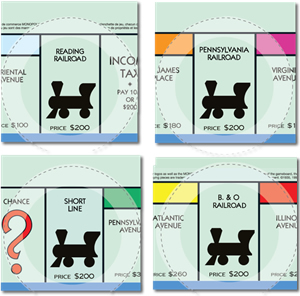
These babies are copyrighted.  That train design is distinctive.  It might also be trademarked, but it's definitely subject to copyright as a part of the Monopoly game board, which is technically a piece of art.


Video games go a long way to illustrate this point.  Because video games comprise a whole lot of art.  And that art is all subject to copyright.  The sound is also subject to copyright.  Even their code is an arrangement that's covered.  Video games sound pretty damn subject to copyright, huh?  Nope.  Underneath all those graphics, sound, and code, there's an underlying system of game mechanics.  Covered by copyright?  I don't think so.

Where does that leave tabletop RPGs?  Well, I won't have a definitive answer to that question for awhile.  We are going to do a lot of investigating.  But, I have a theory about where I'm going to end up.  Right now, at the very outset, I predict that the rules elements of a tabletop RPG aren't subject to copyright.  But, most of the expression elements within an RPG ARE subject to copyright.  This raises all sorts of fun and interesting questions about things like the Open Game License and the Pathfinder license and we are going to look into them!  But, at the end of the day, I'm betting that if you were to print your own book with your own art that covered the rules to ANY tabletop RPG that you'd be able to get off scott free (provided you could pay the court costs Wizards of the Coast, Paizo, or any other game publisher threw at you).
Paizo makes any third-party publisher using their rules system follow rules and stick this little number on their product.  That may be as much boon (it's compatible!) as bane (we have to follow a stinking license!).  But, is it required?
The license that started a new roleplaying game...


Why do we have Copyright?

A lot of people mistakenly believe that the purpose of copyright law is to allow people to control access to their own creations.  This is halfway correct.  But, remember that a copyright exists for a limited time only (though we will explore a dissent by Justice Stevens that questions whether today's copyrights are functionally unlimited).  Here's a dirty little secret: the real purpose for copyright law is to get these ideas into the public domain.  The U.S. Constitution grants the Congress the power, "To promote the progress of science and useful arts, by securing for limited times to authors and inventors the exclusive right to their respective writings and discoveries." (U.S. Constitution, Art. I, § 8).  Public domain works are those whose copyright has expired.  Guess who owns them?  No one does.

Find a work with an expired copyright and you can print and sell all the copies you want for whatever the market will bear.  Of course, so can anyone else, so there's not a huge value in doing so.  That's the whole point.  We want these ideas to get out into general, unprotected circulation.  But, if we don't give authors some control and protection over their creations, they wouldn't make much art for us, would they?  If anyone could take the idea as soon as it was committed to paper, we wouldn't have many people putting ideas to paper.

In economics, this is called a positive externality, meaning that the practice creates benefits but that the creator is unable to internalize those benefits, a.k.a. make money off of them.  (Since I go to a school steeped in the law and economics movement the way that the British East India Company was steeped in tea, you are going to have to read a bit of that too).  Compare that to a negative externality, which is when an activity creates negative effects that don't rebound wholly on the actor.  Pollution is the classic negative externality.  And externalities are BAD.  We want them to go away.  We want people to produce beautiful and useful things like art, literature, and scientific inventions to advance society.  How do we get them to do so?  We bribe them.  We bribe them with the most destructive economic force of all: a monopoly.  Copyright or patent something and you've got a monopoly off of it for decades.

Copyright as Light

Fun fact: Light is both a particle and a wave.  It's analog and digital.  I find it helpful to view legal concepts this way.  It's easiest to view them in a continuum.  There are some things that we're pretty sure are subject to copyright and nobody is going to mess with them.  There are others that pretty obviously aren't subject to copyright, like the phonebook (though, again, phonebooks have been the subject of copyright cases before--and will be important as we discuss what it means to be able to copyright a tabletop RPG or not).  There's a continuum between these two points of things that are less and less obviously subject to copyright and moving towards things that obviously aren't subject to copyright.  Of course, ultimately a court case can decide whether or not something is subject to copyright protection.  But, ex ante, we want to have a good idea about whether or not we think something is.  (Ex ante is fancy lawyer-speak for "before the fact."  I could have just said "before the fact," but what's the fun in that?)

My goal in this explanation is to create a framework that covers what portions of tabletop RPGs are covered by copyright laws ex ante.  To do so, I'll consider various products marketed by tabletop RPG companies.  First and most obviously, the rules systems that underlie the games themselves will be considered.  I believe these occupy the least protected portion of the continuum and are, arguably, already within the common domain.  There are other products like campaign settings marketed by RPG companies.  These products contain fictional places, events, and storylines.  That's starting to sound a lot closer to the kind of expression we want to protect.  Things like tie-in novels are pretty obviously covered.

Finally, there's the product that I find most interesting.  Paizo is the publisher that markets this product in its purest form: the Player's Companion.  A Player's Companion is essentially a 32-page set of rules options and gaming kit that has been adapted to fit into Paizo's Golarion setting.  This is the sweet spot for this investigation.  And, you know what?  It's also the one type of product I'm considering that I'm least sure about its protected status.  Maybe it is and maybe it isn't.
"Each monthly 32-page Pathfinder Player Companion contains several player-focused articles exploring the volume’s theme as well as short articles with innovative new rules for all types of characters, as well as traits to better anchor the player to the campaign. Pathfinder Player Companions are specifically written for players of the Pathfinder RPG."  What do we think?   Uncopyrightable rules or protected expression?

What's Next?

This segment is going to have to explore a lot of ground.  There's going to be an exploration of intellectual property law.  There's going to be an exploration of the theory behind games (not to be confused with game theory, which is much less fun).  There's going to be an exploration of the federal court system, because today it's entirely possible that whether or not an RPG can be copyrighted depends on where you live in America.  (For those of you that live outside of America, shoot me some comments.  I know just enough copyright law to be dangerous and next to nothing about how it gets applied outside of the States).


My next post on this topic is going to review and provide my thoughts on a law review article called Games and Other Uncopyrightable Systems (I'll bet you can guess where I land on this debate).  I picked this article for several reasons.  The author, Bruce Boyden, did his undergrad at the University of Arkansas, which is the flagship university of my home state's public education system.  He also published his piece in the George Mason University Law Review, which is where I go to school.  GMU has a well-recognized intellectual property law program.  Finally (and most importantly for you, dear reader), the GMU Law Review posts its back issues online for free, so it's publicly accessible.  Boyden's piece is focused more on tabletop games, but not on the RPG genre.  It provides a good jumping off point for us on the basics of copyright law and how games fit into it.

What do you think about Invoking IP?  Interesting topic?  Snoozefest?  Glorious or poverty?  This inquiring mind wants to know, so write a comment below!

Monday, September 8, 2014

GenCon Recap: Saturday, August 16

My GenCon Saturday started with sleeping in!  Unlike the previous two days, I didn't have anywhere to be until 9:00a.m. for Kobold Press' seminar about trying to be a freelancer.  I don't really have any desire time to be a freelancer, but I think these types of panels offer good advice on how to make good adventures.  Also, I wanted to support Kobold Press, because they are one of the few established outfits in the industry that takes submissions from people without any publishing credits to their name.  The session was interesting and I took a few nuggets away with me: you'll probably have to give your first piece away but try and start getting paid for your second, know multiple systems because you never know which systems will be in vogue over time, and whenever you do get rejected always ask for feedback on how you can improve your work for future publication.

I confess: I snuck out of the seminar early.  After meeting the folks running all of Monte Cook's games the night before, I was hoping to catch a Numenera game on a generic ticket.  The Kobold seminar was at the very back of the hotel to the southeast of the convention center.  The Monte Cook Games room was at the very end of the hotel to the northwest of the convention center.  So, I got to walk the entirety of GenCon!  It is a long effing way.  

It was longer when I arrived to find out that had I been one person earlier I could have gotten a seat at the table with my generic ticket.  Poverty.  My friend from the bar the night before did manage to get a generic ticket slot though, so that's good though.  I hadn't been able to sign up for a Numenera event in pre-registration.  I was shocked at how quickly these games filled up.  I think that less well-known games are harder to get tickets to because it's a lot easier to find a game of Pathfinder or D&D when you aren't at a Con.

So, it was time to make the long walk back to the Convention Center proper.  With a hole in my schedule, I decided it was time to do something unplanned.  On a whim, I walked into the Dungeons & Dragons room.  I'm inclined to dislike 5th Edition based on the game's management's history, but I figured I could at least check it out.  All their events are set up in a castle and so I stepped inside.

Much of the castle is dedicated to people actually playing D&D, which is nice to see.  They have a tiny retail section in the castle as well and I'm hoping to browse through the new Player's Handbook and edition launching adventure, Tyranny of Dragons.  It's a two-part adevnture set in the Forgotten Realms, a setting that I really liked back in my 2nd Edition days.  The first one is called Hoard of the Dragon Queen.

I come up to the retail area.  It's basically a check out line without any browsing space.  I ask if I can take a look at the game or if I have to get in line to purchase.  The guy behind the counter tells me I have to get in line.  This sales tactic is probably coercively effective on customers that feel less license to be a dick than I do.  I get in line and start browsing the book.  I'm going to have time for either the Player's Handbook or the adventure--and I go with the adventure.  The artwork is top notch and the plot looks good from my five minute overview.  

Unfortunately, I have to put it back once I'm at the front of the line.  I'm a no go on purchasing--this was pretty much a classic customer service fail.  Don't make me stand in the checkout line to browse your product.  I am considering purchasing a book, which a lot of people put a lot of time into writing.  I am not purchasing this, this, or this.

So, back to the Exhibit Hall.  I finally make it through this time.  I also make my first impulse buy of the Con: a copy of Iron & Ale.  You can read my review of it here.  

After finishing my rounds at the Exhibit Hall, I'm walking past a board game company's booth just as an announcer is calling for a single player to jump into a game being demoed.  It's called Hyperborea. It promises an opportunity to, "Embark on an epic quest to build your mythical nation into the greatest empire known to mankind. Capture land, defeat monsters, and discover new technologies on the rise to greatness."

Everyone plays a different army attempting to be the first to capture the most gems.  There are army movements, special resource cards, and a lot of divisions by three going on.   If 13th Age is like Pathfinder with 1/3 of the rules, then Hyperborea is like Settlers of Catan with 3 times the rules.  Seriously, if you like highly complex board games with tricky rules interactions, Hyperborea is for you.

I didn't mind playing it, but didn't love it either.  The woman who explained the game was top notch and the family that I was playing with were big time board gamers.  Super nice too!  Apparently, he worked at TSR back when it was TSR, because they were talking about meeting up with Margaret Weiss and had the father seen Tracy?  Mom from the family ultimately won the game.  It was competitive too--this is not a family that minds going head to head.  It infected me a little bit too, I had to remind myself that these people were TOTAL strangers.

Finally, it's time to play The Strange!  Unfortunately, the girl from the night before that I thought would be my GM actually had the session starting two hours previous.  Well, maybe not unfortunately because our GM was actually awesome!  We had a great party.  I also got to meet my first Gaymer (and he was hot!) at the session.  I was feeling a little shy though so I didn't ask for a ribbon from him.  Wish I had.

The Strange takes place in modern day Earth, but with so much more going on.  Have you heard of dark energy?  Well, Monte Cook and Bruce Cordell have.  And they've decided that it's actually a connection to something called the Strange, which is essentially this network that connects our universe to all sorts of other alternate realities.  Some of these realities have alternate physics.  For instance, another reality, Aredyn, functions a lot like a traditional fantasy game.  There's another alternate reality, Ruk, that has a strong super-science cyberpunk feel.  Oh, and there's the Strange itself, which is also home to planetovores.  In fact, Ardeyn is actually a creation by the Earthling (Terran?) that first discovered the Strange.  He created it as a sort of decoy to throw any planetovores off the trail of the real Earth.  There are other worlds, or recursions, as well.  All in all, this is a really interesting setting.

The system isn't that different though--the Strange RPG is based on the same cypher system that runs Numenera.  One day I'll write a more in depth post talking about what I find interesting about the system, but here are a few interesting details.  
  1. Players do all the dice rolling - Players have rolls to make for any skill check and have target numbers to hit to either hit an enemy in combat or to dodge an attack from an enemy.  This frees up the GM to focus on the story--and it shows in how much more immersive the story can be when the GM doesn't have to fiddle with rolling her own dice.
  2. XP has value - You can use XP to level up, but I wouldn't recommend it.  XP has so many other uses.  Most importantly, XP is used to reroll whenever you feel like it.  You also don't get XP for defeating monsters.  Rather, you get XP for advancing the story's plot.  When the GM wants to screw with you (known as a GM intrusion), she offers you 2 XP.  You take one and give the other XP to another player at the table.  If you don't want the terrible thing to happen, you can pay one XP to the GM to avoid it, though this is frowned upon.
  3. Your strength is also your hit points - Players have three stats in the cypher system: might, intellect, and reflex.  You do extraordinary things by adding effort to your rolls, but adding effort also takes from your character's might, reflex, or intellect.  So, applying effort on a might-based skill actually means that your character will be giving up hit points to perform an action.  It's an interesting mechanic that really makes a player think about how doing something will affect your character's survival.
Usual rules apply: no details on the adventure.  I will say that I got the chance to be a particle physics grad student by day and a go go boy by night.  I also got an opportunity to pretend to be an interpretive dancer when infiltrating a cult.  I went a little far on this one and ended up being "that guy" at the table.  To my fellow players, I apologize.  To Austin, thank you for cluing me in that I needed to rein it in a little.  I'm glad that you got to be the hero on this one in the end!  (Did I mention that we saved the world?)

Also, did I mention that the cosplay at GenCon is amazing?  I have now decided that it's imperative that I create a cosplay vs. drag queens YouTube! compilation.  I'm only shocked that someone else hasn't beaten me to this particular punch.
Cosplay v. Drag Queens is going to be a thing!

It's also time for dinner.  I wander over to the food trucks and also get an opportunity to see the greatest board game of all time: The Cones of Dunshire.  Yes, that game.  Mayfair Games is holding a charity running of the game.  I wasn't willing to pay the $100/head to get in on the game itself, taking pictures for free (well, and picking up a t-shirt) had to be enough for me.


Then, it was time to check out the Film Festival.  I wanted to catch a couple of films.  First, there was a showing of the entire season of Walking in Circles.  It started late and I got a great chance to talk to a nice girl who was hiding out in the viewing room from a crowd of raving zombies.  Someone had organized a giant zombie tag game.  But, the game doesn't happen inside any of the event spaces or in the Exhibit Hall and she was getting some much needed rest from her undead tormentors.  Walking in Circles was fun, but not particularly memorable.

What I've really come to the film festival to see is Gaming in Color, a documentary about homosexuality in gaming culture.  As a Gaymer, I'm interested in seeing how we get portrayed.  The two guys who made it (and who organized the Gaymer X Con in San Francisco) are also present to talk about it on a panel afterwards.  I'm holding off on my review of it as well, because it will make for an entire post.  For now, I'm going to say two things.  First, I'm very glad that this documentary got made because it raises some questions that we should all be looking at for how homosexuals (and all minorities) fit into the gaming world.  Second, I was shocked at how offended one part of it made me and a little bit angry about it.  But more on that later.

Finally, the documentary and the panel are over.  It's almost midnight and I'm a tired puppy.  I hail a cab back to my apartment and fall asleep reading a 13th Age adventure module I picked up the day before.  My Sunday schedule is light and the PFS games start at 9:00 instead of 8:00.  Maybe I'll pick up one with some generic tickets in the morning?