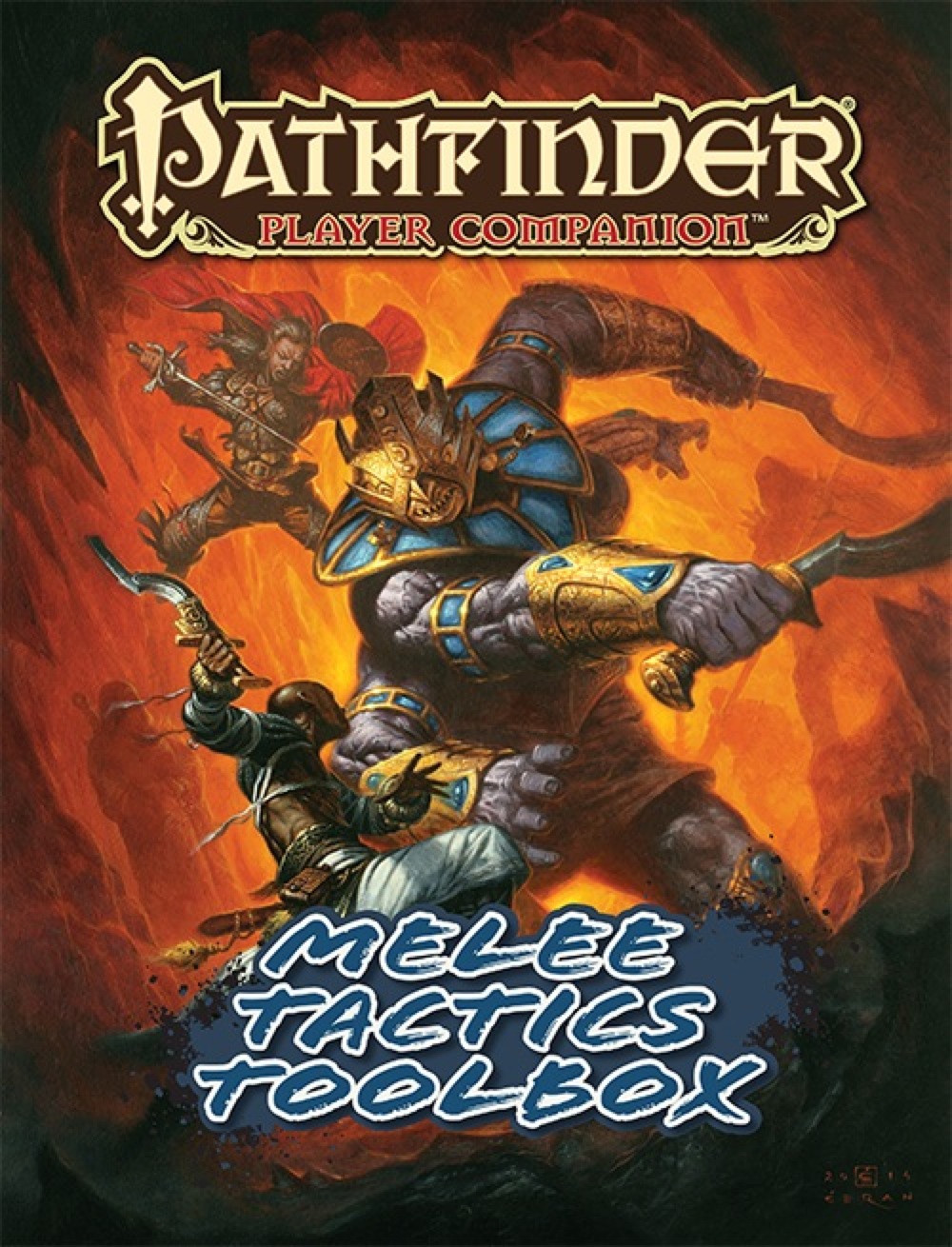
Let's start with the obvious: there's a
calikang on the cover of this module. I've loved this monster since I first saw
it in the Inner Sea World Guide, so I'm always happy to see it getting
some press. Sajan and Jirelle look like they will get the best of it. It's
interesting that Sajan is holding a weapon. One of the book's later sections
goes to great pains to remind us that unarmed combat is melee combat as well,
so I would have liked to have seen him fighting unarmed. Calikangs don't have
any damage resistance, so a good flurry of blows (unchained or core) would be a
great attack on one of these beasts.
But that's imputing game design on art.
Art's job is too look cool. And while I think it might have been fun to have
Sajan flurrying away on the calikang, he and Jirelle (who I hope has some sneak
attack damage coming, swashbuckler or no) look like the bad asses they are
taking on this hulk. In fact, much of the book's art is really good. It's not
an action scene, but page sixteen illustrates all the various swords that exist in the game. It's very cool and helpful--the best quality in a gaming aide.
Page 27 also has a good picture of Lini holding what appears to be a spell
siphoning sickle and ready to make trouble for anybody messing with her.
Cover to Cover
Art is done! On to content! Let's start
with the inside covers, which come out as a wash. On the front inside cover are
short single paragraph descriptions of fighting schools in Brevoy, Lastwall,
Katapesh, and Absalom. The art attached is map-related and non-specific. With
the exception of the Tempering Hall, a warrior training academy on the Isle of Kortos specializing in
training Iomedean Paladins but accepting all righteous warriors, all of these
are better detailed on pages 18-27 of Inner Sea Combat. I don't object to
rehashing old content, but doing so ought to involve fleshing it out rather
than abbreviating it.
Fortunately, the back inside cover more
than makes up for its partner's failing. The back cover has a "Combat
Options Overview." And it's
awesome. It's not the coolest thing in this book, but it is the page that will
be most useful to the largest number of people. Okay, Boyd, so you like it.
What's in it? First, they list
just about every melee combat action a character can take, including ones from
the hardback line like the Advanced Player's Guide. Each action is followed by a column for
"type" and for "action." Type explains if the action is basic (anyone can do it), a
combat maneuver, or if it requires a feat. Next, the opposite column gives the
types of actions: attack, free, melee, standard, full-round, and swift. This is
awesome! Seriously, if Paizo wanted to make this page a single page PDF and
sell it for something like $0.99, they could!
To the Meat!
The book is designed to cover melee
combat writ large, but it specifically calls out Bloodragers, Cavaliers,
Fighters, and Rogues as the classes that will get the most out of the book.
That said, there's something for everyone. There's an archetype for each called out class, but
here are also 16 combat feats, 4 general fights, 2 new fighting styles with
three feats each, and 4 teamwork feats.
There's also an explanation of feats on page 5 that details every type
of feat and what that feat category means. Super useful for the novice to
intermediate player. There are also new weapon and armor special abilities;
bardic masterpieces; magic armors, weapons, and items; mundane equipment; and
(gasp!) even a couple pages of spells.
Different Types of Melee Combat
Early on, the book reminds us that
"there’s much more to melee combat than weapon choice. Armor-wearing
combatants must balance protection and mobility. A high Strength score is
crucial to many melee attack builds, but it’s also possible to build an
effective melee combatant by focusing on Dexterity." This introductory advice is followed by
two page spreads on up close armed combat, defensive melee fighting, mass
combat, unarmed combat, and stuff useful for unexpected combat situations.
Let's take a brief look at each:
Close quarters fighting: this section, like the others,
begins with basic advice for this type of fighting. It would be interesting to
go and compare this advice with the advice for new players in the Strategy
Guide. I'm guessing some overlap, but there's much more here! There are three
interesting feats here, one of which I'd consider for my PFS fighter.
·
Artful Dodge (Combat) gives an extra +1 dodge
bonus to AC when the feat-holder is the only person threatening an enemy.
Unlike Dodge, which requires Dex 13, Artful Dodge is keyed to Int 13 as a
prerequisite. Additionally, it doubles as Dodge for fulfilling the prerequisite
of any other feat.
·
Press to the Wall (Combat) allows you to count
objects like trees and walls as allies for the purposes of flanking. It only
works when the feat-holder is the only person threatening the enemy and
requires both Step Up and BAB +3, but it's still a solid feat for a PC to take.
·
Steadfast Slayer (Combat) provides that when the
feat-holder using a two-handed weapon and is the only person threatening and
opponent larger than them, the feat-holder gains a +2 bonus on melee damage.
·
Other feats in this section: Circling Mongoose(Combat), Heroic Leader (Combat), Mirror Move (Combat), and Redirect Attack(Combat).
Defensive Combat: more feats and an archetype!
·
Armored Athlete (combat) is for those fighters
who are tired of failing armor checks or those rogues that want just a teensy
bit better armor. Choose a single Str- or Dex-based skill in which you've got
at least three ranks. You reduce your armor penalty for using that skill by 3.
If you've got 10 or more ranks, the penalty is reduced by 6. Finally, classes
with armor training 2 (aka fighter 7 or higher) can use this with heavy armor
too. Great feat!
·
Just Out of Reach (combat) gives characters a +4
dodge bonus to AC when attacked by someone more than 5 feat away using reach.
Unclear if this applies only to reach weapons or if it also applies to
creatures with a natural reach, like large and larger creatures. Downside is
that the feat requires both Dodge and Mobility as prerequisites.
·
Other feat: Leaping Evasion
·
Castellan (Cavalier archetype): Castellans
manage castles, though this is more of a generic urban defender class. You get
some sweet bonuses when defending or fighting in urban areas. All in all, it's
a useful archetype. But, it breaks the archetype theme and goes back to the
generic cavalier theme with its "Guard Companion" animal companion
granted at level 4 (companion functions as Druid level -4)
Mass Melee: This section provides support for when all
Hell breaks loose. There's going to be at least one if these fights in every
campaign (and likely in every PFS scenario), so read up on the very useful
general tactics before considering the feats, the bardic masterpiece, and the
drill sergeant fighter archetype.
·
Feats included: Got Your Back (Combat,Teamwork), Harrying Partners (Combat, Teamwork), Open Up (Combat, Teamwork),
Phalanx Formation (Combat), and Stick Together (Combat, Teamwork)
·
Bardic Masterpiece "Battle Song of thePeople's Revolt" is flavored to be like the drum and woodwind military
songs of the American Revolution, though it's Andoran here. With 4 ranks in
Perform (percussion) or (wind) he bard trades in a feat or spell known to pick
up this masterpiece which uses a single bardic performance round per round,
costs only a standard action to initiate, and is subject to Lingering
Performance. When the masterpiece is chosen, the bard selects a single Teamwork
feat. Whenever the bard uses the masterpiece after that, all allies within 30
feet who are affected can that Teamwork feat. Finally, Paizo, you have found a
way to make Teamwork feats useful for one more class!
·
Drill Sergeant (Fighter archetype) is an Advanced
Class Guide-type class that mixes the fighter with the cavalier. I like it
too. The drill sergeant loses bravery in exchange for getting the cavalier
tactician class feature. Weapon training does happen, but only for one group
(still advances though), he picks up the greater tactician feature at 9th level
and at 13th level, all allies within 30 feet using weapons from the same weapon
group get half the drill sergeant's weapon training bonus. Finally, at 17th
level, the drill sergeant picks up the master tactician class feature.
Unarmed Combat: gives tactical advice for both those that
choose to fight unarmed and those who lose a weapon. If you've thought your way
through these issues, questionable how much you'll learn in this section. If
you haven't, this is worth a read. This section also gives us two fighting
styles with three feats each and a bloodrager archetype:
·
Cudgeler [sp] Style: focuses on dealing
non-lethal damage. I like this feat, especially for those rare games where
there are real consequences for killing guards and the like.
·
Kraken style: grappling style with emphasis on
crushing an opponent.
Seriously causes harm to people once you've grappled them. A Kraken
Style brawler would be a terror to fight against...so let's make one to fight
some PCs. By seventh level, a monk with this entire feat tree can deal 1d6+Str
bonus + Wis bonus + 4 per turn just for maintaining a grapple. That's likely at
least 10 damage and on average closer to 13.
·
Bloody-Knuckled Rowdy (Bloodrager archetype):
loses DR, gets one fewer spell known at each level, and loses fast movement in
exchange for Improved Unarmed Strike. Trades out uncanny dodge and improved
uncanny dodge for bonus style feat at 2nd level and Combat Style Master(UC) at
5th level. Finally, deals unarmed strike damage as a monk equal to bloodrager
level -2.
Unexpected Fighting: again has some good tactics I'm not
going to spoil. Also 9 more feats and a rogue archetype:
·
Aquatic Spell (Metamagic): Spell functions
normally underwater but casts as one level higher
·
Deadly Grappler (Combat): When you're grappled,
most non-heavy weapons deal damage against one you're grappling with as if one
size larger.
·
Grappled Caster: Gain +4 on concentration checks
when grappled. Stacks with Combat Casting.
·
One Eye Open: DCs for your Perception checks
don't increase just because you are asleep. Never be surprised even if you fall
asleep on watch ever again!
·
Reactive Arcane Shield: immediate action to
activate Arcane Shield now occurs before attack roll against you is resolved.
All adjacent allies also gain shield's deflection bonus to AC for one round.
·
Other feats: Aquatic Combatant (Combat),
Explosive Escape (Combat), Juke (Combat), Shrug On (Combat)
·
Makeshift Scrapper (Rogue archetype):
interesting archetype built off idea of getting Catch Off-Guard and Throw
Anything as bonus feats. Could be fun to mix with monk in multiclass.
Gear here!
I am gonna give one example of the good,
break down the math and the tactics advice in this book. From page 18,
introducing new melee weapons, "A wide threat range results in more
frequent critical hits, which is especially useful when facing multiple weaker
opponents or if you have critical feats or abilities that trigger on critical
hits. A high multiplier is better when facing fewer, more powerful opponents,
as the additional damage is more effective against damage reduction and useful
for abilities that trigger when you drop a foe, such as Cleaving Finish
(UC)."
New weapons including the machete and the manople. I wish I'd had
the machete, which grants a +1 on Survival checks to get along in the wild in
addition to damage, when I ran Souls for Smuggler's Shiv. My players would have found one early
on. The manople basically let's you be Wolverine and it's only a matter of time
before someone makes a retractable set as a magic item. The book also places
them in fighter weapon training groups.
Next come some interesting, thoughnon-magical, items. First is the acrobat's pillar (50gp, 40 lbs.). The pillar
is basically a tall pole with waving wooden arms that you try and dodge for
practice. It's standard kit in the doorway to a room full of training ninjas
trope and no heroes headquarters is complete without it. Mechanically, if you
practice against its waving arms for an hour and succeed on a DC 20 Acrobatics
check, you get a 24-hour +2 bonus to Acrobatics checks for avoiding attacks of
opportunity for moving into & out of opponents' threatened squares. That's
quite a bonus! Don't forget the waster (1 gp, weight varies), an extra-heavy
training weapon that gives characters that successfully train with it a bonus
to CMD.
Next up we have the exemplar weapon salve (350 gp, 1 lb.). Turns
a normal weapon into a masterwork weapon. This is some cool treasure to give
out at low instead of the ever-expected masterwork weapons used by hostile
NPCs.
The melee contingency kit (150 gp, 14
lbs.) has a little of everything you might. We'd to take on a monster with type
of DR. There's cold iron, silver, acid, alchemists fire, and holy water in
there. Other items include: armor truss, bounty hunter's kit (common &
superior), handle harness, quickcatch manacles, a rockshard canister, shield
bosses (reinforcing, breakaway, hooked, illuminating, and masterwork), sunder
block, and surefoot training blocks.
Man the Battlements!
Of course, a lot of melee combat is
defense and that's why we get new magic armor qualities and new magic
armors! Let's start with the armor
qualities:
·
Channeling: keyed to positive or negative
energy. Wearer reduces damage from other type of energy channeled by 10. If the
wearer can channel the type or energy paired to the armor, three times per day
can increase dice rolled on a channel by 1. (Cost: +18,000 gp)
·
Evolving: Before I even write this,
there's a big ole X on this entry on my notes copy. And now I see why, it's
related to summoner eidolons. Basically, once per day on command, armor fuses
into wearer and for 30 minutes grants some eidolon evolutions. Summonses are
the devil so no. (Cost: +1)
·
Frosted: I like the flavor here. Too
often we focus on mechanics to flavor's detriment. These armors are coated in
thin layer of frost and shimmer faintly with bluish-white hue. Gives +4 bonus
to CMD and inflicts 1d8 cold damage to hose who constrict, pin, or swallow the
wearer. (Cost: +2)
·
Singing: shield only allows to sing for
up to 10 rounds once a day to function like bard's countersong ability.
I'm pretty meh on this one. (Cost: +1)
·
Volcanic: Always save the best for last.
Heavy armor only and gives off soft red glow. Once per day wearer can make it
erupt, with liquid Fire (1d6 damage) and smoke (concealment) affecting all
adjacent squares. One round later, all 9 squares turn to difficult terrain. My
dwarven foe hammer needs this in PFS. (Cost: +2--that's a steal!)
This review is getting long, so here
are a few notes on magic armors. Armor of the Sands has cool flavor and
good abilities--especially for a rogue that might end up in melee combat. The elephantshield is a shield fighter's dream. The gelugon armor adds an
attack. (What's a gelugon? I need to look that one up!). All barbarians lust
after the Mammoth hide and the wizard's mail is the magic armor
that finally broke the game. Our only salvation is that people who love to optimize caster's are unlikely to look in a book about melee fighters. Hidden in plain sight!
You wanna fight me with that?
Weapon special abilities:
·
Culling: only on melee slashing weapons.
Deals +2d6 damage on initial Cleave attack as well as any extras that you get.
(Cost: +2)
·
Growing: once per day, item functions as
if one size larger but without penalties for using larger sized item. (Cost:
+1)
·
Shrinking: with command word shrinks to
size of small dagger so can be more easily snuck around. (Cost: +1,000 gp)
·
Smashing: does extra 2d6 damage to
inanimate objects, includes sundering. (Cost: +1 bonus)
·
Spell Siphon: steals one or more buffs
from its targets if forego a critical hit. (Cost: +5 bonus)
·
Sticky: forego critical to make bonus
steal combat maneuver to take opponent's weapon. (Cost: +1 bonus)
What about specific magic weapons? The Akitonian blade gives some cool low-gravity-style movement and Acrobatics bonuses.
The riddling khopesh? Why that thing is just asking to be made into an
intelligent weapon...
Wondrous Items and Spells
The amulet of quaking strikes
allows the wearer to make a strike against the ground and do damage to everyone
within a 20' radius. I like this, but a little similar to the foehammer's 13th
level ability to me. The Arms of the Marilith look so much fun for a player,
but like a GM looking for game balance's nightmare. The crown of challenge
undermines the inquisitor's main class feature. The eyes of the liar, coming
in at only 16K gold, grant a +5 to Bluff checks and immunity to detect thoughts. Standard evil villain gear from here on out. The vestments of war are cool for buffing channeling and fervor abilities.
As usual for Player's Companions,
they've released some spells with awesome flavor. What’s unusual for a Player’s Companion is that lots of the spells
have general application. Player’s
Companions often have some really cool spells that would be totally awesome in
one single corner case. But,
absent that, it’s not really that great. That problem is not present here. Upon reflection, these spells are all really great to be
placed on scrolls—that way the PCs can decide to use them or learn them. There are also a surprising number of druid
spells on this list. If you’re
running a melee druid, fiery runes
and vine strike should be given
serious consideration.
I thought I’d try explaining it in table form:
Spell
|
General
Applicability?
|
Flavor
|
Crunch
|
Notes
|
Maybe
|
Meh…generic
“ward”
keeps items in character’s possession.
|
DC of
Sleight of Hand checks to remove items warded is increased by 20 and affected
creatures gain +20 bonus to CMDs against disarm and steal combat maneuvers.
|
This is an
example of a spell with weak flavor.
The items are just warded.
Granted it could be useful if you knew the party would be facing an
enemy with tactics that involve stealing weapons, but you’ve
got to know that to make it work.
|
|
Yes
|
An
insubstantial spirit of force that resembles a cloudy vapor hovering around
your fists or any melee weapons you hold appears.
|
When you
use an attack/feat that normally applies penalties to your attack roll (fight
defensively, Power Attack, etc.), this spell reduces the penalty by 1 for
every five caster levels.
|
This is an
awesome spell, especially for a buffing caster (note that it didn’t
make it onto the bard or cleric lists).
If you’re supporting the party tank, what better role than to let
her use her explosive options without incurring any of the normal penalties?
|
|
Yes
|
An illusory
duplicate of you steps clumsily into an adjacent space, presenting a tempting
target before winking out of existence.
|
Any
creature threatening the moving illusory double must make a Will save or use
an attack of opportunity on it.
|
This is
also a good spell of general applicability. It’s more of a corner case than blade tutor’s
spirit or fiery runes, but it’s
still a pretty useful option especially if you have another character that
needs to move around the battlefield to do some raising from the dead or
positioning themselves for a sneak attack/flank.
|
|
Yes
|
You turn
one of your weapons into a two-dimensional object of length and height only.
|
You can
still wield the weapon just fine at it now ignores all armor except for force
effects. Bludgeoning items do
only half damage and are treated as slashing (weird mental image of a bad
paper cut there).
|
In general,
I like this spell. It’s
low enough level that it might actually be useful too. I’m currently building an Aberrant
bloodline sorcerer for PFS. He
fights with a longspear so that no one can hit him and this would be a fun
little spell for him to try out.
|
|
Yes
|
The weapon
is imbued with a magical rune of fire.
|
When the
weapon hits something, the rune activates, doing 1d4+1 fire damage to the
target for every two caster levels beyond third.
|
You’ve
got to touch the melee weapon to place the rune on it, but the rune is good
for 1 minute/level. This should
give buffing casters the option to cast early in combat or safely from behind
a front-line caster. Curiously,
this spell isn’t on the magus list—that’s exactly the class I’d
expect to benefit most from using this spell.
|
|
Maybe
|
Creates a
melee weapon of your choice made of opaque force.
|
Acts like a
masterwork weapon for 1 minute/level.
|
This is
another corner case. Again, if
the PCs know that they might get disarmed, this is great. If not, why use a spell slot to
memorize it.
|
|
Maybe
|
Target
weapon becomes a reservoir of evil spiritual energy drawn from those it
defeats.
|
When the
targeted weapon is used to reduce a living creature to 0 or fewer hit points,
it gains a +1 profane bonus on damage rolls which increases by +1 for every
subsequent creature downed.
|
The spell
only lasts 1 round/level. That’s
not a lot of time to down a lot of creatures. This spell would be better as a step up from magic weapon, where it would
automatically grant the first +1 bonus and then add as it goes. This would be a cool persistent
effect to place on a magic weapon utilized by a final villain.
|
|
Yes
|
Your skin
becomes more elastic, distributing crushing damage more efficiently.
|
All
bludgeoning and falling damage taken is converted into nonlethal damage.
|
It’s
a pretty good chance that the characters will be facing opponents dealing
bludgeoning damage. This is a
good defensive spell. At levels
4 and 5, it’s a little inaccessible. I’d probably bring it down to level 3.
|
|
Yes
|
A shadowy
afterimage trails behind a targeted weapon, potentially damaging foes even
when the weapon itself misses.
|
Once per
round, when the weapon misses a creature with the target weapon, the wielder
can reroll the attack. If the
reroll hits, the afterimage hits for 1d8 cold damage + 1 per two caster
levels.
|
This spell
is dripping with flavor and its actually useful. If your PCs decide that they need to invade Nidal for some
reason—maybe
they are going to visit the tomb of that Horselord from Tombs of Golarion—Kuthite fighters should be bolstered
by this spell.
|
|
Yes
|
Bristles
burst from your body, lodging in your opponent and blossoming into entangling
vines.
|
Your
natural attacks and unarmed attacks deal an
additional 1d6 points of damage and any creature hit by them must succeed
at a Reflex save or be entangled for the duration of the spell.
|
A
druid/monk multiclass character would be cool thematically and could do some
serious damage with this spell.
The save DC is going to be 12 plus Wisdom and other feat
modifications. The spell is
subject to spell resistance though (how to apply? Does it not do either the damage or just not the
entangling?)
|
So that’s it. I’ve
walked all through the Melee Tactics
Toolbox. And, I have to say, I
like the product a lot more after doing the review than I did after I read it
but before writing the review.
Beforehand, I felt let down that Paizo hadn’t followed up with
something to match the Ranged Tactics
Toolbox. Now, I don’t
feel like they’ve surpassed the book’s ranged sister, but they’ve
at least put up some decent material on the board. There are some interesting feats in here and—I
cannot say this enough—the combat action chart on the back inside cover is
everything.
4/5 stars. Buy this book.

