Tuesday, March 31, 2015
PCs do unexpected things
In honor off all the PCs out there who have made some weird decisions and used items, abilities, or spells in exciting and unexpected ways, try this.

Invoking IP: TSR v. Mayfair Games
Last week I was reading ENWorld’s TSR,
WotC, & Paizo: A Comparative History. If you haven’t taken a look at it before, I
suggest that you slip over there. They’ve
got four columns of information that really encompass the growth of the RPG
industry, specifically the fantasy RPG industry covered by (A)D&D and
Pathfinder. But, as I was reading
through it, there was an entry for a 1993 judicial opinion in TSR
v. Mayfair Games.[1]
I got very excited!
Maybe there was some case law related to copyright and games. Alas, there’s not. But, there is some interesting stuff related
to trademark and to contract law (which I will skip over so as to not bore
you). There’s also some interesting
language related to how trademark protection might be lost. We need a little bit of background here. TSR was always worried that Dungeons &
Dragons would lose its protected trademark status. This can happen when a brand name becomes
synonymous with the product itself.
Xerox and Kleenex are good examples of this. In reality, the product is a photocopier or a
tissue, but people often use the brand name more often than the actual product
name. And, when that happens, your
trademark can really weaken. Popular
media often refers to RPGs in general as Dungeons & Dragons despite the
specific game being played. So, TSR was
always extra vigilant to ensure that this didn’t happen with its trademarks.
So, how was Mayfair Games abusing TSR’s trademark? They were producing some products, City
State of the Invincible Overlord and Role Aids, that were
designed to be compatible with AD&D.
To indicate this, Mayfair Games went ahead and threw the AD&D logo
on its packaging. This was probably fair
use of a trademark (more on that later), but TSR started to get litigious and
so the two signed a contract governing how Mayfair Games could use TSR’s
trademark. In addition to making it
clear that Role Aids were not produced by TSR or endorsed by them, Mayfair
Games could also only state that Role Aids were compatible with AD&D rather
than with RPGs in general.
Mayfair had some minor trademark infringement violations and
the judge called them out on it. In a
lot of cases TSR took awhile to respond to these issues. The law hates delay (in anything except a
court case itself, where it’s par for the course) and the common law has
invented this nifty concept called laches to deal with it. Laches apply when someone knew they had a
legal claim but just sat on it instead of telling the person harming them to
stop perpetuating the harm. Mayfair
Games did a lot of advertising in TSR’s
own magazines and tried to apply laches stating that TSR knew about any
violations and had waived them by approving the ads. The judge wasn’t having this on a summary
judgment motion, but it could have gone wildly differently if it were argued in
open court. But, the court did not apply
laches.
As so often happens, the two parties decided that they’d
really split hairs. Mayfair advertised
its products as having “numerous locations that can be worked into any fantasy
campaign.” (TSR v. Mayfair Games at *9).
TSR claimed that was tantamount to breaking its agreement that Mayfair
would only advertise its games as being compatible with AD&D. It actually broke down to the two of them
fighting over the differences between the definitions of an RPG and a
campaign. TSR eventually did have to
admit that there were multiple campaigns in AD&D.
Legal cases also require the plaintiff to show that whatever
he’s complaining about has directly harmed him/her. In a trademark case, that’s customer
confusion. “Mayfair says that its use of
TSR’s trademarks caused no customer confusion.” (TSR v. Mayfair Games at *7) The
court agreed with Mayfair for the most part, saying “this may indeed by a case
of minimal damage to TSR…TSR will not be heard to say that it has been hurt
when the disclaimer has been adhered to” and “there has been no showing of lost
sales or damage to the value of TSR’s trademarks because of Mayfair’s
violations.” (Id.)
But where things really get interesting is how TSR was
wielding its trademark might actually have destroyed it or lay the groundwork for
destroying it in the future. “[T]he
restriction that TSR incorrectly contends was violated…seems to be purely
anticompetitive and hence likely unenforceable as an unlawful extension of
trademarks.” (TSR v. Mayfair Games at *9).
And, “those anti-competitive measures appear to find no rational support
in TSR’s legitimate goals for protecting the integrity of its own trademarks.” (Id.
at *12). The court buries the most
important part of this statement in a footnote:
If anything, it would seem that
measures that would thus tend to promote AD&D’s
market domination would make it more likely, rather than less likely, that
AD&D might become a generic term among consumers. It is only necessary to recall such examples
as Eastman’s fight to prevent “Kodak” from entering the public domain, or Bayer’s
like fight as to “Aspirin” or GE’s comparable fight as to “Frigidaire.” (TSR v.
Mayfair Games at *12 n.24).
Finally, “[b]ecause of AD&D’s prominence in the marketplace,
any revocation of Mayfair’s permission to refer to AD&D with appropriate
disclaimers could be fair to destroy Role Aids as a competitor for the
marketplace with TSR’s own products.” (Id.)
Here, a lot of what happened was because TSR and Mayfair had
signed a contract governing how Mayfair was and was not allowed to use TSR’s
logo. But, absent that, trademark
principles like fair use would have applied, meaning that most of this suit
would never have happened. Mayfair’s “argument
might have had force in the absence of the Agreement—but once the parties had
entered into the Agreement, such a contention comes too late.” (TSR v. Mayfair Games at *6). What’s the bottom line here? Contracts modify your substantive rights so
be careful when you do so. Contracts
always require you to give something up and if you’re going to do so, make sure
you know exactly what you’re giving up and that you’re willing to accept losing
it for as long as the contract remains in force.
[1] Not
Reported in F.Supp. 1993WL 79272 (N.D. Ill.)
The opinion is the text readout of an educational only opinion from
Westlaw. I’m going to assume the EN
World has their intellectual property shit together, but if not, this could be
a huge licensing violation on the part of whomever gave the copy of the opinion
to EN World.
Friday, March 27, 2015
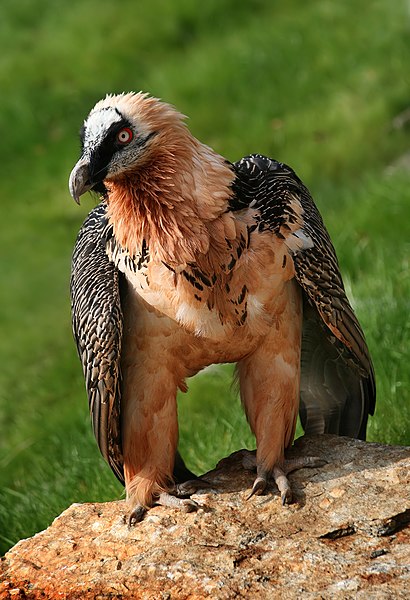
The Terrifying Bearded Vulture, a CR 6 monster
 |
| (C)2007 Richard Bartz. Used with permission under a Creative Commons license. |
This giant buzzard darts from the sky towards a decomposing body, the
maw at the end of its long neck scouring the flesh off of a femur before it devours
the entire bone with a single gulp.
XP 2,400
Neutral Large Magical Beast
Init +5; Senses darkvision 60 ft., low-light vision; Perception +10
Defense
AC 18, touch 8,
flat-footed 18 (+10 natural, -1 dex, -1 size)
hp 72 (8d10+4)
Fort +10, Ref +5, Will +4
DR 5/piercing or slashing
hp 72 (8d10+4)
Fort +10, Ref +5, Will +4
DR 5/piercing or slashing
Offense
Speed 20 ft., fly 60 ft. (average)
Melee bite +13 (1d8+4), 2 claws +12 (1d6+4)
Space 10 ft.; Reach 10 ft.
Special Attacks Bone swallow
Melee bite +13 (1d8+4), 2 claws +12 (1d6+4)
Space 10 ft.; Reach 10 ft.
Special Attacks Bone swallow
Statistics
Str 19, Dex 9, Con 19, Int 6, Wis 14, Cha 10
Base Atk +8; CMB +13; CMD 22
Feats Flyby Attack, Improved Initiative, Skill Focus (Perception), Weapon Focus (bite)
Skills Climb +9, Fly +10 (+4 racial), Perception +10 Racial Modifiers +4 Fly
Languages None
SQ Black and white, Blood bath
Base Atk +8; CMB +13; CMD 22
Feats Flyby Attack, Improved Initiative, Skill Focus (Perception), Weapon Focus (bite)
Skills Climb +9, Fly +10 (+4 racial), Perception +10 Racial Modifiers +4 Fly
Languages None
SQ Black and white, Blood bath
Ecology
Environment Temperate Hills
Organization solitary, nesting pair (1 bearded vulture and 1 young bearded vulture)
Treasure Incidental
Organization solitary, nesting pair (1 bearded vulture and 1 young bearded vulture)
Treasure Incidental
Special Abilities
Black and white (Ex) Naturally black and white, when bearded
vultures lack access to fresh blood to dye their white feathers red, they
instead use dirt to dye their white feathers either yellow or brown. Bearded vultures that cannot partake in a
dirt bath for two days lose their coating, exposing the bright, white feathers. In normal or bright light, bearded vultures
without their dirt coat are dazzled.
Blood bath (Ex) As a full-round, a bearded vulture can
revel in the blood of a helpless enemy subject to the bleed condition or who
has taken piercing or slashing wounds in combat. Bathing in blood grants the bearded vulture a
30 ft. fear aura (DC 17) and changes DR to 5/----.
Bone swallow (Ex) As a standard
action, a bearded vulture can swallow the bone of a size small or smaller
creature whole. Swallowing a bone whole
grants the bearded vulture the grab and swallow whole abilities for an
hour. Swallowed bones must first be
separated from the rest of a carcass, which requires a full round action. After swallowing an enemy whole, a bearded
vulture attempts to return to its nest and kill its victim before feasting on
her bones.
Bearded
vultures are larger versions of their normal-sized cousins, scavengers that
survive on their targets’ bones rather than their meat. With razor-sharp claws and a lightning quick
beak, a bearded vulture can scour the meat and hide from a bone in seconds
before devouring it whole. Their flesh
takes on features of the bones they eat, rendering it tougher than other birds’
meat. Despite their ferocity and rarity,
their tough skin makes them an unpalatable meal at best.
Bearded
vultures attack animals, but their preferred prey are small humanoids and the children
of medium-sized humanoids. A bearded
vulture will take this prey, even alive, and drop it from great heights to
before carrying the carcass back to its mountaintop lair. Bearded vultures naturally attack animated
skeletons on sight. Sages are divided
about whether this reflects animosity against the undead or if animated bones
simply taste more appealing than truly dead ones.
Bearded
vultures are solitary creatures, each one claiming territories of hundreds of
square miles. Outside of their mating
season in early fall, a bearded vulture will fight any other vulture that invades
its territory. Bearded vulture females
lay two eggs, but raise only one hatchling to adulthood. The mother encourages the stronger hatchling
to devour its weaker sibling.
Bearded
vultures’ feathers are naturally black and white, but vultures will stain their
lighter feathers with brown dirt or yellow dirt. When possible, vultures prefer to stain their
feathers red by bathing in the blood of their slain enemies. Bearded vultures are eight feet tall with wingspans up to ten feet. They weigh up to 500 pounds.
RFRA Update: Send your thoughts to GenCon
GenCon has published another letter, this time to its attendees. They are asking out our experiences with the local community as vendors and in general. You can respond to them by using the following:
Email: customerservice@gencon.com
Phone: 800-529-3976 (x3806)
Twitter: @Gen_Con
I'll draft my response and post it as an update to this later. I loved my only GenCon experience and I can't wait to be going back!
Update: The Game Manufacturer's Association has also come out with a statement supporting GenCon's position.
Whole letter:
Unbelievably Simple Roleplaying - Interesting Simple System

USR is contained in a 21-page PDF. That's it. There's a cover and a copyright page at the beginning. At the end, there's an ad. Take that out and there's 18 pages of content. How does it shake out?
- Page 1 - Intro
- Page 2 - What's an RPG
- Pages 3-6 Creating a character
- Page 7 Example of a PC
- Pages 8-11 Rules for playing the game
- Pages 12-13 Example of play
- Pages 14-16 Basic setting suggestions
- Page 17-18 Optional rules
How simple are these mechanics? Someone has made a cheat sheet that has all of the rules on a single page. This is the second edition of the rules.
I'd like to print some excerpts from the rulebook, but the copyright page makes it clear that there's no showing anything from the (free) PDF without the express permission of the author. Part of me thinks that this is part of the common misapprehension in the RPG industry that you can copyright a set of rules, which of course you can't. That said, the expression of the ideas, the way the rules are presented, and the artwork are protected so I'll stay away from using any clips from the book.
There is also an excellent page that explains what a roleplaying game is in a single page. Even if not using USR, this page is incredible for introducing new players to the genre in general. That was one of the goals of the new edition. I did not peruse the previous edition, but I'm blown away. This page also covers the most important rule in all of roleplaying games: no rule is more important than that people have fun. There are other good tips in the book, such as the recommendation that you should build a party of characters with abilities that match each other. The rulebook also suggests that players answer several questions about background pretty early in their character generation process. I personally would bring these to the beginning of the process with a suggestion that players revisit their answers after assigning statistics to make sure the decisions still fit and have informed the character.
The book comes with three pre-designed settings: a spaghetti Western, a space opera, and an urban fantasy setting. Malthouse says that he plans on releasing future settings for the USR system. He's released a few of these on his blog: It Came from VHS, a 1980s pastiche of everything awesome in the vein of Spirit of 77 and Slackers, designed for roleplaying in the world created by Kevin Smith's movies. Hopefully there will be more of these. The fan community (we'll discuss this in some depth later) has also created some settings. There's a traditional fantasy setting and a Cyberpunk setting.
 |
| The creator's website has mini-setting info that can be used for making characters in a some rando-awesome settings! |
What about the rules? There are three ability scores: action, wits, and ego. Action combines the functions of the strength, dexterity, and constitution scores from traditional d20 games. Wits covers intelligence and wisdom. Finally, ego encompasses charisma. Rather than assigning a score to each of them, the player assigns a die to each of them: a d10, d8, and a d6. Instead of a static score, players roll the die assigned to the score when they need to use it in play. Hit points are just called Hits. You roll your action and wits dice to determine your character's hits. There's a suggestion that PCs could actually just take the average die rolls, similarly to the way they do in many other d20 games.
USR has a skills system similar to 13th Age. Characters have three "specialisms." A specialism is basically a skill. The book suggests 42 possibilities from acrobatics to plant lore to leader. When it applies, the character adds 2 to any die rolls made that relate to the specialism. Each skill is tied to an ability score. I'm 50/50 on this. One of the best features I've found in the Archmage system used in 13th Age is that skills don't have to be tied to a particular ability score. That seems like an easy house rule to make--which is one of the things that USR encourages GMs to do. It would be even more interesting in the USR system--instead of changing a small bonus (usually between 0 and +4), you're changing what die is rolled and changing the probabilities.
There are also four combat specialties: hand-to-hand, light weapons, medium weapons, and heavy weapons. These grant a +2 bonus to using them in combat. They're individual specialisms, so taking heavy weapons doesn't necessarily give you skills in using medium or light weapons. In a modern setting, that makes sense to me. In a more classic sword and sorcery setting, it might make sense to give players skills with medium/heavy weapons, ranged weapons, and hand-to-hand weapons.
So how does anything happen in the game? "Attribute tests" are rolled. You decide which attribute applies to anything and roll the corresponding die. Advantages or disadvantages can give a player a +1 or -1, but that's about it for modifying rolls. Contested checks are just rolls against each other and the highest one wins. Uncontested rolls have a difficulty table. Combat functions as a contested action ability roll (with the type of weapon granting a bonus) and with bonuses if you have a specialism in the relevant skill for your weapon. Defenders also make an action roll. If defenders are higher, it's a miss. If attackers roll higher, the difference between the two rolls is the damage. Armor doesn't reduce the chance to hit. Instead it just reduces the amount of damage dealt. (Mechanically, this is the same thing, but it feels different, which is nice).
The book closes out with optional rules for narrative points (similar to hero points) and experience points for character advancement if you're planning on playing a full-on campaign with recurring sessions.
Overall, I really like this system. I have a few friends who have been asking about what Pathfinder is and saying they'd like to try it. I think it's a little too complicated for newer players. USR might be a much better system to try--I'd been leaning 13th Age up until now. At the end of the day, the system is free and the entire rule book is only 21 pages long. Definitely worth checking out.
 |
| USR has an active fan community. |
One of the few things that the rulebook doesn't have are monsters or rules for creating them. This wouldn't be too difficult for creating villains that are based around the character creation rules. But, if you want to add monsters that don't follow the PC generation rules there's no guidance. Fortunately, there's an active fan community on Google+. One user there has uploaded a short bestiary for fantasy settings. You could probably reskin the stats here pretty easily for cyberpunk--though you'd need to change out some of the special abilities. Additionally, haven't found any published adventures--you'll just have to make some of this stuff up yourself!
EDIT: Did I say they were short on monsters? Trollish Delver has a new update for "Halcyon Fantasy" that gives the basics for running a fantasy game. 4 "classes": warrior, mage, thief, and priest. Also 4 races: human, elf, dwarf, and halfling. Some basic abilities and a short bestiary. You could easily plan a starting adventure out of this. (3/31/15)
EDIT: Did I say they were short on monsters? Trollish Delver has a new update for "Halcyon Fantasy" that gives the basics for running a fantasy game. 4 "classes": warrior, mage, thief, and priest. Also 4 races: human, elf, dwarf, and halfling. Some basic abilities and a short bestiary. You could easily plan a starting adventure out of this. (3/31/15)
Thursday, March 26, 2015
Villainous Divinations from the Advanced Player's Guide
So, after doing an earlier post about what divination spells from the Pathfinder Core Rulebook villains could/should be using on your players, I decided it would be fun to follow up with the divination spells from the Advanced Players Guide. This is certainly helped by the fact that there are many fewer divination spells in the APG. As in the last post, spells with obvious uses or that likely won't be useful, like Sift, are omitted. So, without further ado, here are the APG divinations that smart villains will be casting on your players:
First Level
Detect Aberration (druid 1, ranger 1): Use this spell like Detect Undead, as detailed in the previous post.
Residual Tracking (ranger 1): Again, the villain/opposing organization is at the scene of the "crime." Did a PC leave a footprint? Now you've got an idea of who you're looking for. If the villain can also cast scry, there's a significant advantage if he hasn't seen the PCs in real life. If not, the NPC casting residual tracking could make a passable drawing to give a smaller bonus/penalty mitigation with a successful Craft (drawing) check. Finally, this would also be an interesting way to plant a red herring in a mystery/murder-mystery campaign.
Second Level
Blood Biography (bard 2, cleric 3, inquisitor 3, sorcerer/wizard 3): This spell gives the caster the answers to the following four questions:
Third Level
Seek Thoughts (alchemist 3, bard 3, inquisitor 3, sorcerer/wizard 3, summoner 3, witch 3): This spell requires the caster to be within 40 ft. of the target and it offers a will save. So, it's best used by a villain that knows the PCs actions are against his plans but the PCs don't necessarily know who they're up against yet. It could also be useful in a heavy roleplaying game where the villain and the PC do know they are up against each other but the politics of the situation means that the PCs can't out and out attack. Ditto here for situations like a meeting under a flag of truce--what a great way to get an idea of what the PCs are planning to do to an opposing force!
Share Senses (sorcerer/wizard 4, witch 3): Pretty obvious here, but the villain's familiar is a great tool for spying on the PCs, especially if the familiar is something the PCs wouldn't expect. Even if it is, and even if the PCs know they are dealing with the villain's familiar, they might not expect that it could communicate back concepts as complex as the villain could learn through casting Share Senses. One problem--your villain must choose between seeing and hearing. Hearing's most useful once the familiar sites the PCs, but seeing is most useful to figure out where they are. First locate the PCs through another method--even their rough location--and send your familiar to them with hearing enabled--it will take you much further.
Well, folks, that's all there is to it. There aren't a lot of divination spells in the APG. If I'm feeling moved, I'll try this with the other hardbacks. The Advanced Class Guide will likely get a treatment--a cursory glance shows a lot of spells with outside the box applications.
First Level
Detect Aberration (druid 1, ranger 1): Use this spell like Detect Undead, as detailed in the previous post.
Residual Tracking (ranger 1): Again, the villain/opposing organization is at the scene of the "crime." Did a PC leave a footprint? Now you've got an idea of who you're looking for. If the villain can also cast scry, there's a significant advantage if he hasn't seen the PCs in real life. If not, the NPC casting residual tracking could make a passable drawing to give a smaller bonus/penalty mitigation with a successful Craft (drawing) check. Finally, this would also be an interesting way to plant a red herring in a mystery/murder-mystery campaign.
Second Level
Blood Biography (bard 2, cleric 3, inquisitor 3, sorcerer/wizard 3): This spell gives the caster the answers to the following four questions:
- Who are you? (The name by which the creature is most commonly known)
- What are you? (Gender, race, profession/role)
- How was your blood shed? (Brief outline of the events that caused its wound, to the best of the victim's knowledge)
- When was your blood shed?
Plus, the answers appear in blood on the wall. The duration is instantaneous, meaning that they stick around. As a plot device, imagine that the lieutenant fought the PCs, failed, and then was slain by his master. She casts blood biography to leave a grisly message to the PCs/anyone that might cross her in the future.
Create Treasure Map (bard 2, druid 3, ranger 2, sorcerer/wizard 2): Have a villain who's bent on revenge about the PCs? Did that villain manage to kill a close NPC friend or perhaps an animal companion? Create Treasure Map is a great way for that villain to circle back to go up against our valiant heroes. As a GM I'd most likely use this spell to help the PCs "fail forward" in 13th Age parlance. Maybe the PCs miraculously escape or aren't killed when they should be. The villain has left their bodies to be conveniently raised by whatever brings the party back. Why has the villain left the bodies? The go after the PCs' treasure of course!
Eagle Eye (druid 2, ranger 2): I've loved the concept of this spell ever since I first saw it used in Might & Magic 2. The spell creates a sensor ~500 ft. above you and can see in all directions. It can't see through walls, but it can see through foliage. Best damn spell for dealing with a siege--ever.
Follow Aura (inquisitor 2): Track an alignment for at least thirty minutes. If you're a good guys and you know the good guys were here, you've got a much more effective way to track them than even with dogs. (Related monster idea: Magical dogs that use an effect like this and can track good PCs.)
Guiding Star (cleric 3, ranger 2, witch 3): This spell seems like it should have some useful applications, but I can't think of anything right now. Any suggestions?
Third Level
Seek Thoughts (alchemist 3, bard 3, inquisitor 3, sorcerer/wizard 3, summoner 3, witch 3): This spell requires the caster to be within 40 ft. of the target and it offers a will save. So, it's best used by a villain that knows the PCs actions are against his plans but the PCs don't necessarily know who they're up against yet. It could also be useful in a heavy roleplaying game where the villain and the PC do know they are up against each other but the politics of the situation means that the PCs can't out and out attack. Ditto here for situations like a meeting under a flag of truce--what a great way to get an idea of what the PCs are planning to do to an opposing force!
Share Senses (sorcerer/wizard 4, witch 3): Pretty obvious here, but the villain's familiar is a great tool for spying on the PCs, especially if the familiar is something the PCs wouldn't expect. Even if it is, and even if the PCs know they are dealing with the villain's familiar, they might not expect that it could communicate back concepts as complex as the villain could learn through casting Share Senses. One problem--your villain must choose between seeing and hearing. Hearing's most useful once the familiar sites the PCs, but seeing is most useful to figure out where they are. First locate the PCs through another method--even their rough location--and send your familiar to them with hearing enabled--it will take you much further.
Well, folks, that's all there is to it. There aren't a lot of divination spells in the APG. If I'm feeling moved, I'll try this with the other hardbacks. The Advanced Class Guide will likely get a treatment--a cursory glance shows a lot of spells with outside the box applications.
6-10 seconds to decide
Kobold Press' Howling Tower has a suggestion for making games faster and more enjoyable: give players 6-10 seconds to make decisions about what to do in combat. The idea is that you're divorced from feeling like you need to make the "best" choice. Obviously, characters only need to make the basic choice. But, it helps the characters feel more like they are immersed in combat, rather than sitting around a table pretending to be. Howling Tower suggests that, at it's most basic:
That doesn’t mean your turn can’t take more than 10 seconds. It means you should answer the basic question, “what am I going to do this turn?,” in 10 seconds or less. Figuring out specifically how your character performs the chosen action within the allowances and restrictions of the rules can take substantially longer than that, especially if a fancy maneuver, an unusual weapon, or a complex magic spell is involved. But the basic question—”What am I going to do this turn?”—should be made quickly.One other hint:
All the infinite combat options really boil down to just six broad choices: stab something, shoot something, cast a spell, interact with the environment, go on defense, or run away. If you find yourself struggling to make quick decisions, then limit yourself to thinking only in those general terms before considering any details.So, maybe I should try this when I'm running my next table...
Subscribe to:
Posts (Atom)