Tuesday, September 9, 2014

Support Net Neutrality!


Look, I don't have to tell you that the people that own the pipes want to own how the content travels through the pipes.  Things are bad, and the FCC could conceivably make them much, much worse if the current proposal passes.  Visit battleforthenet.com to learn what you can do to ensure that all traffic is treated the same no matter how much you pay to get Internet access.  The Internet is a commodity, the same as electricity and should be treated as such!

Illusions of Intellectual Property: Conjuring Copyright

What is Conjuring Copyright?

So, in addition to being a casual gaymer, one of my other hats is not-so-casual law student.  And, I'm lucky enough to attend an institution that's pretty big into intellectual property law.  Though I'm not planning on practicing it (admin law, baby!), I think that tabletop RPGs occupy a fascinating place in the intellectual property mix.  And, given the large number of freelancers and third-party publishers out there, I think that a lot of other people might be interested in the confluence of tabletop RPGs and copyright law as well.  And, on top of that, I need to write a fairly major law review-style paper sometime in the next 18 months.  There's not a lot out there on copyright law in RPGs, so I think it's a topic worth exploring.  So, I'm going to use this blog to write out some thoughts as I do some research.  In keeping with giving fantasy RPG-ish terms for my columns, I'm going to call this segment Conjuring Copyright.

Disclaimer: I am a law STUDENT.  I am not a LAWYER.  I am licensed to practice law in exactly zero states.  Therefore, I cannot offer anyone legal advice.  Repeat: these postings will NOT constitute LEGAL ADVICE.  While I certainly think that my insights into the law are valid, if you have an actual copyright law question, seek out a competent and barred attorney.  Feel free to show them these posts, but don't rely on this blog as a source of binding authority.  Every case is different and I'm not working on yours.  Partially that's because you aren't paying me to do so.  More importantly, it's because it would be a felony if I did take your money to do so without the supervision of a practicing attorney.  So, let's get this straight.  This is an explorational information source.  I am not your lawyer.  You might be a beautiful and unique snowflake.  But you are not my client.

Because this is going to be used for a future paper, I'm going to drop some citations in to make things easier when I come back to it.  Ignore them if you're not interested.  In case you are, I will cite to free databases like Google Scholar rather than the traditional legal databases.

Copyright as it applies to games

Let's get one thing straight.  Games cannot be copyrighted.  This is a concept so old that even old U.S. Courts of Appeals' cases just cite to it as a truism.  But, they do cite to it and rely on it, so we know one thing: games cannot be copyrighted.  This is why no one owns basketball or baseball or bridge or tag.  Facts cannot be copyrighted.  You cannot copyright the capital of Arkansas.  It's just Little Rock.  Ideas cannot be copyrighted.  The Pythagorean Theorem is off limits, too.  So, what CAN be copyrighted?

The "I'm Big on Little Rock" trademarked logo.  In addition to copyrights, trademarks and patents are the other two types of intellectual property.  A copyright protects an expressive work.  A patent protects as useful design, machine, or process.  Trademarks protect product identity.  This particular bugger was trademarked in 1994 by Beth Blevins Carpenter.  I'm using it without her permission, but want her to know that a) I will take it down immediately if asked, and b) I think she's a genius for designing it.


Copyright protects artistic expression.  Most traditionally, artistic express covers things like novels, plays, and art.  Novels involve the creation of characters, places (sometimes), and fictitious events that are woven together into a coherent whole.  Plays are similar, except they require a public performance (which is also a copyrightable expression).  Music is copyrightable too.  (Let's not dwell on this, because music is one of those areas where things get complicated).  Art's pretty obvious.  If you drew, painted, sculpted, etc. something, you have the copyright to it--at least unless you assign it to someone else.

Games are tough though, because they occupy this strange place between expressions and something uncopyrightable (we'll discuss what that is in depth later, but for now let's just go with games are sitting on the edge of the cliff).  Things like the rules of a game are not subject to copyright.  But, many games have artistic expression along side their rules.  So, you can't copyright the rules to Monopoly.  40 squares with pieces moving around them based on rolls of two six-sided dice; some of the squares can become a player's property and others provide other game effects.  Those are rules and ANYONE can create and sell a game that has those characteristics.  But, if you want a board that has Ventnor Ave., Park Place, Boardwalk, and those four specific railroads, you've got another thing coming to you.  That board is a piece of art, my friend.  And art most definitely is subject to copyright.  Now you see why tabletop RPGs are so complicated on this front.
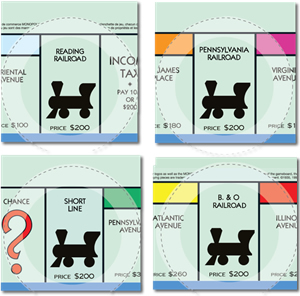
These babies are copyrighted.  That train design is distinctive.  It might also be trademarked, but it's definitely subject to copyright as a part of the Monopoly game board, which is technically a piece of art.


Video games go a long way to illustrate this point.  Because video games comprise a whole lot of art.  And that art is all subject to copyright.  The sound is also subject to copyright.  Even their code is an arrangement that's covered.  Video games sound pretty damn subject to copyright, huh?  Nope.  Underneath all those graphics, sound, and code, there's an underlying system of game mechanics.  Covered by copyright?  I don't think so.

Where does that leave tabletop RPGs?  Well, I won't have a definitive answer to that question for awhile.  We are going to do a lot of investigating.  But, I have a theory about where I'm going to end up.  Right now, at the very outset, I predict that the rules elements of a tabletop RPG aren't subject to copyright.  But, most of the expression elements within an RPG ARE subject to copyright.  This raises all sorts of fun and interesting questions about things like the Open Game License and the Pathfinder license and we are going to look into them!  But, at the end of the day, I'm betting that if you were to print your own book with your own art that covered the rules to ANY tabletop RPG that you'd be able to get off scott free (provided you could pay the court costs Wizards of the Coast, Paizo, or any other game publisher threw at you).
Paizo makes any third-party publisher using their rules system follow rules and stick this little number on their product.  That may be as much boon (it's compatible!) as bane (we have to follow a stinking license!).  But, is it required?
The license that started a new roleplaying game...


Why do we have Copyright?

A lot of people mistakenly believe that the purpose of copyright law is to allow people to control access to their own creations.  This is halfway correct.  But, remember that a copyright exists for a limited time only (though we will explore a dissent by Justice Stevens that questions whether today's copyrights are functionally unlimited).  Here's a dirty little secret: the real purpose for copyright law is to get these ideas into the public domain.  The U.S. Constitution grants the Congress the power, "To promote the progress of science and useful arts, by securing for limited times to authors and inventors the exclusive right to their respective writings and discoveries." (U.S. Constitution, Art. I, § 8).  Public domain works are those whose copyright has expired.  Guess who owns them?  No one does.

Find a work with an expired copyright and you can print and sell all the copies you want for whatever the market will bear.  Of course, so can anyone else, so there's not a huge value in doing so.  That's the whole point.  We want these ideas to get out into general, unprotected circulation.  But, if we don't give authors some control and protection over their creations, they wouldn't make much art for us, would they?  If anyone could take the idea as soon as it was committed to paper, we wouldn't have many people putting ideas to paper.

In economics, this is called a positive externality, meaning that the practice creates benefits but that the creator is unable to internalize those benefits, a.k.a. make money off of them.  (Since I go to a school steeped in the law and economics movement the way that the British East India Company was steeped in tea, you are going to have to read a bit of that too).  Compare that to a negative externality, which is when an activity creates negative effects that don't rebound wholly on the actor.  Pollution is the classic negative externality.  And externalities are BAD.  We want them to go away.  We want people to produce beautiful and useful things like art, literature, and scientific inventions to advance society.  How do we get them to do so?  We bribe them.  We bribe them with the most destructive economic force of all: a monopoly.  Copyright or patent something and you've got a monopoly off of it for decades.

Copyright as Light

Fun fact: Light is both a particle and a wave.  It's analog and digital.  I find it helpful to view legal concepts this way.  It's easiest to view them in a continuum.  There are some things that we're pretty sure are subject to copyright and nobody is going to mess with them.  There are others that pretty obviously aren't subject to copyright, like the phonebook (though, again, phonebooks have been the subject of copyright cases before--and will be important as we discuss what it means to be able to copyright a tabletop RPG or not).  There's a continuum between these two points of things that are less and less obviously subject to copyright and moving towards things that obviously aren't subject to copyright.  Of course, ultimately a court case can decide whether or not something is subject to copyright protection.  But, ex ante, we want to have a good idea about whether or not we think something is.  (Ex ante is fancy lawyer-speak for "before the fact."  I could have just said "before the fact," but what's the fun in that?)

My goal in this explanation is to create a framework that covers what portions of tabletop RPGs are covered by copyright laws ex ante.  To do so, I'll consider various products marketed by tabletop RPG companies.  First and most obviously, the rules systems that underlie the games themselves will be considered.  I believe these occupy the least protected portion of the continuum and are, arguably, already within the common domain.  There are other products like campaign settings marketed by RPG companies.  These products contain fictional places, events, and storylines.  That's starting to sound a lot closer to the kind of expression we want to protect.  Things like tie-in novels are pretty obviously covered.

Finally, there's the product that I find most interesting.  Paizo is the publisher that markets this product in its purest form: the Player's Companion.  A Player's Companion is essentially a 32-page set of rules options and gaming kit that has been adapted to fit into Paizo's Golarion setting.  This is the sweet spot for this investigation.  And, you know what?  It's also the one type of product I'm considering that I'm least sure about its protected status.  Maybe it is and maybe it isn't.
"Each monthly 32-page Pathfinder Player Companion contains several player-focused articles exploring the volume’s theme as well as short articles with innovative new rules for all types of characters, as well as traits to better anchor the player to the campaign. Pathfinder Player Companions are specifically written for players of the Pathfinder RPG."  What do we think?   Uncopyrightable rules or protected expression?

What's Next?

This segment is going to have to explore a lot of ground.  There's going to be an exploration of intellectual property law.  There's going to be an exploration of the theory behind games (not to be confused with game theory, which is much less fun).  There's going to be an exploration of the federal court system, because today it's entirely possible that whether or not an RPG can be copyrighted depends on where you live in America.  (For those of you that live outside of America, shoot me some comments.  I know just enough copyright law to be dangerous and next to nothing about how it gets applied outside of the States).


My next post on this topic is going to review and provide my thoughts on a law review article called Games and Other Uncopyrightable Systems (I'll bet you can guess where I land on this debate).  I picked this article for several reasons.  The author, Bruce Boyden, did his undergrad at the University of Arkansas, which is the flagship university of my home state's public education system.  He also published his piece in the George Mason University Law Review, which is where I go to school.  GMU has a well-recognized intellectual property law program.  Finally (and most importantly for you, dear reader), the GMU Law Review posts its back issues online for free, so it's publicly accessible.  Boyden's piece is focused more on tabletop games, but not on the RPG genre.  It provides a good jumping off point for us on the basics of copyright law and how games fit into it.

What do you think about Invoking IP?  Interesting topic?  Snoozefest?  Glorious or poverty?  This inquiring mind wants to know, so write a comment below!

Monday, September 8, 2014

GenCon Recap: Saturday, August 16

My GenCon Saturday started with sleeping in!  Unlike the previous two days, I didn't have anywhere to be until 9:00a.m. for Kobold Press' seminar about trying to be a freelancer.  I don't really have any desire time to be a freelancer, but I think these types of panels offer good advice on how to make good adventures.  Also, I wanted to support Kobold Press, because they are one of the few established outfits in the industry that takes submissions from people without any publishing credits to their name.  The session was interesting and I took a few nuggets away with me: you'll probably have to give your first piece away but try and start getting paid for your second, know multiple systems because you never know which systems will be in vogue over time, and whenever you do get rejected always ask for feedback on how you can improve your work for future publication.

I confess: I snuck out of the seminar early.  After meeting the folks running all of Monte Cook's games the night before, I was hoping to catch a Numenera game on a generic ticket.  The Kobold seminar was at the very back of the hotel to the southeast of the convention center.  The Monte Cook Games room was at the very end of the hotel to the northwest of the convention center.  So, I got to walk the entirety of GenCon!  It is a long effing way.  

It was longer when I arrived to find out that had I been one person earlier I could have gotten a seat at the table with my generic ticket.  Poverty.  My friend from the bar the night before did manage to get a generic ticket slot though, so that's good though.  I hadn't been able to sign up for a Numenera event in pre-registration.  I was shocked at how quickly these games filled up.  I think that less well-known games are harder to get tickets to because it's a lot easier to find a game of Pathfinder or D&D when you aren't at a Con.

So, it was time to make the long walk back to the Convention Center proper.  With a hole in my schedule, I decided it was time to do something unplanned.  On a whim, I walked into the Dungeons & Dragons room.  I'm inclined to dislike 5th Edition based on the game's management's history, but I figured I could at least check it out.  All their events are set up in a castle and so I stepped inside.

Much of the castle is dedicated to people actually playing D&D, which is nice to see.  They have a tiny retail section in the castle as well and I'm hoping to browse through the new Player's Handbook and edition launching adventure, Tyranny of Dragons.  It's a two-part adevnture set in the Forgotten Realms, a setting that I really liked back in my 2nd Edition days.  The first one is called Hoard of the Dragon Queen.

I come up to the retail area.  It's basically a check out line without any browsing space.  I ask if I can take a look at the game or if I have to get in line to purchase.  The guy behind the counter tells me I have to get in line.  This sales tactic is probably coercively effective on customers that feel less license to be a dick than I do.  I get in line and start browsing the book.  I'm going to have time for either the Player's Handbook or the adventure--and I go with the adventure.  The artwork is top notch and the plot looks good from my five minute overview.  

Unfortunately, I have to put it back once I'm at the front of the line.  I'm a no go on purchasing--this was pretty much a classic customer service fail.  Don't make me stand in the checkout line to browse your product.  I am considering purchasing a book, which a lot of people put a lot of time into writing.  I am not purchasing this, this, or this.

So, back to the Exhibit Hall.  I finally make it through this time.  I also make my first impulse buy of the Con: a copy of Iron & Ale.  You can read my review of it here.  

After finishing my rounds at the Exhibit Hall, I'm walking past a board game company's booth just as an announcer is calling for a single player to jump into a game being demoed.  It's called Hyperborea. It promises an opportunity to, "Embark on an epic quest to build your mythical nation into the greatest empire known to mankind. Capture land, defeat monsters, and discover new technologies on the rise to greatness."

Everyone plays a different army attempting to be the first to capture the most gems.  There are army movements, special resource cards, and a lot of divisions by three going on.   If 13th Age is like Pathfinder with 1/3 of the rules, then Hyperborea is like Settlers of Catan with 3 times the rules.  Seriously, if you like highly complex board games with tricky rules interactions, Hyperborea is for you.

I didn't mind playing it, but didn't love it either.  The woman who explained the game was top notch and the family that I was playing with were big time board gamers.  Super nice too!  Apparently, he worked at TSR back when it was TSR, because they were talking about meeting up with Margaret Weiss and had the father seen Tracy?  Mom from the family ultimately won the game.  It was competitive too--this is not a family that minds going head to head.  It infected me a little bit too, I had to remind myself that these people were TOTAL strangers.

Finally, it's time to play The Strange!  Unfortunately, the girl from the night before that I thought would be my GM actually had the session starting two hours previous.  Well, maybe not unfortunately because our GM was actually awesome!  We had a great party.  I also got to meet my first Gaymer (and he was hot!) at the session.  I was feeling a little shy though so I didn't ask for a ribbon from him.  Wish I had.

The Strange takes place in modern day Earth, but with so much more going on.  Have you heard of dark energy?  Well, Monte Cook and Bruce Cordell have.  And they've decided that it's actually a connection to something called the Strange, which is essentially this network that connects our universe to all sorts of other alternate realities.  Some of these realities have alternate physics.  For instance, another reality, Aredyn, functions a lot like a traditional fantasy game.  There's another alternate reality, Ruk, that has a strong super-science cyberpunk feel.  Oh, and there's the Strange itself, which is also home to planetovores.  In fact, Ardeyn is actually a creation by the Earthling (Terran?) that first discovered the Strange.  He created it as a sort of decoy to throw any planetovores off the trail of the real Earth.  There are other worlds, or recursions, as well.  All in all, this is a really interesting setting.

The system isn't that different though--the Strange RPG is based on the same cypher system that runs Numenera.  One day I'll write a more in depth post talking about what I find interesting about the system, but here are a few interesting details.  
  1. Players do all the dice rolling - Players have rolls to make for any skill check and have target numbers to hit to either hit an enemy in combat or to dodge an attack from an enemy.  This frees up the GM to focus on the story--and it shows in how much more immersive the story can be when the GM doesn't have to fiddle with rolling her own dice.
  2. XP has value - You can use XP to level up, but I wouldn't recommend it.  XP has so many other uses.  Most importantly, XP is used to reroll whenever you feel like it.  You also don't get XP for defeating monsters.  Rather, you get XP for advancing the story's plot.  When the GM wants to screw with you (known as a GM intrusion), she offers you 2 XP.  You take one and give the other XP to another player at the table.  If you don't want the terrible thing to happen, you can pay one XP to the GM to avoid it, though this is frowned upon.
  3. Your strength is also your hit points - Players have three stats in the cypher system: might, intellect, and reflex.  You do extraordinary things by adding effort to your rolls, but adding effort also takes from your character's might, reflex, or intellect.  So, applying effort on a might-based skill actually means that your character will be giving up hit points to perform an action.  It's an interesting mechanic that really makes a player think about how doing something will affect your character's survival.
Usual rules apply: no details on the adventure.  I will say that I got the chance to be a particle physics grad student by day and a go go boy by night.  I also got an opportunity to pretend to be an interpretive dancer when infiltrating a cult.  I went a little far on this one and ended up being "that guy" at the table.  To my fellow players, I apologize.  To Austin, thank you for cluing me in that I needed to rein it in a little.  I'm glad that you got to be the hero on this one in the end!  (Did I mention that we saved the world?)

Also, did I mention that the cosplay at GenCon is amazing?  I have now decided that it's imperative that I create a cosplay vs. drag queens YouTube! compilation.  I'm only shocked that someone else hasn't beaten me to this particular punch.
Cosplay v. Drag Queens is going to be a thing!

It's also time for dinner.  I wander over to the food trucks and also get an opportunity to see the greatest board game of all time: The Cones of Dunshire.  Yes, that game.  Mayfair Games is holding a charity running of the game.  I wasn't willing to pay the $100/head to get in on the game itself, taking pictures for free (well, and picking up a t-shirt) had to be enough for me.


Then, it was time to check out the Film Festival.  I wanted to catch a couple of films.  First, there was a showing of the entire season of Walking in Circles.  It started late and I got a great chance to talk to a nice girl who was hiding out in the viewing room from a crowd of raving zombies.  Someone had organized a giant zombie tag game.  But, the game doesn't happen inside any of the event spaces or in the Exhibit Hall and she was getting some much needed rest from her undead tormentors.  Walking in Circles was fun, but not particularly memorable.

What I've really come to the film festival to see is Gaming in Color, a documentary about homosexuality in gaming culture.  As a Gaymer, I'm interested in seeing how we get portrayed.  The two guys who made it (and who organized the Gaymer X Con in San Francisco) are also present to talk about it on a panel afterwards.  I'm holding off on my review of it as well, because it will make for an entire post.  For now, I'm going to say two things.  First, I'm very glad that this documentary got made because it raises some questions that we should all be looking at for how homosexuals (and all minorities) fit into the gaming world.  Second, I was shocked at how offended one part of it made me and a little bit angry about it.  But more on that later.

Finally, the documentary and the panel are over.  It's almost midnight and I'm a tired puppy.  I hail a cab back to my apartment and fall asleep reading a 13th Age adventure module I picked up the day before.  My Sunday schedule is light and the PFS games start at 9:00 instead of 8:00.  Maybe I'll pick up one with some generic tickets in the morning?

Sunday, September 7, 2014

Holy Shit! Gaming is NOT a marginal hobby!

So, I was looking around Amazon today, mostly to check out whether they had opened up their page for People of the Stars for reviews.  They haven't, but they had a some other recommended books for me.  Good shopper I am, I checked out one of them (The Bone Clocks, if you are asking.  And I'm likely to get a copy.  An inter-generational story about two warring groups with psychic powers sounds too good to miss, even if I did find Cloud Atlas a difficult, if rewarding, read).  It was #31 in books which made me wonder...what were the top books right now.  That's when I saw this little gem:

The new Dungeons & Dragons Player's Handbook is the #7 bestselling book on Amazon right now.

#7 and rising!
Also #1 in it's own category, which is not quite as exciting.  For example, this blog is also #1 in blogs called A Gaymer's Quest!


 Gaymers rejoice!  We are not alone!


Saturday, September 6, 2014

Content Constitution: World kernels

World building is a tricky art and one that I'm working to get better at as time goes on.  In this first installment of Content Constitution, I'll be laying out the basics of the three campaign worlds I in which I reside when I'm in my own headspace.  Future Content Constitution entries will talk about where I get world building ideas from and how I incorporate them into my campaign world.

Before I start talking about my own content, I'd like to plug the World Building Academy, which publishes regular content about how to create a world from scratch.  There's a mailing list that gives you regular updates about things you ought to think about (but probably haven't) like transportation limitations.

For those of you interested in getting in greater depth, consider checking out Deborah Teramis Christian's (she of World Building Academy fame) book World Building Tips.  I'll also plug Kobold Press' Kobold Guide to Worldbuilding.  I haven't read Deborah Christian's book (aside from the emails to her list that made it into her book), but her email updates always bring a lot to think about.  The Kobold Guide is fantastic though.  It's a quick read with multiple essays.  If you are really serious about working on your own campaign world for a roleplaying game or for a novel, I suggest reading each essay in turn and then using its tips and tricks to better flesh out your world.

And now, without further ado, here are my three worlds, from oldest to newest:

Aeyn

Aeyn was inspired during my high school days when I had a habit of laying on my bedroom floor between the two speakers hooked up to my stereo and listening to my music.  It was a great way to tune out everything that wasn't whatever I happened to be listening to.  As a rather misanthropic kid, I did this a lot.  One day, I was listening to Brandy by Looking Glass.  You can listen to it here or read the lyrics here.  I've always liked how a song that's mostly about two people (three, if you count his life, his lover, his lady: the sea) manages to create an entire city with a bustling harbor.  And thus the city of Aeyn was born.  Aeyn is a free city state centered around a massive castle.  It's also the last of the human-dominated realms to have significant dealings with the Elven Queendom of Moonshadow to its northeast.  Moonshadow has cut off contact with humans ever since the night that the Empress was assassinated and the infant heir to the throne went missing thirty-five years ago and a regent began ruling in her place.


Here's the regional map.  I did a surprisingly large amount of design work on Aeyn in high school, and I'll add some to this blog from time to time.


To the northwest stands Waxholm, a thaumarchy ruled by a council of archmages.  To the east are Cabral and Balawa.  Balawa shares a southern border with Moonshadow, but the elves let few cross the border into their lands.  It's recently militarized and people expect an invasion of Cabral any day now.  Aeyn, Cabral, and Balawa are bordered to the south by a mountain range, with a single large pass in Cabral that leads to the Caliphate of Sahara in the south.

Within the city of Aeyn, Castle Aeyn stands as a reminder of a massive battle fought by humans and elves together against an ancient enemy, the Phyrrans.  Milennia have passed since this battle.  During that time the city grew up around Castle Aeyn.  Castle Aeyn itself exists out of phase with the rest of the universe.  Most cannot even enter the castle's confines.  Of those who do, none has ever returned.

The Vishkanariad

The Vishkanariad came into being more slowly than Aeyn.  Rather than springing fully formed from my head its underlying concepts accreted slowly over time.  Of the three worlds it remains the least formed.  I had been re-reading The Wheel of Time series in preparation for the final book and my flight was delayed at Dulles airport (alas, not an uncommon occurrence).  I started musing on fate and luck and how my life (and other's lives) might have been different if my flight had left on time or if I hadn't gone to the airport at all.  Was it luck that caused me to miss my flight or was it foreordained?

Suddenly, I thought of the Land of the Foxes and the Snakes from The Wheel of Time.  What was their world like?  We see so little of it in The Wheel of Time and I was curious about how it could be further fleshed out.  At the time I was just getting back into RPGs and to Pathfinder specifically.  The snake people seemed like an analog to the vishkanya.  The foxes were clearly kitsune.

Suddenly I had an idea of how they were different.  The vishkanya are a highly urbanized people and also highly stratified by class due to a complex racial caste system.  The castes consist of commoners, an artisan class, a warrior class, a priestly class (born of the warrior class but marked with distinctive ridges on their heads at birth).  Each has different colored scales.  They are ruled over by an Imperial caste with coloring identical to that of the commoner class.  They worship Lady Fate and their her priest astrologers divine all things future in the stars.

The nomadic kitsune also live within the Empire.  The two groups live in peace, but associate little with each other.  The kitsune worship Lady Luck and she guides their movements across the forests and plains of the Vishkanyan Empire.  The Vishkanyan Empire is bordered on the west by a massive desert and to the north by tall mountains that are believed to stretch all the way to the world's northernmost point.  The legendary fortress Agharti, where both the vishkanya and the kitsune were created, lies within these mountains.

There are no humans on this world.  They were exterminated eons ago by elemental forces that rose up against them when they first appeared on this world.  They took sides in a greater elemental conflict and lost.  Their alliance with the forces of earth was short-sighted and the combined forces of fire, water, and air wiped them from the planet.  Some few human-like creatures remain, the elementally descended and the kitsune are said to take a second form reminiscent of their human friends upon occasion.


The Kyrine

The Kyrine was born out of an NPR article about life in war-torn Southern Sudan.  Refugees were living in an island in a river there.  I'm not going to say a lot about the Kyrine Valley and the Kyr people livnig there in this post.  That's because the Kyrine is my current project and most of the design I do on this blog will expand upon it.

The Kyr River flows north from the chill peaks of the Taubourin Mountains in the south.  As it approaches the cliffwall that separates the Kyrine Valley from the Castlecoast far below, it breaks up into a wide alluvial delta.  The Kyr have lived in the valley as long as anyone remembers and are divided into three major ethnic sub-groups: settled farmers in the northwestern part of the river valley, nomadic hunters and gatherers in the northeastern and southwestern parts of the valley, and a boreal tribe that lives within the fey-touched woods in the valley's southeastern quadrant.

The Kyr River Valley.  As you can see, I'm not great artist by hand.


There have been three major population movements into the valley in the last century.  First, the dwarves broke through to the surface of the Taubourin Mountains in the south.  Like the Kyr people, the dwarven pantheon is headed by the great god Venturi, whose form both races believe they were created in image of.  Many of the Kyr consider the dwarves as the lost race of the "Fourth Kyr," who vanished beneath the mountains when Venturi's city was attacked by his corrupt brother Nehemeh.  Some dwarves believe this as well, but the belief is not widespread and is considered heretical by those that do not hold to it.

Roughly twenty-five years ago the Abangans invaded the Kyrine Valley.  The Abangans are native to the desert east of the Kyrine Valley.  They attacked the valley en mass, fleeing what they claimed was certain destruction by insect hordes that have arisen in the southern part of the desert.  The insects began their terror after a group of Abangan adventurers broke a seal in a mysterious temple in the southern part of the desert.  Since then, insect life in the desert has multiplied.  Such insects heedlessly attack all Abangans.

Fleeing the insects, the Abangan marched west, conquering the native Kyr people.  At this time, the Kyr live as a servitor people to their Abangan overlords.  Most of the northeastern Kyrine Valley is under Abangan control and the northwestern part of the valley is pacified as well.  Nomadic Kyr have formed a resistance movement in the southwest, sheltered by the giant, mysterious wendigo-worshipping kalooski elephant-people that live in the foothills of the mountains there.

The boreal Kyr in the southeastern woods have successfully repelled the Abangan invaders, but have been essentially cut off from contact with the rest of the Kyrine Valley.  At first this isolation stemmed from an attempted Abangan siege of their forest.  But, Abangan siege forces were lifted almost a decade ago and few have emerged from the forest.  Of those that have ventured in, almost none have returned and those who do are made speak of impossibilities occurring in the forest as if they were common.  They tell tales of mountains made of butterflies, talking animals, trees or whole forests that are there one moment and gone upon second look.  They also tell tales of a golden skinned people claiming their ancient rights to the woods.

Finally, in the last three months halfling refugees from the Castlecoast have flooded north up the Great Climb, which connects the northwestern quadrant of the Kyrine Valley with the lands of the smallfolk below.  These refugees claim monstrous sea creatures have besieged their cities.  Entire settlements have been covered with tidal waves and children vanish in the night.  The Castlecoast was always a dangerous place, but never had it seemed under active attack from the ocean before.  The cause for this attack is unknown.

So, those are my three big campaign worlds right now.  I am not actively GMing any parties in any of them right now (and, truthfully, Aeyn and the Vishkanariad might make for better novels than campaign settings).  That said, I continue to work on expanding them and will do so on this blog.  Feel free to adopt the materials you see here to your own home campaign.

What do you think of my three little worlds?  Leave your thoughts in the comments section below.

Friday, September 5, 2014

GenCon Recap: Friday, August 15

Finally!  I am awake at a decent hour!  I make it from my apartment down to the convention center with time to spare.  I quickly find a group and we sit down for our morning session.  Although I had fun playing Kygar yesterday, today I'm playing my new Taldan rogue, Averitt.  Named after a band I particularly like, Averitt is a hard core Taldan nationalist.  He believes that the empire is destined to rise again.  Unsurprisingly, he's joined the Taldor faction of the society.  After last night, as a player I'm curious to see how the faction Taldor's being moved into, the Sovereign Court, will play out.

This morning's session is PFS Scenario 6-01: Trial by Machine.  They've said that the new season of PFS won't be over the top on technology.  But I'm excited to see how things play out with integrating Numerian superscience into the metaplot for the season.  The scenario takes place on Absalom, but involves exploring a ruin that's been "redecorated" by a Pathfinder with ties to the Technic League.  We're basically right at the line between upper tier and lower tier, so we decide to play up.  Averitt's only played one scenario before, the opening scenario from Reign of Winter.  Playing up was a great challenge but one piece of advice--THIS SCENARIO IS A KILLER, DON'T DO IT!

No spoilers on the scenario for you!  But, I'd like to tell you how excited I am about the chronicle sheet I got.  Averitt's got an e-pick now!  Numerian ruins, beware!  There's a thief that's going to open you up like an oyster!

Next, it's off to a one-shot session playing 13th Age.  This is my first foray over to play in an independent session.  Those are all over at the J.W. Marriott, which is actually blocks away.  It took me past both the anime and collectable card games portions of the Con.  This really marks how big the Con actually is.  Although I was at a session at the Westin the day before, it's directly across the street from the Sagamore Ballroom, where the Pathfinder Society scenarios are played.  The trip to the Marriott takes about fifteen minutes.  This walk really makes something hit home.  There is so much going on at GenCon that it would be completely impossible to experience all of it.  (I did mean to make it into the card game rooms to check out some games, especially A Terrible Time, which I Kickstarted, but it just didn't happen).

I'm a big fan of 13th Age.  Although also a fantasy-derived system, it has about 1/3 of the math that Pathfinder does.  I played a dark elven sorcerer with connections to the city's underworld.  The session took place in a city dominated by trade and that is therefore hospitable to monsters.  We were employed by a lamia in love with a dwarf.  Her medusa friend turned the lamia's fiance into stone.  She wants him changed back, but on the sly.  We have to procure some ingredients to fix his petrification.

Our GM was a guy named Graham Wills.  I'm unsure if he was British or Australian but can 100% verify that he was awesome!  He really set things up to make playing the game easy on us.  He'd designed character sheets that had all the necessary background info and mechanics so that we needed very little explanation.  That really freed us to focus our time on roleplaying.  Graham was great about creating a story-driven game and he was the perfect type of GM--good at setting the scene and good about creating intrigue but also fantastic at saying, "Yes!"

Without going into details, we got to have an opportunity to put on a play!  The scenario ended well and, honestly, I enjoyed it so much that I'm thinking about GMing a session for DC Game Day next month.  After the session was over, two of the other players accosted me about my Arkansas hat--Pierce and Alyssa are from my home state!  Pierce had come to GenCon solo on a lark the year before, which really helped validate my decision to do so this year.

After 13th Age, I decided it was time to brave the Exhibit Hall.  The Paizo line was long, but I braved it!  I picked up all the stuff.  I had a great time talking with a lot of the Paizo staff.  I also talked to the publisher of 13th Age, Pelgrane Press and picked up a few other things along the way.  I've got a little bit of time, so I hail a cab back to my apartment and drop off my loot.  He agrees to wait and bring me back to the Con.  I have bought too much--this is going to be hell on my bag & on my checking fee!

And now it's time for the end of season scenario for Pathfinder Society.  Khygar's back for this one.  "Spoiler" alert!  The Pathfinder Society has finally found the lost Sky Citadel, Jormundun and it's time to explore it before the demons of the Worldwound have a shot to overrun it.

This was hands down the best group I played with all weekend!  Things were looking rough on finding a group, but slowly but surely things worked out.  First, I met a great couple from Seattle, who were actually using GenCon as their honeymoon.  We had another sweet couple, and another single.  I made number 6.

Our GM was the Venture Captain of Chattanooga, Justin Peters.  He hasn't gotten his official shirt yet.  Note: He deserves it and more!  I got in trouble early on for meta-gaming.  Justin totally kept us on task.  Never before had I noticed how much faster things go if you roll attacks and damage at the same time.  Justin kept us on track and really helped us move through the Sky Citadel at a brisk pace.  And, boy, was it necessary!

Things are going along and we are part of a major work.  All the tables' results are tabulated together and individual sessions get interrupted from time to time to let us know how the overall session is going.  Part-way through the session, we get stopped for an unrelated reason: Paizo has won all the Ennies!  As a celebration, everyone gets a special mini--the Slaver Demon.  James Jacobs himself delivered them to our table.

There's a twist in the scenario, but I'm not telling.  But, our party finishes and nobody dies, which is a relief.  Investigating ancient dwarven ruins is thirsty work, so I decide to head over to Scotty's Brewhouse again.

Yet again I'm drinking alone.  But, then this hot guy sits down next to me.  For the life of me, I have no idea if he's gay or straight or whether he's even hitting on me.  But we chat a bit.  He's from Chicago and he's her Numenera game the following day.  I also meet another GM running a table (either Numenera or the Strange).  His name is Brandon and he runs podcasts related to Numenera and the Strange.  You should check out Transmissions from the Ninth World and Translating the Strange.  Everybody finishes up their drinks and it's back to the apartment for the night!


e visiting from Chicago and he has a huge group.  I met some nice people, including the girl who's supposed to GM my

Enjoy the tale?  Hate it?  Leave comments below!

Wednesday, September 3, 2014

A New Campaign!

I’m playing in a new campaign and I’m pretty excited about it.  My college roommate (who is a player in the game I run) has started up a new campaign.  He’s done some amazing world design.  The campaign is very gritty and incredibly low-magic.  Our party (best as I can figure out thus far) consists of a barbarian, a fighter, a rogue and my bard, Rhyss Ravenwind.  We’re in a city in the middle of the continent. 

The main meta-plot element is that magic doesn’t work very well.  It just kind of stopped about a hundred years ago.  This was bad news for the races that relied heavily on magic, especially elves and gnomes.  The dwarves and the humans allied and basically hemmed all the magical creatures into a ghetto country on the southwestern portion of the continent.  The dwarves really run the show, as they essentially control the economy.  Even in the human lands, they are pretty clear powers behind the throne.  Halflings, no surprise, have ended up as slaves.

Recap:

Last night was our first session.  I’m playing a bard, so I’m relatively well-known around town.  (I’ll post Rhyss’ stats at another time).  I’d ended up tied up with an elf who was looking to bring his wayward daughter home.  She’d gotten tied up in a commune or cult or some such, all of whom have been tattooed with the “TREK” symbol.  (I have taken to calling these partisans the ‘Trekkies,’ much to my GMs annoyance I fear).  I really am trying to give the symbol, which is a stylized form of ancient words (in Elvish or perhaps a language pre-dating it) for ‘tryanny’ and ‘infinity.’ 

None of our characters had met at the opening of the show.  Rhyss’ mysterious elven companion got taken away by the town guards after they’d tried to convince her to quit the Trekkies (I’ve done it again).  He had apparently been involved in a bit of a murder shortly after he got to town.  (It’s okay though—the government’s totally corrupt and being an elf is liable to just get you made a slave, so forcefully resisting arrest just for being alive is rational).  But, the elven companion had another friend who’d been laid up at the inn.  Her name was Aliana.  Things got excited when Rhyss was headed to the public square for the public execution of the elf and his companion, named Aliana.  Given that Rhyss was with the REAL Aliana, things very a little bit confusing.

We arrived and they put on a brutal show.  The fake Aliana (alas, Rhyss’ friend the elf’s daughter, who apparently should have known to come home when her father tried to be a good dad) was drawn and quartered.  Then, all hell broke loose.  Rebels?  Rioters?  We don’t know except that a bunch of incendiaries were thrown onto the dais.  The guy running the show’s bodyguards hustled him off while the town guards came out in force.  We hightailed it back to the Inn Aliana and Rhyss were staying at, with some other randos (including, it seemed, our other two PCs) in tow. 

Back at the inn, we learned that the authorities in this town really don’t do well with defiance.  We barricaded ourselves in the inn.  Rhyss got some time to meet his new companions.  He and Aliana were already getting along famously, less so Joramon.  Joramon’s a dwarf, but has been kicked out of his clan (Rhyss thinks there’s a story there).  He decided to pick a fight with the proprietor of the inn over free booze.  Unfortunately, said proprietor puts a roof over Rhyss’ head and Rhyss was already having to calm things down.  Fortunately, the complete chaos outside helped with that.  We tried to help some ladies get in to the inn from the danger through a window upstairs, but one of them was shot down (literally!) while trying to climb up.  The other ran off in the scuffle, but we ended up killing some guards.  This was very cathartic, but in retrospect, probably not a very good idea for remaining non-slave members of society.

Then a building near Joramon’s home caught fire.  In a fit of over-niceness (the guy had tried to kill Rhyss’ boss), everyone agreed to accompany this dude to his home.  So, we start hauling ass through the streets.  In a riot.  (But not a zoot suit riot).  The journey through the streets was brief, but harrowing.  Every building was boarded up from the inside and dead bodies were everywhere.  The only folks about and about were guards, looters, victims, and—of course—us.  We saw soldiers trying to force their way on a young lady.  Well, actually doing so.  We took out those guys.  With extreme prejudice.  Aliana and Rhyss learned that they work pretty well in combat together, which was a nice thing to learn.  One rapist got away, and called for reinforcements—we were wanted fugitives!

The group finally made it to Joramon’s home.  On the bright side, it hadn’t burnt down yet.  One the less bright side, all of Joramon’s stuff in the house had been looted.  So, kind of a waste going there.  About that time, the inn at which Rhyss had been working collapsed in a burning heap.  It was only a few blocks away from the tenement in which Joramon’s small dwelling was, so we had a nice view of our last connections to civilization go up in flames.

Aliana made it to the roof of the building next door while Joramon was checking out his house, so she noticed the folks in the street first, three more guards upset about the morning’s execution gone wrong.  They seemed to be coming our way.

We made our way out to meet them, but suddenly two guys dressed like the bomb throwers from the execution intervened.  They too had the mysterious TREK symbol.  We made quick work of the guards (including a brief reappearance of our sexually demanding friend from earlier in the scenario) with their help.  That’s when we noticed that one of the buildings had been unboarded.  People were gesturing that we go inside.  The TREKies seemed okay with it, and we were apparently all on the same team, so in we went.  That’s where our session ended.

End scene.

Thoughts:

Our GM did an amazing job.  First of all, the map was gigantic.  He’d clearly made plans for any number of things that we might say or do.  Also, this was my first time on the player side of fog of war in Roll20.  Damn, that feature can get annoying.  What seems like just a minor shading on the GM’s screen is completely opaque to the players!!!  I am going to try and balance between ‘the map shows only what you can see’ and ‘here’s enough information to orient yourself.’  Honestly, I had enough information to orient myself.  Maybe I will start keeping some maps?

The opening scene was HUGE.  By huge, I mean that I had my screen zoomed to only 40% and I still couldn’t see everything.  The square and the barracks looking over it took up more space than I could really keep track of.  It made it easier to just focus in on what Rhyss could see and focus on.  Well, sort of.  One of our players is also out of DC and he and I share my computer.  Keeping the screen wide enough so that we could both see things was a little disconcerting.  I may ask him to bring his laptop next time.

This is also not a campaign that’s going to concern itself about niceties like CR.  There were several times when it was fairly obvious that if we attacked we would die (having arrows raining out of the barracks and twenty guards headed into the crowd we were a part of come to mind).  As a GM, I struggle to keep encounters challenging but still pretty close within the CR system.  As a player, I like being part of a story and knowing that CR has gone out the window.  There are encounters that we cannot win.  I embrace that.  It will only make things sweeter when we do win everything in the end.

Also, our GM had created several factions and given them motivations.  What didn’t become clear until about halfway through the session was that all of these factions were playing on the full board and he was having to keep track of where they were, what they were doing, and how they might react to us.  It looked like a lot of work, and my sympathies lie with him. 


On balance, I’m interested and intrigued with the new campaign.  It’s unclear whether or not we’ll learn where the magic went.  But, we are definitely going to learn who these TREKkies are and what’s going on with the political situation in the city.  I look forward to recapping our sessions as we go along.

Enjoy hearing about the adventures of Rhyss?  Find them boring as watching paint dry?  Leave a comment below!